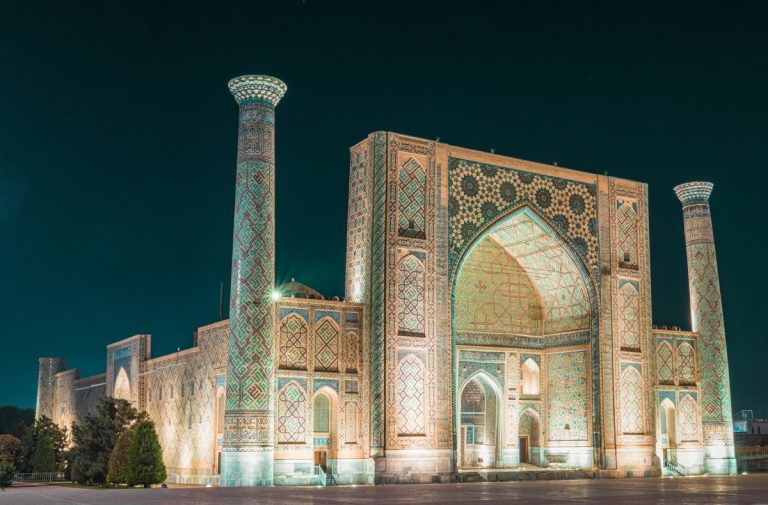
Bukhara Travel Guide: Why I fell in Love with this City
How often do you find yourselves lost in the beauty and awe of a single place? I am talking about the place that you visit without expectations, but end up feeling connected to it, maybe for no apparent reason. For me, that place was Bukhara, Uzbekistan’s third largest city.
In this Bukhara travel guide you’ll find everything you need to know, from history, to practical information and the best things to do in my favourite place in Uzbekistan.
If you are wondering how to plan a trip to Uzbekistan and you’re struggling to find all the information you need, head to my complete guide for the country. In that article, I have also created a few free itinerary ideas that you can be inspired from. Trust me, you won’t regret it!
Just so you know: Some links on this page are affiliate links, which means I might earn a small commission if you book or buy through them, at no extra cost to you. Thank you for your support!
A little bit of History

Bukhara is one of Central Asia’s oldest cities, with a history that stretches back over 2,500 years. Legend has it, that it was founded by Siyavush, a Persian prince who fled his trial, after being accused for seducing his stepmother.
By the early medieval period, Bukhara had become a major city in the Samanid Empire, which helped establish it as a center of Islamic learning, art, and architecture. The city was home to many scholars, poets, and theologians, and its mosques and madrasas were considered models for Islamic architecture in the region.
Bukhara’s role as a religious and intellectual center continued under later empires, including the Karakhanids and Khwarezmshahs (I couldn’t pronounce the names either). In the 14th-16th centuries, it became part of the Timurid and then Shaybanid empires. During that period, the city saw the construction of many of the landmarks that we still admire today, including madrasas, caravanserais, and mosques.
The Emirate of Bukhara became a Russian protectorate in 1868. While the city retained much of its traditional culture and architecture, Russian influence began to reshape administration, trade, and military structures. After the Russian Revolution of 1917, Bukhara became part of the Bukharan People’s Soviet Republic and, later, the Uzbek Soviet Socialist Republic under the USSR.
While the soviet period brought modernization efforts, secular education, and infrastructure projects, it also brought the suppression of religious institutions and destruction of many historic buildings. Despite these changes, much of Bukhara’s historic core survived.
Is Bukhara safe to visit?
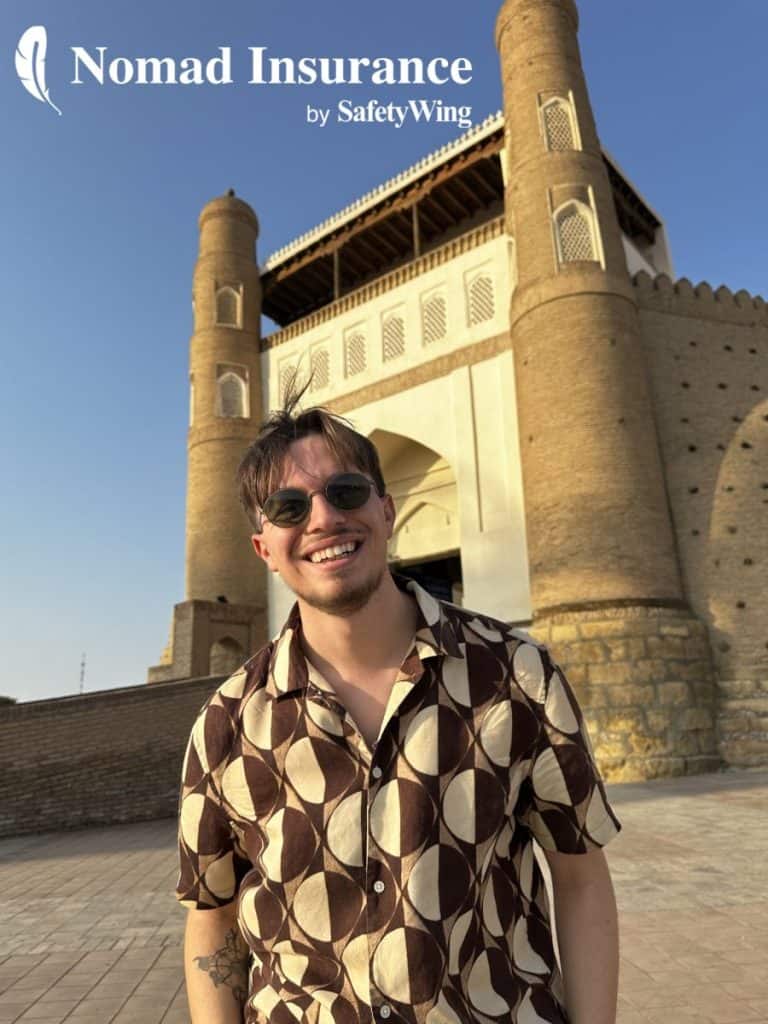
Yes, yes, and yes. What really surprised me during our trip to Uzbekistan was the level of safety. I cannot recall any places where we even felt a tiny bit uncomfortable. The same applies to Bukhara. One of the reasons that I fell in love with this town is that it has a calm, family feel. I could even say that it is one of the safest places I’ve ever visited.
Interestingly enough, there are also tourist police stationed in many places throughout the city, tasked to ensure safety for tourists. Obviously, I highly recommend you exercise normal safety precautions, as anyone would in any other country.
That said, I never travel without travel insurance. I personally trust Nomad Insurance by SafetyWing when I travel. I pick this specific plan because it’s quite affordable, offers very good coverage, and has very short response times for any questions that may arise.
A major advantage is that you can purchase your regular insurance even after your trip has already started – especially convenient if you’re a forgetful person like me. I would definitely recommend visiting their website to learn more.
What is the best season to visit Bukhara?
The best periods to visit Bukhara are spring (March-May) and autumn (September-November), when the weather is mild and pleasant for sightseeing. During these months, daytime temperatures usually range from 20-30°C (68-86°F), making it comfortable to explore the city without the extremes of summer heat or winter cold.
Summer (June-August) can be extremely hot, with temperatures frequently surpassing 35-40°C (95-104°F), which can make walking through the old city and the open-air monuments it has to offer exhausting. Early mornings and late afternoons are more manageable, but midday sightseeing is, indeed, uncomfortable.
We traveled during August and it was hot. However, due to being a desert country, Uzbekistan has very low humidity. This means that it can be very hot, but you will not suffer in the same way you would in another country since sweat will be minimal. Afternoons felt really nice, with a refreshing summer breeze compensating the heat. I also believe that the long golden hour during the summer shouldn’t be underestimated.
Lastly, winter (December-February) is cold and dry, with temperatures sometimes dropping below 0°C (32°F), and while it’s much quieter and less crowded, the outdoor sites may be less pleasant to visit. But again, like summer, it depends if you value budget more than a slight discomfort due to the weather conditions.
Is Bukhara expensive?
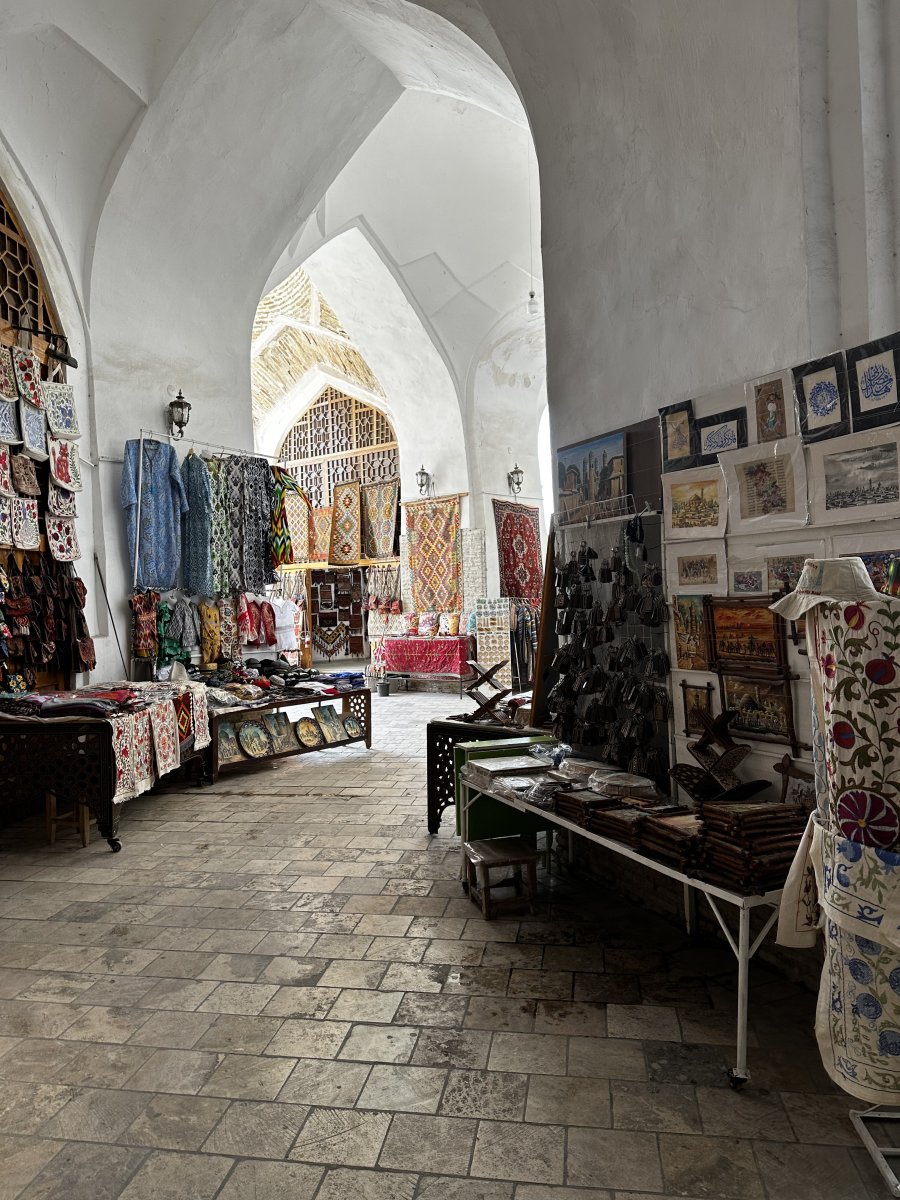
If you have any worries before traveling to Bukhara (or Uzbekistan in general), finances would not be one of them. Uzbekistan is considered to be one of the cheapest countries in the world. For example, a bottle of water would cost around 0.25$, a plate of local plov would cost as low as 3$, a mojito around 2$. So, you’ll probably not miss anything, even if you have a tight budget.
Specifically about Bukhara, my experience showed that it actually might be the cheapest city in Uzbekistan. That’s why I’d suggest you buy your souvenirs there. I could only compare the prices to my beloved Syria.
When it comes to souvenirs, however, the situation gets a little bit more complicated, as sellers tend to inflate the prices a little bit when they are approached by a tourist. Therefore, you should do some strong bargaining, aiming at never paying more than 75% of the original asking price.
Do I need VPN for Uzbekistan?
Using a VPN in Uzbekistan is a smart move for both privacy and access while traveling. Internet infrastructure is improving, but public Wi-Fi in hotels, cafés, and airports is often unsecured. A VPN encrypts your connection, protecting sensitive data like passwords, emails, online banking details, and booking confirmations from potential interception.
I personally use and trust NordVPN. At the moment, it offers thousands of servers across 165 locations throughout the world, meaning that there are always fast servers to choose from, no matter the location. It is also is a five-times audited service to ensure that your online activities remain confidential, your activities will be private and your devices risk-free.
Lastly, there’s a 24/7 chat, which is very helpful if you need assistance. Visit their website to learn more.

How can I get to Bukhara?
1. Train


The most popular and comfortable option to travel to Bukhara is the high-speed train. From Tashkent, the Afrosiyob fast train takes about 3.5-4 hours, while from Samarkand it’s only about 1.5-2 hours. This particular train is modern, air-conditioned, and reliable, making it one of the best ways to move between major cities in Uzbekistan.
However, let’s not underestimate the slower, cheaper trains. Those date back to the soviet times and offer a less comfortable, but different travel experience. We traveled from Samarkand to Bukhara on the traditional night train.
How it works: You can book three classes of tickets. In the third class, the classic seats become beds, while in the second you will stay in a room with two bunks, that is, four beds. There is also the first class, in which you will stay in a more “private” cabin with two beds. The linens are provided by the company and are quite clean.
Be careful, though. If you are traveling in the summer months, I would recommend staying in the first class, as it is the only one with air conditioning. Even there, however, air conditioning only works when the train is moving, which is especially noticeable at the stops.
I would urge you to try the traditional, soviet train experience at least once. While not as comfortable as the Afrosiyob, it is a way to experience the local culture.
2. Plane
Bukhara is also served by Bukhara International Airport (BHK), located about 10-15 minutes from the city center. There are flights from Tashkent and occasionally from destinations like Istanbul, or other regional cities, depending on the season and airline schedules.
Flights are quick, around 1 hour from Tashkent, but trains for me are a simpler and more convenient option.
3. Car
If you prefer flexibility, you can travel to Bukhara by car or shared taxi. The drive from Samarkand takes about 3-4 hours, while from Tashkent roughly 6-7 hours.
Private transfers can be arranged through hotels or local agencies, offering convenience and the opportunity to make stops along the way. Shared taxis are the budget option, though they can be less comfortable.
Where should I stay in Bukhara?
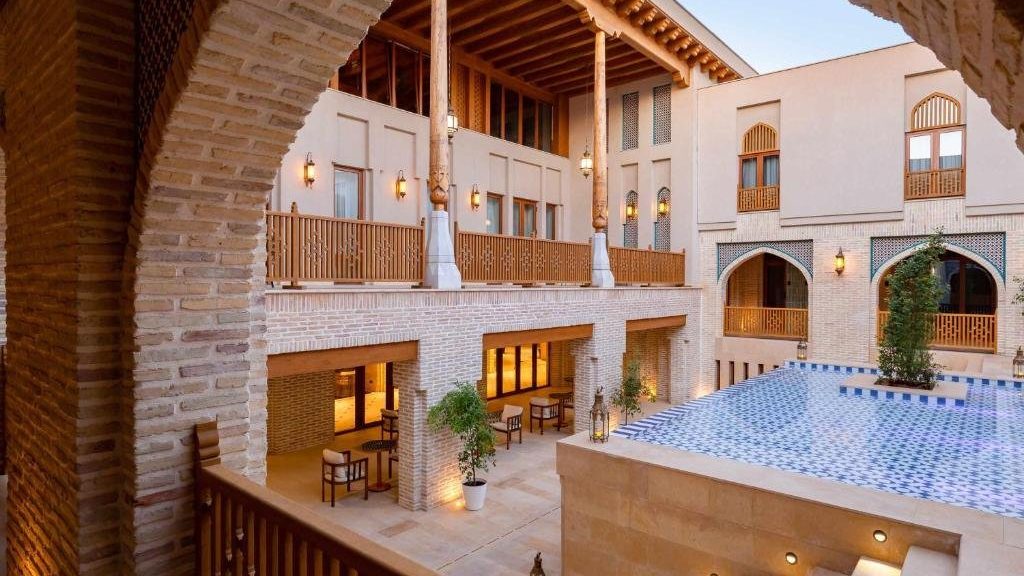
Since it is one of the most loved places in the country by visitors, there are plenty of accommodation options available in Bukhara, from budget-friendly guesthouses to luxurious modern hotels. You can find more on Booking.com. However, I do have a suggestion for you.
We stayed at Bobosh Boutique, a small and budget-friendly hotel in Bukhara’s old town. It is located in a cute and quiet neighborhood, which I found excellent. The rooms were clean, comfortable, and decorated with touches of traditional Uzbek style, while the breakfast was very tasty and the staff friendly and helpful.
They also have a small terrace, where you can enjoy a cold bear in the quiet summer nights, while enjoying the views of the lighted old town.
How long should I stay in Bukhara?
I think it is finally time for an unpopular opinion in this Bukhara travel guide.
Most travelers and bloggers say that 2-3 days in Bukhara is the ideal amount of time to explore the city comfortably. Indeed, in that period you can cover the main highlights of the historic center pretty comfortably. However, I don’t completely agree with this as the ideal stay duration.
If it hasn’t been clear yet, I fell in love with Bukhara. I don’t know if it was the sights, the aura, the people – maybe it was all of them. I could literally spend days walking around the old city, people watching or finding a new little cafe or teahouse in the most random corner. Or should I talk about those summer nights playing UNO with my brother while enjoying a cold beer and the views of the old town from the hotel’s entrance? Those little things will stay with me.
My personal recommendation would be this: When planning your Uzbekistan itinerary, leave 1 or 2 extra days aside, in case you want to take it slower and spend more time in Bukhara. That was in fact my case, ending up staying 2 extra days.
How can I move around in Bukhara?
Getting around Bukhara is generally easy and comfortable, because most of the city’s major attractions are concentrated within the historic center. The old town is highly walkable, with most monuments only a few minutes apart. For me, walking is the best way to experience Bukhara.
When you need to travel farther – such as to the train station, airport, or sites outside the center – you can rely on taxis, which are plentiful and inexpensive. We used Yandex, which made everything more convenient. No bargaining was needed, prices were great. Let’s not forget that Uzbekistan is one of the cheapest countries in the world.
For example, a 10-minute ride will cost around 1 dollar. However, I would not choose a regular taxi (meaning not being booked through an app), unless absolutely necessary, since they tend to inflate the prices a lot, and our experience with them was not nice.
Another great option is renting a bicycle, which some guesthouses and hotels offer. They can also be found and booked in the old town. Bukhara’s flat terrain makes cycling easy, and it can be a nice, alternative way to explore the city’s neighborhoods.
Lastly, if you prefer a guided experience, many tour companies also offer walking tours, car tours, or even evening city tours to help you navigate the main sights without a hassle.
The Best things to do in Bukhara
1. The Ark


- Address: QCH5+6W6, Afrosiab St, Bukhara
- Opening times: 9:00-22:00
- Tickets: 40,000 UZS (Approx. $3.5)
Before I start, I would like to say that this one, alongside the next, are two of my favorite spots in the entire world.
The Ark of Bukhara is a massive fortress that has served as the city’s political and military center for over a thousand years. Its construction dates back to the 5th century, and it was continuously expanded by successive rulers.
One of the reasons that it is so famous are its weirdly-shaped walls. They are made out of thick clay and mud-brick. Their iconic shape made it much harder for intruders to climb and gave a strategic advantage. I don’t believe that I have seen anything like that ever again. I could literally spend hours admiring them. I don’t know why, but I was really astonished by their sheer beauty.
The fortress was the residence of the emirs of Bukhara and a few thousand people. Inside the Ark, there were palaces, administrative buildings, barracks, stables, and a mosque. It mainly functioned as the center of government, decision-making, and royal ceremonies.
However, most of it was destroyed in the 20th century, but it is not known if it was done by the Soviets, or as an act of desperation by the ousted Emir.
The complex now operates as a museum, the entry of which is the imposing western gate, the only one still surviving. When you go inside you can still see the remains of grand halls, royal apartments, and the views of the defensive walls.
Some interior spaces like the throne room have already been renovated and give a good idea of how everything was like. Some buildings, however, were damaged beyond repair and can only be seen through pictures and descriptions. The museum also houses exhibitions of artifacts found in the area.

The square around the Ark, called the Registan (does it ring a bell?), was historically a central place for public life in Bukhara. From here, people gathered for markets, celebrations, and public announcements. It also served as a slave market, one of the biggest in the region, and a space for executions. Someone could as well argue that it can be classified as a dark tourism spot.
The square was once home of many historic buildings, but it was all flattened by the Soviets. It now serves as a gathering space, so you will see a lot of local families and kids playing around. There are also bikes for rent, in case you would like to continue your exploration this way.
Be careful: When you visit the square you’ll see a few chained camels that you can ride or take photos with. DO NOT DO THAT. They are known to have been abused and chained for many hours a day.
2. Poi Kaylon Square

Address: Strada, Khodja Nurobobod St, Bukhara
The Poi Kalyon Square is the historic (and quite literal) center of Bukhara. The square is dominated by three structures: the Kalyon Minaret, the Kalyon Mosque, and the Mir-i-Arab Madrasa.
The Kalyon Minaret, built in the 12th century, is definitely the most iconic structure of the square. Standing over 45 meters tall, it was originally used to call to prayer and also served as a watchtower. It is so big, that the foundations had to be dug more than 10 meters in depth for it to be able to stand. I cannot put in words the beauty of this architectural marvel.
But it is not only me who was awed by it. Legend has it, that when Genghis Khan reached the city, he was so impressed that he ordered that it would be the only thing left standing. It had also earned the nickname “Tower of Death” in local legend because criminals were once executed by being thrown from its top.


Right next to the minaret, the Kalyon Mosque is one of the largest mosques in Central Asia. It has a huge courtyard that can host thousands of worshippers. You can really feel the serenity and spirituality of the place once there. The mosque is decorated with beautiful tilework, carvings, and Arabic calligraphy.
Lastly, the Mir-i-Arab Madrasa, located opposite the mosque, was built in the 16th century as well and continues to serve as a place for Islamic learning.
Around the square you’ll find a lot of stands that open in the evening and sell souvenirs, snacks and toys for children. Don’t forget to try, and why not buy, a traditional Uzbek hat, so that you fit more into the local culture. There are also a few luxury shops that sell jewellery, ceramics, and more expensive, but better quality souvenirs.
Lastly, you will see a few terrace cafes that offer some really nice views of the square, but are rather touristy and I am not so sure that they are worth the cost.
3. Lyabi Hauz
- Address: QCFC+686, Divan-Beghi, Bukhara, Uzbekistan
- Opening times: 8:00-24:00
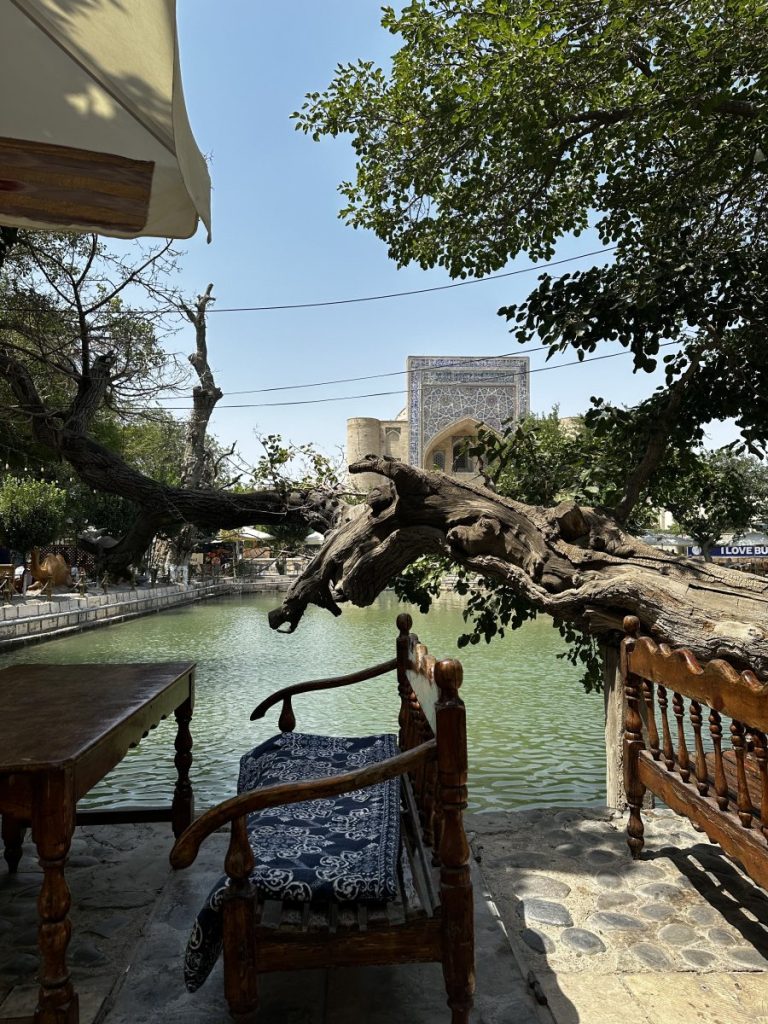
Lyabi Hauz is one of the most famous (maybe a little too famous) and atmospheric spots in Bukhara. Built between the 16th and 17th centuries, it is one of the few surviving hauz (water reservoirs) in the city, which once relied on such pools as a main source of water.
Fun fact: The water there was once stale, creating the perfect environment for algae, bacteria, and therefore, waterborne diseases. Luckily, the soviets drained and replaced the water system.
The area is covered with ancient mulberry trees, which outlive it by more than a hundred years. It is a popular gathering place, featuring many cafés and restaurants. There are many benches to sit, enjoy an ice cream and a coffee, and get lost in the beauty and the serenity of the square. We tried a (possibly Russian) popsicle which was surprisingly tasty.
It is generally a great place to lay back, people-watch and reorganize. I believe that it perfectly encapsulates the summer spirit.
The famous Labi Hovuz restaurant is also located in the square, but more on that later. The area can get overcrowded with tourists, but visiting before or after lunchtime will do the trick.
The complex is surrounded by the Kukeldash Madrasa, the Nadir Divan-Begi Madrasa, and the Nadir Divan-Begi Khanqah.
The Kukeldash Madrasa, built in the 16th century during the Shaybanid period, served as a center for both religious and secular learning, providing lodging for students and space for prayer. Architecturally, it features a large rectangular courtyard surrounded by classrooms, a massive entrance portal, and richly decorated walls with geometric patterns and Quranic inscriptions. The Madrassa now houses the Bukhara literary history museum, though the exhibition is not translated in English.
The Nadir Divan-Begi Madrasa, constructed in the 17th century by the statesman Nadir Divan-Begi, also functioned as a school and student residence. The mosaic of two mythological creatures and a deer, symbols banned in islam, create one pf the best existing examples of Uzbek tile art. Unlike the madrasa, the Nadir Divan-Begi Khanqah focused on meditation, prayer, and communal religious life.
4. The Bukhara central Bazaar


- Address: QCH2+Q9W, Ulitsa Suleymana Muradova, Bukhara
- Opening times: 7:30-18:00
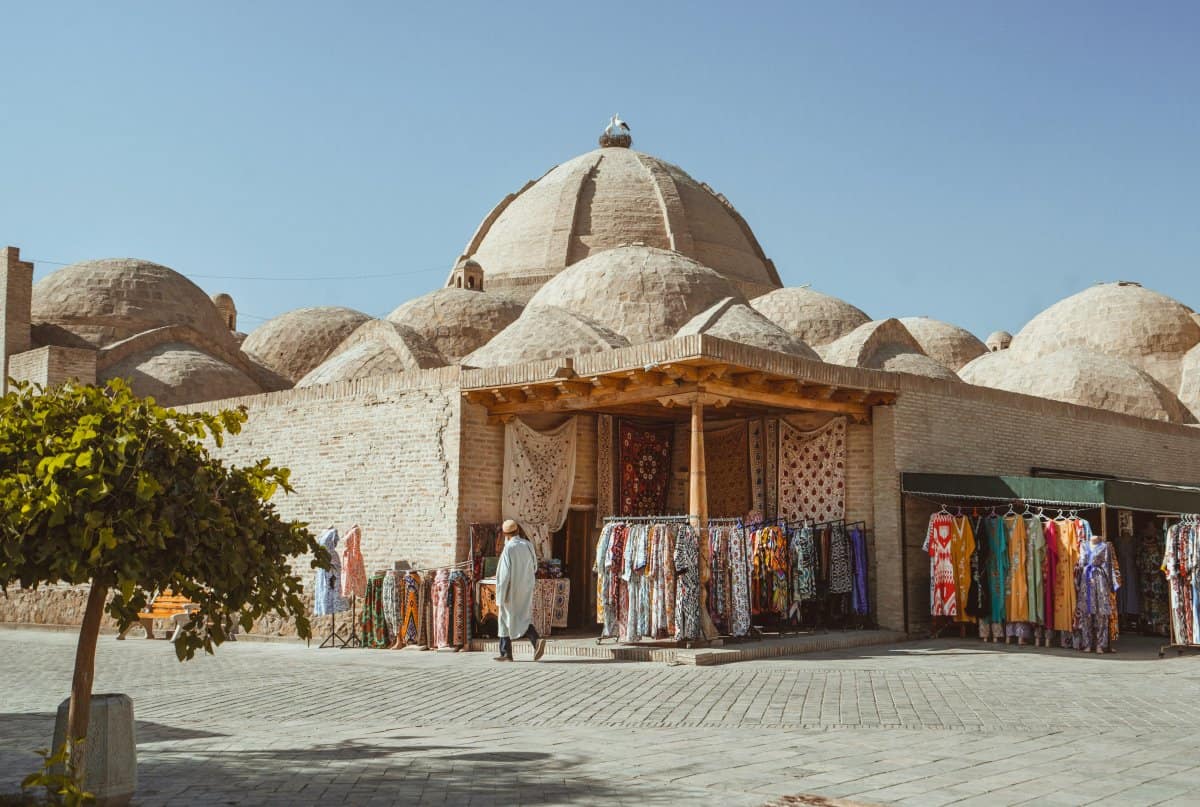
The Bukhara Central Bazaar is one of the liveliest places in the city and an important part of daily life. It has existed in different forms for centuries, something that makes sense considering Bukhara’s long tradition as a trading center on the Silk Road.
The market is filled with stalls selling fresh fruits and vegetables, spices, nuts, bread, and sweets, as well as clothing and household goods. The smells, colors, and sounds of bargaining create a busy and energetic atmosphere, a perfect place to enjoy the daily life of the locals.
When visiting the market you can also try local snacks (like the famous Uzbek halva – it’s GODLY) or a quick meal from the many food-stalls located there.
5. The Samani Park

Address: Ulitsa Bakhauddina Nakshbandi 110, Bukhara
The Samani Park is a public park next to the Bukhara bazaar and is one of the city’s most popular green spaces. It is named after the Samanid dynasty, which ruled the region in the 9th and 10th centuries and played an important role in the early history of Bukhara.
The park offers a calm place for rest after a long walk at the bazaar. It is laid out with tree-lined paths, lawns, and benches, making it a common spot for local families. The park has indeed a lively, everyday atmosphere.
The Bukhara zoo is located next to it, but I am not sure if I’d recommend visiting, since Uzbekistan has not been very popular about its treatment of zoo animals.
However, let’s not overlook the two mausoleums that lie in the park. The first one is the Chasma Ayub Mausoleum, believed to contain the tomb of the Prophet Ayub. The building has been constructed over several centuries, the oldest part of which dates back to the 12th century. The mausoleum houses also a small museum, but we didn’t get in.
The second one is known as the Ismail Samani mausoleum, considered to be the oldest islamic funerary building in Central Asia. It had been buried in mud from flooding for centuries. Thus, when the Mongol armies reached Bukhara, the tomb was saved from destruction, unlike most other buildings.
It is shaped as an oddly satisfying square, with elaborate baked brick decorations on the exterior. it is well worth a visit if you find yourselves around the park or the market area.
6. The Chor Minor

- Address: MX6H+RW9, Bibikhonim Str., Samarqand
- Opening times: 7:00-19:00
- Tickets: free
I will continue my Bukhara travel guide with another personal favorite. Built in 1807 by a wealthy Turkmen merchant named Khalif Niyazkul, Chor Minor originally served as the entrance gate to a madrasa that no longer exists.
The name means “Four Minarets” in Persian, referring to the four small towers that frame the structure. Interestingly enough, the towers were never used as minarets in the traditional way, which is to call for prayer.
Architecturally, it stands out because each of its four towers has a different decorative design. Scholars often suggest that the motifs symbolize the four major world religions, while others believe that they represent the four daughters of the merchant.
Though relatively small compared to other Islamic structures in Uzbekistan, it is the only one of its kind in the country. It is an, again, oddly satisfying structure you should visit when you travel to Bukhara.
It is located in a quiet neighborhood in the old town, where you can also find souvenir, artwork and soviet medal shops.
7. The Bukhara Museum of fine arts
- Address: QCC8+WR9, Bahouddin Naqshbandi Ko’chasi, Buxoro
- Opening times: 9:00-16:00
- Tickets: 20.000 UZS (Approx. $2)
The Bukhara Art Museum is housed in a historic building that once belonged to a wealthy local family. The museum displays inside paintings and miniature sculptures by both Uzbek and Russian artists who worked in the region. On the outside, artworks and soviet medals are placed for sale.
It is a nice change if you are an art enthusiast and have more time to spend in Bukhara.
8. The House Museum of Faizulla Khodjaev

- Address: QCC8+WR9, Bahouddin Naqshbandi Ko’chasi, Buxoro
- Opening times: 9:00-16:00
- Tickets: 20.000 UZS (Approx. $2)
Faizulla Khodjaev was a local revolutionary and statesman who played a key role in the Soviet transformation of Uzbekistan. Born into a wealthy merchant family in Bukhara, he was educated in both traditional Islamic schools and modernist institutions. As a young man, he became involved with the Jadid movement, a group of Muslim intellectuals advocating educational, social, and political reform within Central Asian society.
Khodjaev became popular during the revolutionary uprisings of the late 1910s. He became a leading figure in the overthrow of the Emirate of Bukhara in 1920, with support from the Bolsheviks, and soon became one of the most influential local leaders in the new political order.
When the Uzbek Soviet Socialist Republic was established in 1924, Khodjaev was appointed chairman of its Council of People’s Commissars, serving as head of government. In this role, he sought to balance loyalty to Moscow with efforts to protect Uzbek cultural interests and promote economic development.
Khodjaev’s position became increasingly precarious during Joseph Stalin’s consolidation of power. He was accused of “bourgeois nationalism” and disloyalty to the Soviet center. He was arrested In 1937, subjected to a show trial, and charged with treason and counterrevolutionary activities. He was executed in 1938.
In the post-Stalin era, Khodjaev was officially rehabilitated, and today he is known in Uzbekistan as a tragic figure: a reform-minded intellectual and early state builder whose life was cut short by false accusations.
The house where he grew up has bow become a museum and is generally considered to be one of the best preserved old houses in the entire city. Inside, the house is decorated with painted ceilings, carved wooden columns, and traditional designs on the walls. The museum houses also an exhibition about Khodjaevs life.
I would classify the museum as a “hidden gem” and I’d highly recommend you visit it.
9. The Bolo Hauz Mosque

- Address: QCH4+4W3, Buxoro, Buxoro Viloyati
- Opening times: 4:30-21:30
I will be bold enough to say that Uzbekistan is home to some of the most beautiful mosques I’ve ever seen and the Bolo Hauz mosque is not an exception to that rule. It is located in a quiet quarter behind the Bukhara tower and is said to be the only building in this part that survived the soviet period.
The mosque is build in the traditional Uzbek style, namely out of wood. It is supported by thin wooden pillars. You can freely go inside, but truth is that the exterior is more beautiful. Before it stands a pond, similar to the one in Lyabi Hauz. The park around the mosque is nice for an afternoon or night walk.
The Best places to eat in Bukhara
A little food tour could not be missing from any Bukhara travel guide, so let’s dive a little bit more into detail.
1. Labi Hovuz

- Address: QCFC+84R, Buxoro, Buxoro Viloyati
- Opening times: 8:00-23:00
Labi Hovuz sits beside the historic Labi-Hauz pond and is one of Bukhara’s best-known restaurants. It’s popular for shashlik (grilled meat skewers) and plov (Uzbekistan’s national dish). Its waterside setting makes it a lovely choice for lunch or dinner, especially if you can get a table near the fountain-lit area in the early evening, though the service can be busy at peak times due to constant traffic.
2. Joy chaikhana lounge
- Address: Сарафон2, Buxoro
- Opening times: 12:00-23:00
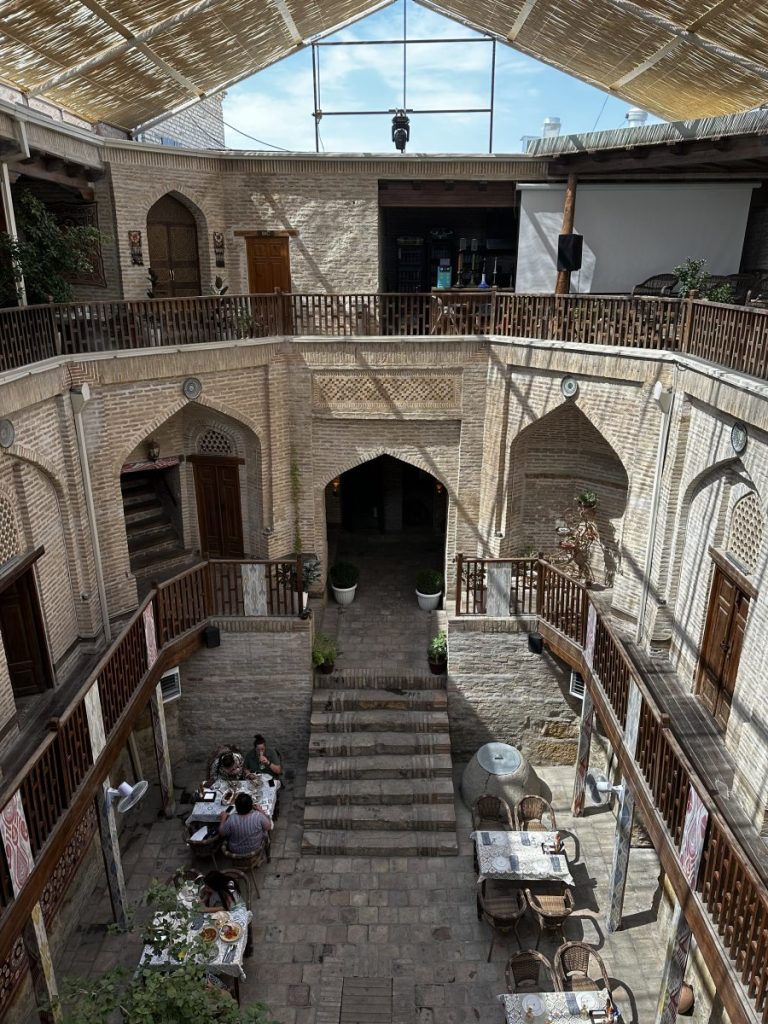
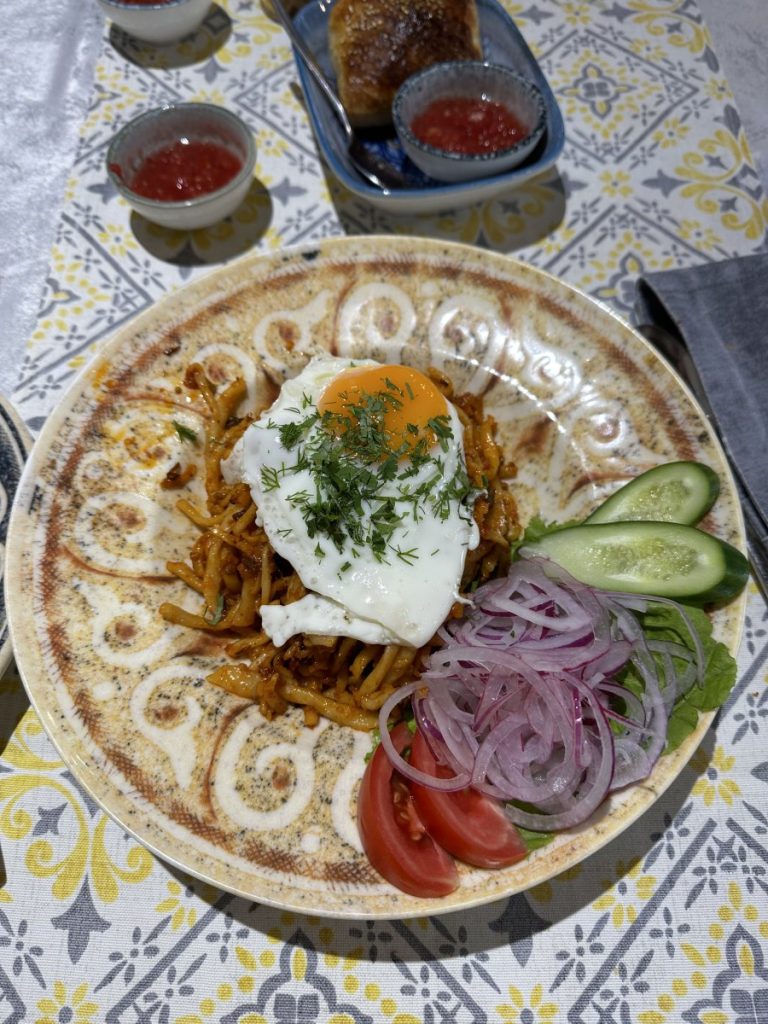
Joy chaikhana lounge is one of Bukhara’s liveliest and most famous dining spots, located in a historic building and evolving from a traditional tea house by day to a lounge with live music by night. The menu features Uzbek favorites like lagman, manti, and shashlik.
This one is a personal favorite and I really loved their lagman noodles and the somsa.
3. Chinar
- Address: Mekhtar Anbar Str., Buxoro
- Opening times: 11:00-23:00
Chinar offers a cozy, traditional Bukhara dining experience with a menu focused on classic Uzbek dishes. It offers an authentic local atmosphere and satisfying portions. I would say that it is a dependable mid-range option while exploring the old town.
4. Jam
- Address: QCFF+HMC улица Ходжа Кучкор дом
- Opening times: 11:00-24:00
Jam offers excellent value and friendly vibe, tucked away on a side street in the old town. It has affordable prices, tasty Uzbek food, and a welcoming interior that feels local rather than touristy. It’s a great spot to try traditional dishes with a good glass of wine or local drink without the crowds you find at larger eateries.
5. Chalet
- Address: Mekhtar Anbar Str., 200100, Buxoro
- Opening times: 8:00-2:00
Chalet is another solid choice in Bukhara’s historic centre, known for its comfortable atmosphere and varied menu that offers both Uzbek classics with some European-style options. It works well for both lunch or dinner after a day of sightseeing.
6. Giotto gourmet


- Address: Ibrokhim Muminov Str. 2, Buxoro
- Opening times: 24/7
Giotto gourmet is a smaller, more gourmet-oriented restaurant in Bukhara, with a menu that leans toward European-style cuisine. It offers some lovely pizza, which can be a nice break from the tasty, but oily uzbek cuisine. They also make nice waffles. The biscoff ones in particular were very tasty.
My Favorite Tea house in Bukhara


- Address: Khakikat Str., Buxoro, Buxoro Viloyati
- Opening times: 10:00-18:00
Silk Road Teahouse is a lovely, family-run café and tea house in Bukhara’s Old Town. It is a peaceful spot to relax and experience traditional Uzbek tea culture amid your sightseeing.
Established by a local family in 2004 and renovated with heritage touches, it offers a wide variety of teas, including spiced blends like saffron, mint, cardamom, ginger, as well as black and green teas, all served with an assortment of oriental sweets, dried fruits, and nuts included in the price.
It offers a warm, unpretentious atmosphere featuring wooden furnishings, handcrafted carpets, and local décor that make it a cozy retreat from the busy streets outside. All in all, it is a great place to take a break from sightseeing or to sample Uzbek tea traditions in an authentic setting.
While the pricing slightly tourist-oriented compared with local standards, it’s worth a visit for the quality of the drinks and the cultural experience.
Final Thoughts
If you kept up with this rather long guide, I hope you can now understand why I felt in Love with Bukhara. It is a place full of history that doesn’t feel touristy. It is traditional, but also has a few modern touches. It is a place where you can get a glimpse of Uzbek life, while not feeling staged. It has historic buildings, museums, bustling markets and yet a calming aura that I have not experienced in many places in the world.
That is why I do hope you give it a fair chance. And who knows, maybe you’ll fall in love with it, too.