Travel to Samarkand: The Ultimate Guide (2026)
If there is one thing I love doing during my travels, it is to do a deep dive into a place’s history. Imagining and experiencing a destination as it was hundreds or thousands of years ago is something that truly fascinates me. And that is exactly why I loved my trip to Uzbekistan.
If one place in Uzbekistan would sum up the above, however, it would certainly be Samarkand, the country’s second largest city. A place where rich history meets beauty, culture and amazing hospitality.
In this guide, you will find everything you need to know about traveling to Samarkand, from general information to the best things to do, and some important travel tips and advice. So sit back, grab a cup of coffee, and enjoy the ride.
If you are wondering how to plan a trip to Uzbekistan and you’re struggling to find all the information you need, head to my complete guide for the country. In that article, I have also created a few free itinerary ideas that you can be inspired from. Trust me, you won’t regret it!
Just so you know: Some links on this page are affiliate links, which means I might earn a small commission if you book or buy through them, at no extra cost to you. Thank you for your support!
A little bit of History
Samarkand’s history dates back to the 7th century BCE. Initially founded by the Sogdians, an Iranian-speaking people, Samarkand became home of various civilizations, taking influences from Persian, Greek, Arab, Turkic, and Chinese cultures over time.
In 329 BCE, Alexander the Great conquered the city, known then as Maracanda, making it part of his empire. After Alexander’s death, the city became part of successive empires, including the Seleucid, Greco-Bactrian, and Kushan Empires, further enriching its culture.
Samarkand’s “Golden Age” came under Islamic rule, beginning in the 8th century when Arab forces introduced Islam and made it a center of learning and science.
The city reached its zenith in the 14th and 15th centuries during the reign of Tamerlane (Timur), who established it as the capital of his Timurid Empire. However, after the fall of the Timurid Empire, Samarkand’s prominence waned.
In the 19th century, Samarkand was absorbed into the Russian Empire and later became part of the Soviet Union. Today, Samarkand is the second largest city of the Republic of Uzbekistan.
Is Samarkand safe to visit?
Absolutely! What really surprised me during our trip to Uzbekistan was the level of safety. I cannot recall many places where we felt even a tiny bit uncomfortable. The same applies to Samarkand, with only a few, poorly lit spots far away from the city center feeling a little bit sketchy during the night. However, it is a very lively city, so most places are always packed with people, mostly families.
Interestingly enough, there are also tourist police stationed in many places throughout the city, tasked to ensure safety for tourists. Obviously, it is highly recommended to excercise normal safety precautions, as someone would in any other country.
However, having travel insurance for your trip is extremely important. Personally, I choose Nomad Insurance by SafetyWing when I travel. I pick this specific plan because it’s quite affordable, offers very good coverage, and has very short response times for any questions that may arise.
A major advantage is that you can purchase your regular insurance even after your trip has started – especially convenient if you’re a forgetful person like me.
I would definitely recommend Nomad Insurance. Visit their website to learn more.

When is the Best time of the year to visit Samarkand?
The best time to travel to Samarkand is generally spring (April-June) and autumn (September-October), when the weather is mild and ideal for exploring outdoor monuments. Spring temperatures usually range from 15-30°C (59-86°F) as the city warms up, with comfortable days for walking. Autumn is similarly pleasant, with temperatures around 18-28°C (64-82°F). These seasons offer the most enjoyable balance of climate, atmosphere, and crowd levels.
Summer (July-August) brings very high heat, often reaching 35-40°C (95-104°F) or even higher. While the long daylight hours are appealing, the heat can be really tough. However, due to being a desert country, Uzbekistan has really low humidity. This basically means that it can be very hot, but you will not suffer in the same way you would in another country. We travelled in July, and it was quite manageable after a few adjustments (sightseeing early in the morning or after sunset).
Winter (December-February) is much colder, with temperatures typically ranging from -5 to 5°C (23-41°F) and occasional snow. Though it’s the quietest and cheapest season – with a calm, atmospheric feel – the cold makes long outdoor visits less comfortable.
To sum everything up, spring and autumn provide the most comfortable experience, summer works if you don’t mind heat, and winter suits you if looking for low prices and peaceful streets.
How can I get to Samarkand?
There are actually many ways you can reach this beautiful, historic city.
First things first, it is through Samarkand International Airport. It was quite recently renovated and it must be one of the most impressive designs I have ever seen. The building looks like an astronomy book on top of which are some star formations. Flights are operated daily from Tashkent, the capital city of Uzbekistan, as well as major international hubs such as Abu Dhabi.
Secondly, Uzbekistan offers some high-quality rail services. This might sound surprising, but the Uzbek trains are reliable, high quality, and quite cheap. There are both old, Soviet-style, as well as new trains available. The Afrosiob, Uzbekistan’s bullet train, is a more expensive but extremely fast solution. You can travel to Samarkand from most of Uzbekistan’s cities and towns.
How many days should I spend in Samarkand?

The ideal length of stay really depends on how deeply you want to explore the city. If you are on a tight schedule, a short stay of 1 to 2 days is more than enough to see the main highlights. However, the pace can feel a little bit rushed, leaving little time to enjoy the smaller attractions.
A 2 to 3-day stay would be the ideal time in my opinion. This allows you to visit every important thing the city has to offer, without giving the feel of being “rushed”.
If, however, you want to enjoy a more in-depth experience, a 4-day stay offers the chance to explore Samarkand at a relaxed pace and take day trips to surrounding areas. This would be better if you’re planning to visit Shakhrisabz (more on that in the end of the article).
Lastly, if time is not your ally, you can travel to Samarkand on a day-trip from Tashkent. While this certainly is not enough to see everything it has to offer, I believe that it is a good opportunity to get a good taste of it.
Is Samarkand Expensive?
If you have any worries before traveling to Samarkand (or Uzbekistan in general), finances would not be one of them. Uzbekistan is actually considered to be one of the cheapest countries in the world.
For example, a bottle of water would cost around 0.25$, a plate of local plov would cost as low as 3$, a mojito around 2$. So, it is not easy to miss anything, even if you have a tight budget. I could only compare the prices to my beloved Syria.
When it comes to souvenirs, the situation gets a little bit more complicated, as sellers tend to inflate the prices a little bit when they are approached by a tourist. Therefore, consider some strong bargaining, aiming at never paying more than 75% of the original asking price.
Do I need VPN for Uzbekistan?
Using a VPN in Uzbekistan is a smart move for both privacy and access while traveling. Internet infrastructure is improving, but public Wi-Fi in hotels, cafés, and airports is often unsecured. A VPN encrypts your connection, protecting sensitive data like passwords, emails, online banking details, and booking confirmations from potential interception.
I personally use and trust NordVPN. At the moment, it offers thousands of servers across 165 locations throughout the world, meaning that there are always fast servers to choose from, no matter the location. It is also is a five-times audited service to ensure that your online activities remain confidential, your activities will be private and your devices risk-free.
Lastly, there’s a 24/7 chat, which is very helpful if you need assistance. Visit their website to learn more.

How can I move around Samarkand?
Well, moving around when you travel to Samarkand is both convenient and cheap. The city offers public buses and minibusses which provide affordable and frequent connections to all locations you might need.However, Public transport will most probably not be needed.
Taxis are maybe the most convenient way of getting around Samarkand. We used Yandex, and it made everything extremely convenient. No bargaining was needed, and all the prices were great. Let’s not forget that Uzbekistan is one of the cheapest countries in the world.
For example, a 10-minute ride will cost around 1 dollar. However, I would not choose a regular taxi (meaning not being booked through an app), unless absolutely needed, since they tend to inflate the prices a lot, and our experience with them was not nice.
Where should I stay in Samarkand?
Well, I am about to tell you something I wish I knew before booking my accommodation in Samarkand. While checking the best hotel options through Booking.com, I tried to find a place near downtown Samarkand. Well, as it turns out, downtown Samarkand is quite far away from the main places of interest, leading to some small, but unnecessary taxi fees.
I would suggest finding a place around the Registan, since it is close to every other point of interest. I have compiled a map to help you find your perfect accommodation.
The best places to stay in Samarkand
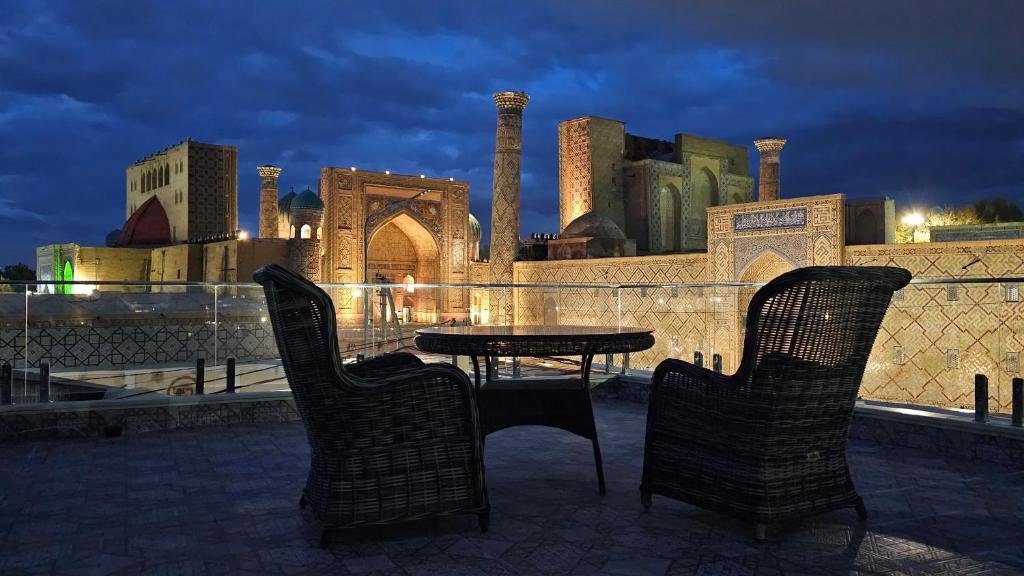
Hotel Legende is a small, family-run hotel located within walking distance of major attractions like Registan Square, Bibi-Khanym Mosque, and Shah-i-Zinda. Housed in a historic building, it offers a cozy, authentic atmosphere with a garden and terrace, and guests often praise the warm, personal hospitality. Breakfast is highly regarded, featuring local dishes and freshly baked bread, and there is an on-site restaurant for home-style Uzbek meals.
Hayati Hotel is another well‑reviewed 3‑star hotel that offers an excellent location, friendly staff, and good value for money.The property also offers amenities such as an airport shuttle service and a shared kitchen. Overall, it is a comfortable, centrally‑located choice.
We stayed at Vasiev’s Hotel, a well-regarded, guesthouse-style hotel located short taxi ride from Registan Square. It had modern, clean rooms with air conditioning, and friendly, helpful staff who also gifted us a small souvenir at the end. It was comfortable, however it required a taxi in order to get to Registan, which was a little bit time consuming.
Lastly, I must mention Hotel Minor, located just behind Registan Square, offering panoramic views of the square. The hotel serves a good breakfast and has a restaurant on site. It would generally be considered being in the more luxurious side.
What are the BEST things to do in Samarkand?
Well, I’ll be completely honest. When planning this trip, I found quite a lot interesting things to do in Samarkand. However, when it was time to visit, I realised that Samarkand is a relatively small city and most of the sites are nearby. That’s why, while they might seem a lot, most of the attractions mentioned can be visited in a few days.
1. The Registan square

- Address: 140101, Samarkand
- Opening times: 8:00-20:00
- Tickets: 100.000 UZS (Approx. $8)
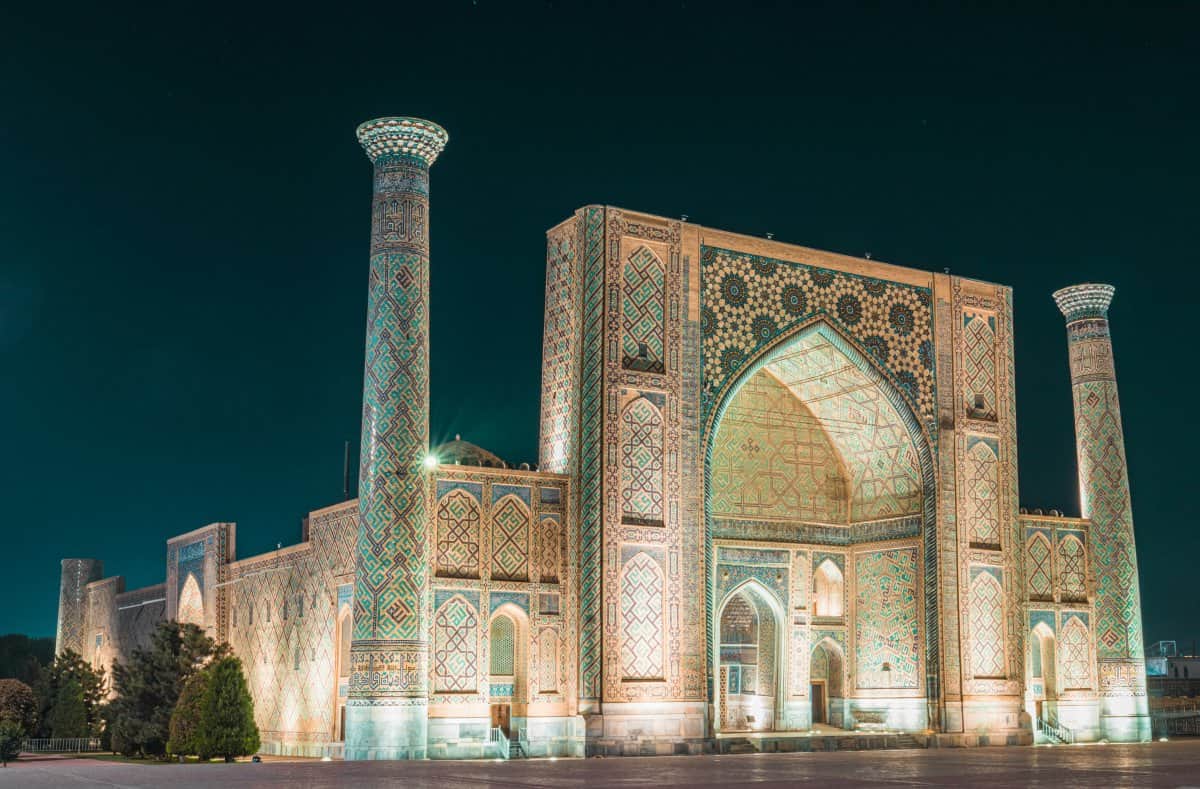
I do not think that there can be any talking about the best things to do in Samarkand without mentioning the Registan square. In fact, I do not think there can be any talking about traveling to Uzbekistan without it. And why would it? Even in my wildest dreams I could have not imagined the true beauty of this place.
The story of the Registan begins around the 9th Century, when all that existed there was the tomb of saint Imam Muhammad ibn Djafar. By the 14th Century, it had already been established as the cultural and financial center of the town.
What you see now, however, is the result of the work done under the ruling of Ulug Beg, grandson of the Great Amir Timur. There are three main Madrasas (former Islamic schools) decorating the square.
First and foremost, located on the left of the square, there is the Ulug Beg Madrasa. It is the oldest one, built somewhere around 1420. Above its giant arch, a detailed mosaic depicting the sky and the stars can be seen. Ulug Beg was a big fan of astronomy and this is a real testament to his love of it.
The Madrasa is massive, with a height of around 80 meters. At its peak, around 100 students used to live in its 50 cells. Interestingly enough, this was not a religious Madrasa, but one where students were taught Mathematics and Science. This was quite unusual and can tell us a lot about Ulug Beg’s Personality and ethics.
I had read that for an extra charge you can climb up to the 34 meter Minaret, but we did not see such thing when there. There are not many other things you can see inside.

On the right hand side, there is the Sher Dor Madrasa. Its name is literally translated to “The Madrasa of the Tiger or lion”. It was built in the 1620s and its name is derived from the wonderful mosaics that decorate it.
The mosaics show two sun gods, two animals with tiger stripes but lion-like mane, and two deers. In fact, such depictions are strictly forbidden in Islam, adding more on the rather unusual thinking of the Timurid dynasty. Despite this, It was a religious building. Inside, the former student cells have now become art and souvenir shops, where you can buy all sorts of local things.
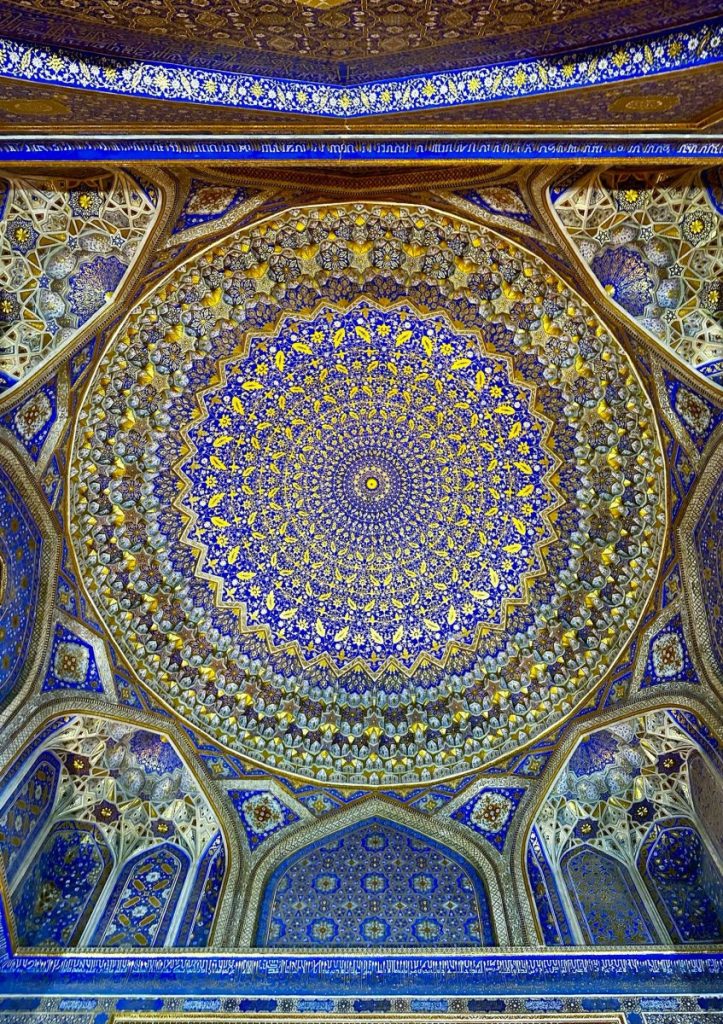
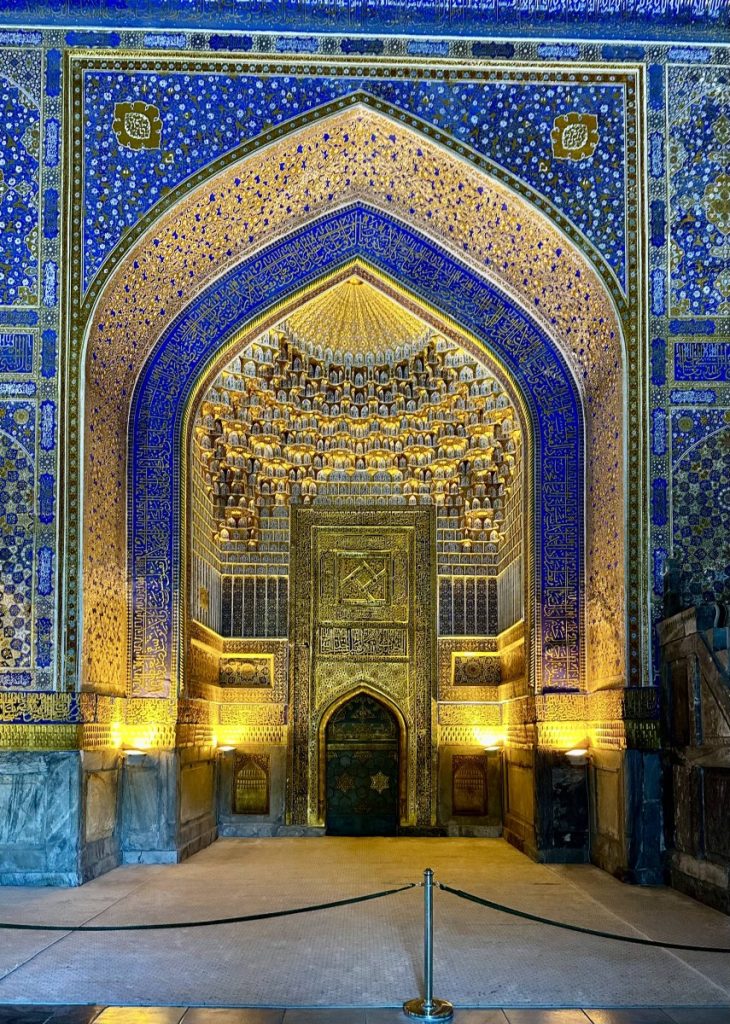
Lastly but most importantly, standing right in the middle of the square, there is the Tila Kari Madrasa (Gold covered Madrasa). Its construction finished in 1660 and it took a total of 14 years. In fact, it is the one Madrasa that you should definitely go inside when you travel to Samarkand. You will find a golden dome, surrounded by beautiful blue artwork.
Seeing this in person was fascinating, and I cannot recommend it enough. Take your time to wander around the souvenir shops, or sit outside in the courtyard for a moment of relaxation and thinking. It is totally worth it!
Tips after visiting:
- The square is massive and can fit many people, but, if travelling on the peak months, I would suggest arriving early morning or late evening.
- Outside the square there is a viewing platform where locals gather and admire the square. It is completely free to sit and enjoy for as much as you like.
- Right outside you’ll also stumble upon a sweet shop. I’d strongly recommend you stay there, enjoy some ice cream or some extremely cheap fresh watermelon and admire the Registan
- Every night at 21:00 there is a spectacular light show, where the square is covered in all shorts of different colors. You can see it for free from the outside and it is so amazing to watch.
2. The Bibi Khanym complex

- Address: MX6J+5W8, Samarqand, Samarqand viloyati
- Opening times: 9:00-18:00
- Tickets: 75,000 UZS (Approx. $5.5)
Walking the entirety of the street that starts from the park next to the Registan will take you to the Bibi Khanym Complex. It took the name of Amir Timur’s wife and consists of two main buildings, the Mosque and the Mausoleum.
The mosque is massive and really impressive. Built between 1399 and 1404, it was once the world’s largest mosque. Legend has it, that Bibi Khanym ordered its construction while her husband was in a conquest in India. The architect, however, demanded a kiss from Bibi in order to be able to speed up construction. The kiss however, left a permanent mark on Bibi’s cheek. When Timur came back, he was infuriated and orders both to be executed.
While impressive, the truth might be quite different because historians have found out that Bibi Khanym outlived Timur by 4 years.
The Mosque is trully impressive. Due to bad construction quality, most of the mosque collapsed after an earthquake in 1897. After that, plans were laid for the complete reconstruction.
In the middle of the square lies a Quran stand, where the world’s oldest Quran (See where you can find it now) was once located. The mosque is extremely quiet, and still operates as a praying place. It is a very nice place to walk around, sit back and admire (Signs of the earthquake can still be seen to date).
On the opposite side of the Mosque the Bibi Khanym mausoleum is located. it is the burying site of Bibi, as well as a her mother’s and two nieces’. It consists of a crypt from the 14th century, and a recently constructed part that finished in 2007. You can take up the stairs leading to its dome, but there is not much to see. Inside the building you can also admire some very intriguing mosaics depicting scenes from paradise.
3. The Shah i Zinda

- Address: Shohi Zinda ko’chasi, Samarkand, Samarqand Region, Uzbekistan
- Opening times: 7:00-22:00
- Tickets: 50,000 UZS (Approx. $4.5)
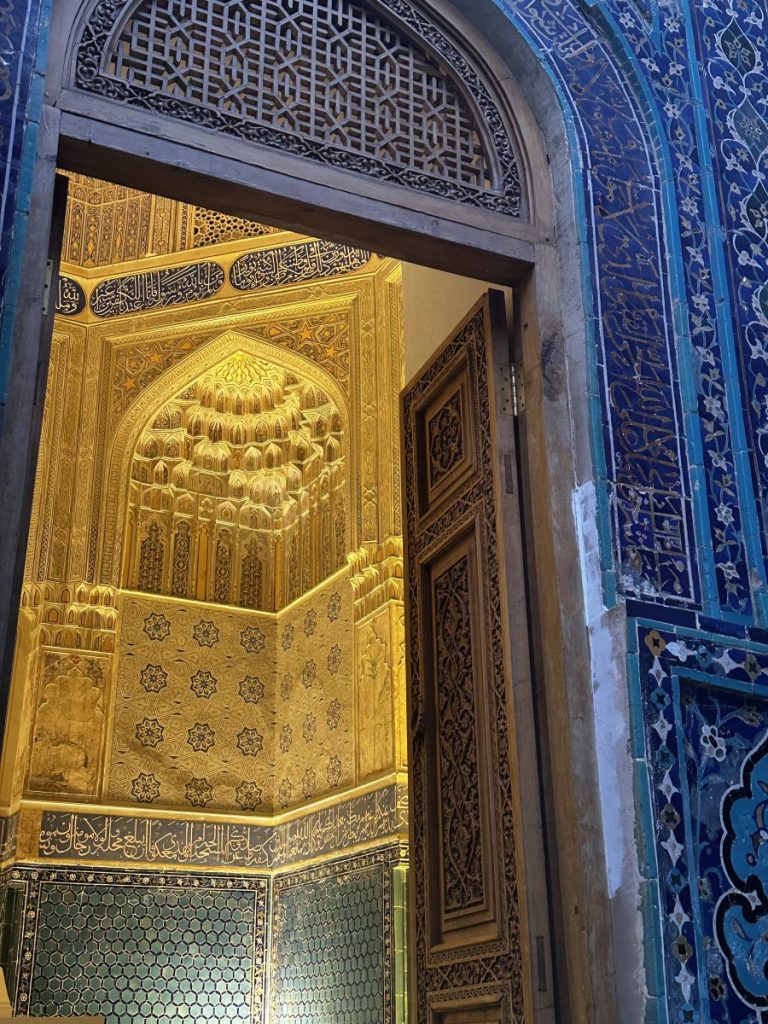
Shah-i-Zinda, which translates to “The Living King”, is, in my opinion, one of the most beautiful sites you can visit when you travel to Samarkand. This necropolis is a collection of mausoleums and other ritual buildings, dating primarily from the 9th to the 14th centuries.
The site is strongly connected to Kusam ibn Abbas, a cousin of the Prophet Muhammad, who is said to have brought Islam to the region. Legend has it, that he was beheaded by brigands while at prayer, picked up his head and jumped into a well, where he lives to this day.
The mausoleums are decorated with turquoise and blue tiles, featuring geometric patterns and calligraphy that show the artistic achievements of the Timurid period. The necropolis is structured along a narrow, elongated passageway.
I would suggest someone visiting it during the early evening, as golden hour there is breathtaking (let’s not forget those Instagram photos). While not getting the attention that Registan has, the Shah I Zinda is an underrated gem!
4. The Hazrat Khizr Mosque
- Address: Khuja Khidr Mosque, Toshkent yo’li, Samarqand
- Opening times: 8:00-17:00
- Tickets: free
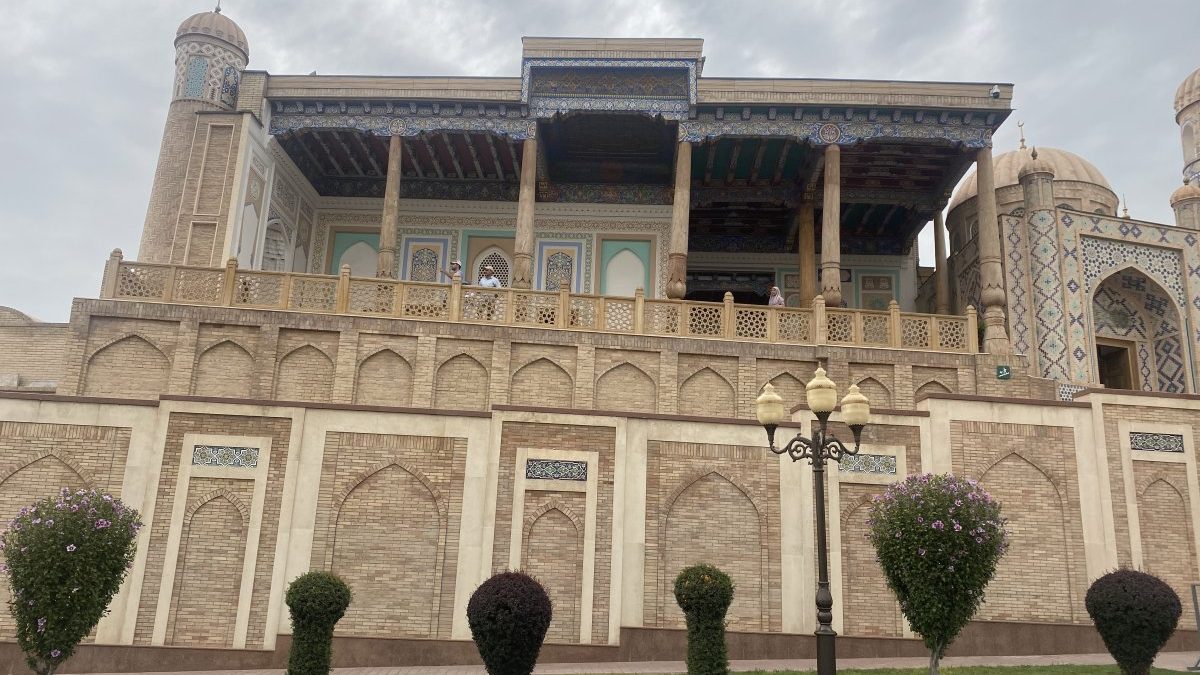
Hazrat Khizr Mosque is one of Samarkand’s oldest religious sites, standing on a hill overlooking the ancient Bibi Khanym area.
Although the original mosque dates back to the 8th century, the current structure was rebuilt in the 19th century and later restored, blending traditional Central Asian architecture with wooden columns, intricate carvings, and a peaceful courtyard. Dedicated to Hazrat Khizr, a legendary Islamic figure associated with guidance and protection.
It was the first time I had seen a mosque designed in the Uzbek wooden style and I have to say that I was really impressed.
5. The Mausoleum of islam Kharimov
- Address: Khuja Khidr Mosque, Toshkent yo’li, Samarqand
- Opening times: 8:00-17:00
- Tickets: free
The Mausoleum of Islam Karimov is a memorial dedicated to the first President of independent Uzbekistan. Following his death in 2016, he was buried on the grounds of the Hazrat Khizr Mosque, in accordance with his will, and a specially designed mausoleum was completed and officially opened in 2018. The project was developed in coordination with UNESCO to ensure that the new structure harmonized with the historic mosque and the surrounding heritage site.
The mausoleum combines traditional Central Asian architectural elements with modern design. Inscriptions in Uzbek and English mark the site as the resting place of Uzbekistan’s first president, while Quranic verses and calligraphy enhance the solemn atmosphere.
6. The Afrosiab Fortress and Museum
- Address: MXCQ+39C, Samarqand, Samarqand viloyati
- Opening times: 9:00-20:00
- Tickets: 50,000 UZS (Approx. $4.5)
This fort is related to the early history of Samarkand. It comprises of a set of ruins that, for the most part, have not been restored. Thankfully, there is a museum at the site explaining all you need to know. It is a nice addition if you have mode days in the city, but I would not necessarily deem it a “must visit”.
7. The Ulug Beg Observatory

- Address: M2F4+W7C, Toshkent yo’li, Samarqand
- Opening times: 8:00-19:00
- Tickets: 40,000 UZS (Approx. $3.5)
The Ulugh Beg Observatory was built in the 15th century and represents one of the most advanced astronomical centers of its time. Ulug Beg constructed the observatory around 1428-1429, equipping it with state of the art instruments for celestial observations.
The most notable feature of the observatory was its massive sextant, a key tool for measuring the positions of celestial bodies, parts of which still survive today. Using this and other instruments, Ulug Beg and his team compiled the Zij-i Sultani, an astronomical catalog documenting the positions of over 1,000 stars with incredible precision for its time.
Their measurement of the Earth’s axial tilt (23.52°) and the solar year proved the observatory’s advanced capabilities, significantly influencing later astronomical studies in Europe and Asia.
Despite its groundbreaking for its time discoveries, the observatory fell into disrepair following Ulug Beg’s assassination in 1449 and was eventually destroyed. Turns out that Ulug Beg was a much better scientist than leader. It remained lost until 1908, when Russian archaeologist V.L. Vyatkin rediscovered its remains, including parts of the sextant.
Today, the Ulug Beg Observatory site consists of the ruins and a small museum. The museum is well worth a visit and provides detailed depictions of how the observatory looked like, its history, and how it influsnced astronomy around the world.
While the site located a little further from the Samarkand city center (a few minute taxi ride), it is one of the best things to do when you travel to Samarkand.
8. The Siob Bazaar

- Address: MX6H+RW9, Bibikhonim Str., Samarqand
- Opening times: 7:00-19:00
If you want to experience Samarkand’s local life, then you have to visit the Siob Bazaar. It is a big space where all sorts of things such as fruit, vegetables, clothes, and souvenirs are sold. It is a nice place to grab some gifts, but negotiating a good price is needed.
When visiting the market you can also try to find and taste the iconic Samarkand bread. It is a massive, weirdly-shaped, and heavy bread that is baked in a tandoor. It uses a special type of yeast that helps it be fresh for months(!).
The best places to eat in Samarkand

1. Emirhan Restaurant
- Address: Махмуджанова 1/18 Самарканд Сиябский, 140100, Samarkand
- Opening times: 11:00-23:00
Emirhan Restaurant is maybe my favorite spot in the city for a traditional Uzbek meal. It offers an elegant setting and its rooftop terrace with views toward Registan Square. But don’t let the looks deceive you, the restaurant is very affordable! Among the things you should definitely try are their lagman noodles, which were my favorite in the country.
2. Platan
- Address: Pushkin Str., Samarqand, Samarqand viloyati
- Opening times: 10:00-1:00
Platan is another personal favorite. While it is located quite far from the city center and being on the more expensive site, it offers welcoming interior, quality cooking, and a comfortable atmosphere for lunch or dinner. I tried a mushroom dish in white sauce with cheese. While I cannot recall the name of the dish, it was well worth it and ai would surely recommend it.
3. Restaurant Karimbek
- Address: Гагарин кўчаси 194, Samarqand, Samarqand viloyati
- Opening times: 9:00-23:00
Restaurant Karimbek is a classic Samarkand favorite, even though a little bit more touristy. The menu focuses on local dishes like plov, lagman, kebabs, and shashlik, served in generous portions at reasonable prices. It’s often busy with families and groups.
4. Kokandskaya Somsa
- Address: JXM5+RRW, Ulitsa Usmana Yusupova 73, Samarkand
- Opening times: 8:00-17:00
Kokandskaya Somsa is one of the best places in the country to try the fresh, flaky Uzbek somsa baked in a tandoor oven. But what is somsa? They are basically simple, delicious pastries filled with meat, pumpkin, vegetables or herbs.
This spot is more casual than a full restaurant, but it excels at what it does: offering quick, affordable snacks that locals love. It’s a great stop if you want to try everyday Uzbek street-style food in its most authentic form.
5. Sashlik.uz
Address: Many places throughout the city.
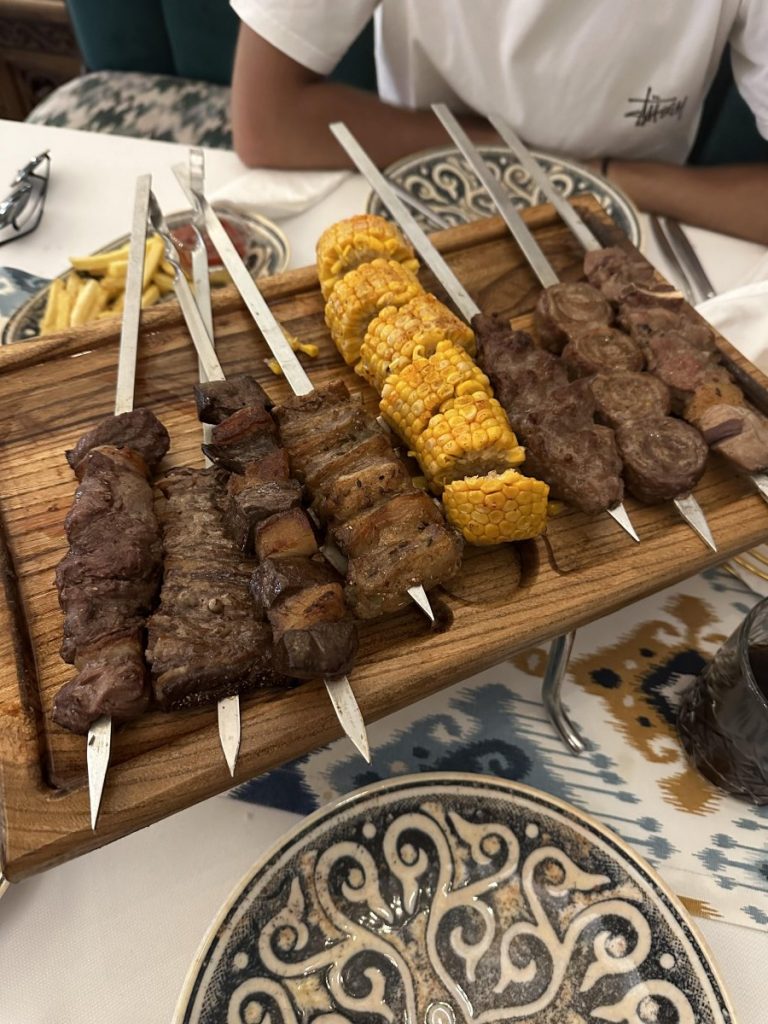
Sashlik.uz is a local uzbek chain that specializes in grilled meats prepared over open flame. Expect a massive variety of skewers of lamb, beef, or chicken, served with salad, corn, bread, and tea. It’s a good choice if you are looking to experience everyday Uzbek barbecue culture at an affordable price.
6. Art Cafe Norgis
- Address: MX5J+W4W, Samarqand, Samarqand viloyati
- Opening times: 9:00-19:00
Art Cafe Norgis is a small café between the Registan square and the Bibi Khanym complex. They offer refreshing juices and tasty Russian desserts. It is a little bit less-known place, but well worth a visit if you have a sweet tooth or if you travel to Samarkand in the Summer.
The best day trips from Samarkand
1. Shakhrisabz
Shakhrisabz is a historic city in southern Uzbekistan, about 90 km from Samarkand. It is the birthplace and a former capital of the empire of Amir Timur (Tamerlane).
The historic centre is a UNESCO World Heritage Site, home to architectural remnants from the Timurid era. The most impressive site in Shakhrisabz is the Ak-Saray Palace, once a magnificent summer palace ordered by Timur, whose massive blue-tiled portal towers still dominate the area.
Nearby, you can explore the Dorut Tilovat complex with the Kok-Gumbaz “Blue Dome” Mosque, beautiful mausoleums like Dorus-Saodat, and other historical buildings that showcase Timurid artistry. The city also offers a local bazaar where traditional crafts, spices, and textiles give a taste of authentic Uzbek life.
GetYourGuide offers organized day trips, something I’d really recommend to check out if you would like to leave out the hassle of planning, or if you’re short in time.
Though much smaller and less visited than Samarkand or Bukhara, Shakhrisabz is the best place to learn more about Timur’s origins and the architectural legacy of his dynasty. It’s worth a day trip from Samarkand if you’re interested in Timurid history or want to experience a more “authentic Uzbek” city beyond the major tourist hubs.
2. The Seven lakes of Tajikistan
Feeling more adventurous? How about a day trip to another country? A day trip from Samarkand to the Seven Lakes of Tajikistan (Haftkul) is a long but unforgettable excursion into the wild Fann Mountains.
Your journey begins early in the morning with a drive to the Uzbek–Tajik border, followed by customs formalities and a short ride to Panjikent, the nearest Tajik city. From there, you will head into the mountains, passing small villages before reaching the series of seven alpine lakes.
Once you arrive, the Seven Lakes offer a refreshing contrast to the desert landscapes often associated with Central Asia. The lakes sit at increasing altitudes, and the views become better with each ascent. Most tours include photo stops, short walks, and sometimes a traditional Tajik meal in a local guesthouse or as a picnic.
I would say that this one is definitely worth checking out!
Keep in mind: Check Tajikistan entry requirements and, if needed, a multiple-entry Uzbekistan visa to re-enter Samarkand on the same day.
Final Thoughts
Packed with History, culture, and beauty, Samarkand should definitely be part of your Uzbekistan itinerary. Even though it is relatively small, it has everything to cater to every single type of tourist, and is surely a place I would be eager to visit again.