Your Ultimate Travel Guide to Uzbekistan (+Itinerary Ideas)
Uzbekistan has emerged in the past few years a one-of-a kind travel destination. And why wouldn’t it? From rich history, to amazing culture and hospitable locals, it truly has it all.
I am completely aware that planning a trip to a new country from scratch can be quite a hassle. However, I was lucky enough to spend 10 days in this fantastic country, and I am here to help you figure everything out.
In this Uzbekistan travel guide, I have covered all you need to know to plan and execute a memorable trip to the Central Asian gem. From the basics like safety, visa requirements and transportation options, to itineraries for 5, 7, or 10 days, I’ve got everything included!
Just so you know: Some links on this page are affiliate links, which means I might earn a small commission if you book or buy through them, at no extra cost to you. Thank you for your support!
What is Uzbekistan?

Let’s start with the basics. Uzbekistan is a double landlocked country in Central Asia. This Basically means that it only neighbors countries that are also landlocked (do not have direct access to the sea).
To the north and northwest, it borders Kazakhstan, while Kyrgyzstan lies to the northeast. Tajikistan is located to the southeast, Afghanistan to the south, and Turkmenistan to the southwest.
With a population of around 36 million people, Uzbekistan is the most populous country in Central Asia. But what about history, I hear you asking.
A Little Bit of History
The territory of modern Uzbekistan has been inhabited since prehistoric time. Ancient civilizations including Sogdiana, Bactria, and Khwarezm flourished there, developing urban centers, irrigation systems, and complex trade networks.
Through the early Middle Ages, Uzbekistan stood in the middle of the Silk Road, the massive network of trade routes connecting China, India, the Middle East, and Europe. Samarkand, Bukhara, and Khiva became major centers of trade, learning, and cultural exchange.
Goods, religions, technologies, and ideas moved through these cities,creating a cosmopolitan and intellectually rich society. Zoroastrianism, Buddhism, and Christianity all existed in the region before the spread of Islam.
In the 7th and 8th centuries, Arab armies conquered much of Central Asia, introducing Islam, which gradually became the dominant religion. Under Islamic rule, the region experienced a cultural and scientific golden age. Scholars from cities in present-day Uzbekistan made major contributions to mathematics, astronomy, medicine, and philosophy.
From the 9th century onward, Turkic peoples increasingly settled in the region, creating the predecessor of modern Uzbek identity. In the 13th century, the Mongol invasions led by Genghis Khan devastated many cities, causing massive destruction and population loss.
In the late 14th century, the conqueror Amir Timur (Tamerlane) created a powerful empire with Samarkand as its capital. Under Timur and his successors, especially Ulug Beg, the region experienced a cultural renaissance. Many of the iconic monuments that define Uzbekistan today, including madrasas, mosques, and mausoleums, date from this period.
After the decline of the Timurid Empire in the 16th century, the region fragmented into several independent states, notably the Khanates of Bukhara, Khiva, and Kokand. These states maintained Islamic traditions and trade but gradually weakened due to internal conflict, economic decline, and isolation from emerging global trade routes.
In the 19th century, the Russian Empire expanded into Central Asia, conquering the Uzbek khanates. By the late 1800s, most of present-day Uzbekistan was under Russian control. While Russian rule introduced railways, new industries, and modern education, it also brought exploitation and cultural suppression.
After the Russian Revolution of 1917, Uzbekistan became part of the Soviet Union. In 1924, the Uzbek Soviet Socialist Republic was formally established. Soviet rule brought widespread literacy, industrialization, and urbanization, but also severe repression and devastating agricultural policies-most notably the overproduction of cotton, which contributed to the Aral Sea environmental disaster. Religious practices were heavily restricted, and traditional culture was tightly controlled.
Following the collapse of the Soviet Union, Uzbekistan declared independence in 1991. Under its first president, Islam Karimov, the country pursued stability and state control with strong emphasis on national identity and sovereignty.
Since his death in 2016, Uzbekistan has undergone gradual reforms, opening up economically and diplomatically while working to redefine its role in Central Asia.
Is it Safe to Travel to Uzbekistan?
Short answer – Extremely safe. What really surprised me during our trip to Uzbekistan was the level of safety. While there are both cities, villages and desert camps, your safety will not be a problem.
There is also tourist police stationed in all major tourist hubs to ensure your safety. Obviously, I highly recommend you exercise normal safety precautions, as anyone would in any other country.
Having travel insurance for your trip is extremely important. I personally trust Nomad Insurance by SafetyWing when I travel. I pick this specific plan because it’s quite affordable, offers very good coverage, and has very short response times for any questions that may arise.
A major advantage is that you can purchase your regular insurance even after your trip has already started – especially convenient if you’re a forgetful person like me.
I would definitely recommend Nomad Insurance. Visit their website to learn more.

Emergency services can be reached through several nationwide emergency numbers that can be useful for your trip:
- 112 – Unified emergency number (works for police, ambulance, and fire services)
- 102 – Police
- 103 – Ambulance / medical emergency
- 101 – Fire brigade
- 104 – Gas emergency service
How to get to Uzbekistan
Getting to Uzbekistan is not as complicated as it might seem. The two biggest cities, Tashkent and Samarkand, both have international airports, receiving flights from many cities in Europe and Asia. Both airports are renovated and well-organized, so you should feel free to choose them.
Another way to reach Uzbekistan is by train. The country is connected to the rail networks of Kazakhstan and is currently establishing a connection with Tajikistan. Sleeper trains are common, so you have quite a few options.
Lastly, You can enter Uzbekistan with a car, an option that could cause some bureaucratic hassle, so I am not so sure if I’d recommend that.
What is the best time of year to visit Uzbekistan?
The best time of year to visit Uzbekistan is spring (April to May) and autumn (September to October), when the weather is mild and well suited for sightseeing and travel between cities. Spring temperatures usually range from 15-30°C (59-86°F) as the city warms up, with comfortable days for walking. Autumn is similarly pleasant, with temperatures around 18-28°C (64-82°F). These seasons offer the most enjoyable balance of climate, atmosphere, and crowd levels.
Summer (July-August) brings very high heat, often reaching 35-40°C (95-104°F) or even higher. While the long daylight hours are appealing, the heat can be really tough. However, due to being a desert country, Uzbekistan has really low humidity. This basically means that it can be very hot, but you will not suffer in the same way you would in another country. We travelled in July, and it was quite manageable after a few adjustments (sightseeing early in the morning or after sunset).
Winter (December-February) is much colder, with temperatures typically ranging from -5 to 5°C (23-41°F) and occasional snow. Though it’s the quietest and cheapest season – with a calm, atmospheric feel – the cold makes long outdoor visits less comfortable.
To sum everything up, spring and autumn provide the most comfortable experience, summer works if you don’t mind heat, and winter suits you if looking for low prices and less tourist traffic.
Do I need a visa to travel to Uzbekistan?
Well, good news! Citizens of over 100 countries, including the US, EU, UK, Canada, Australia, Japan, South Korea, and others can enter visa-free for up to 30 days for tourism purposes. I will add at this point that the Uzbek stamp is purple, which will look very well in your passport.
Some countries have longer or special arrangements: for example, citizens of Russia, Ukraine, Georgia, Armenia, Azerbaijan, Belarus, and Moldova often have visa-free entry for up to 90 days, while Kyrgyz citizens can stay visa-free for up to 60 days
If you are not eligible for visa-free entry, Uzbekistan offers a relatively simple eVisa system where you can apply for online before arrival. This eVisa typically allows a 30-day stay.
If your nationality is not covered by visa-free or eVisa schemes, or for stays longer than 30 days, you will need to apply for a tourist visa through an Uzbek embassy or consulate before travelling.
A little detail to keep in mind: Uzbekistan uses an old system that registers visitors. This will be done automatically at the entry points and at the hotels you will stay in. You do not have to do anything about it, the professionals will do it as a routine procedure. It is, however, something that you should know in case it gets brought up. In fact, I was asked about it at a hotel in Tashkent, due to a spelling mistake from another hotel.
What is the Language spoken in Uzbekistan?
The Uzbek language is the official state language of Uzbekistan. It belongs to the Turkic language family and is closely related to languages such as Kazakh, Kyrgyz, and Turkish.
Modern Uzbek is written using the Latin alphabet, which was officially adopted after independence, although the Cyrillic script is still widely understood and commonly used, especially among older generations and in informal contexts. Historically, Uzbek was also written in Arabic script before the Soviet period.
Russian is also widely spoken alongside Uzbek. In fact, the first reaction of locals when meeting a tourist is to speak in Russian, assuming that you can speak it as well. However, Younger people tend to be able to speak in english. Even if they cannot speak English, locals are very kind and hospitable, always willing to help if asked.
What is the official religion in Uzbekistan?

The official religion of Uzbekistan is Islam. Truth is that, mainly due to the Soviet influence, religious practice is generally more relaxed compared to other islamic countries. For example, there is a culture of alcohol consumption, while the country also produces its own beer.
At the same time, it is evident from Uzbek islamic architecture that they loved to “experiment” with the boundaries and prohibitions of religion. For example, the old madrasas (islamic schools) in Samarkand and Bukhara are decorated with tiles depicting animals, something strictly prohibited in islam.
That is not to say, however, that you should not be respectful to the local culture. In the end, Uzbekistan is a conservative country.
What is the currency in Uzbekistan and where can I exchange money?
Uzbekistan’s official currency is the Uzbek Som. It was introduced in 1994, a few years after Uzbekistan gained independence from the Soviet Union, replacing the Soviet ruble. The current rate is 1 USD to 12.097,96 som.
While cash still is dominant, most establishments in the country were, to my surprise, accepting card payments. Keep in mind that this may not be the case in every single place you visit, so I’d recommend you change money when you arrive to the country.
Unlike other countries I’ve visited, ATM’s are a good means of exchanging money, since their fees are quite small. I would suggest you have a Revolut card, because it offers the best exchange rate available. If you still find it hard to trust a local ATM, visiting a local bank will do the trick. In general, I never choose exchange offices, as they tend to mess up the rate quite often (and I prefer banks, instead).
Do I need VPN for Uzbekistan?
Using a VPN in Uzbekistan is a smart move for both privacy and access while traveling. Internet infrastructure is improving, but public Wi-Fi in hotels, cafés, and airports is often unsecured. A VPN encrypts your connection, protecting sensitive data like passwords, emails, online banking details, and booking confirmations from potential interception.
I personally use and trust NordVPN. At the moment, it offers thousands of servers across 165 locations throughout the world, meaning that there are always fast servers to choose from, no matter the location. It is also is a five-times audited service to ensure that your online activities remain confidential, your activities will be private and your devices risk-free.
Lastly, there’s a 24/7 chat, which is very helpful if you need assistance. Visit their website to learn more.

What about SIM cards in Uzbekistan?
The major mobile network providers in Uzbekistan are Ucell, Beeline, Uzmobile, and UMS (Mobiuz / UMS). All of them offer prepaid SIM cards suitable for tourists, with fairly similar pricing. Ucell tends to have very broad coverage (including some rural areas), and that is why we chose it.
Ucell’s coverage was great throughout the country (even when our train was passing through desert areas). The best part? We paid less than $10 for 30 GB data plus unlimited texts and calls! We bought the SIM at the Samarkand airport and I’d urge you do the same since there is no big price difference.
Is Uzbekistan Expensive to Travel to?

If you have any worries before traveling to Uzbekistan in general, finances would not be one of them. Uzbekistan is actually considered to be one of the cheapest countries in the world.
For example, a bottle of water would cost around 0.25$, a plate of local plov would cost as low as 3$, a mojito around 2$. So, it is not easy to miss anything, even if you have a tight budget. I could only compare the prices to my beloved Syria.
However, Tashkent, Uzbekistan’s capital city, lies on the more expensive side of the country. that’s not to say that it is not affordable, it very much is. But this basically means that it will be harder to find the extremely low prices seen for example in Bukhara.
When it comes to souvenirs, the situation gets a little bit more complicated, as sellers tend to inflate the prices a little bit when they are approached by a tourist. Therefore, consider some strong bargaining, aiming at never paying more than 75% of the original asking price.
What is the best way to travel around Uzbekistan?

Traveling around Uzbekistan is easy and comfortable, with many options being available.
First, you can travel between all the major cities in Uzbekistan by plane. Tashkent and Samarkand have international airports, while Bukhara and Kokand have airports that receive regional flights. The local airlines have generally good reviews and I would recommend flying as a way of getting around if your time in the country does not allow for long and time-consuming train journeys.
Of course, the most common way to get around Uzbekistan is by train. Uzbekistan railways is the country’s national carrier, which was surprisingly organized, reliable and high quality.
The Afrosiyob is Uzbekistan’s high speed train. It is modern, air-conditioned, and reliable, making it one of the best ways to move between major cities in Uzbekistan. It offers airplane-like air condition, comfortable seats, while you can also order a meal during your journey. However, it is more expensive than the other trains.
I couldn’t help but mention the old Soviet trains. These are also in very good condition. Of course, they are slower than modern ones, but much more affordable. There are three ticket classes, the first, the second and the third. Their difference is the comfort they offer, especially if the trip is at night, where the seats are converted into beds. But let’s get a little more into detail:
In third class, the seats you would normally sit on turn into beds, while second there are two bunks, meaning four beds. Lastly, in first class, which is considered the most luxurious, there are two single beds. First class also has air conditioning, which is extremely important if you travel during the summer. However, note that the air conditioning only works when the train is moving, so you will be exposed to the desert heat when the train stops.
Keep in mind that tickets in the first two classes sold out fast, so make sure to book at least a week in advance.
Can I drink the tap water in Uzbekistan?
While technically safe for consumption (At least in Tashkent), I would advise against drinking tap water when you travel to Uzbekistan. Bottled water is very affordable, so taking risks that could impact the rest of your trip is unnecessary.
9 Tips for your Uzbekistan Trip
1. Time your visit: The best months to visit Uzbekistan are April-May and September-October, when temperatures are mild and sightseeing is comfortable. Summer heat can be extreme (but still manageable if budget is way too tight), especially in desert cities like Bukhara and Khiva.
2. Pack for Cultural Norms: Modest dress is expected at mosques and religious sites (covered shoulders/knees).
3.Get Vpn: Using a VPN in Uzbekistan is a smart move for both privacy and access while traveling. It is especially important if you work remotely or manage finances while traveling.
4. Stay Connected with a SIM or eSIM: Wi-Fi exists in hotels and cafés but can be slow or unreliable. A local SIM or international eSIM helps with maps, translations, train bookings, and ride-hailing.
eSIMs are especially convenient – no physical store visit required.
5. Carry Cash (But Don’t Skip Cards Completely): Uzbekistan is still largely a cash-based economy, especially in markets and smaller towns. ATMs are available in cities, and Visa/Mastercard work in the vast majority of hotels and restaurants. However, carry small bills for normal taxis, tips, and bazaars.
6. Use Trains for City-to-City Travel: Uzbekistan’s Afrosiyob high-speed trains are modern, clean, and fast. They connect major destinations like Tashkent–Samarkand–Bukhara efficiently. Tickets sell out quickly, so booking in advance is essential.
7. Protect Yourself with Travel Insurance: Healthcare quality varies, especially outside major cities. Travel insurance is highly recommended for medical care, delays, or trip cancellations. Some adventure activities and long train journeys make coverage extra important.
8. Do NOT use normal taxis: You should never use taxis that are not booked from an app like Yandex.go. You will never get a good price, while taxi drivers tend to be intimidating to use them for the rest of your trip (something that feels like harassment at times). We booked more than 20 drives through Yandex, and every single one of them was professional.
9. Bargain (A LOT): When buying things from a bazaar or a local market, bargaining is expected. Prices for tourists are, most of the time, inflated. Therefore, you should aim to pay NO MORE than 75% of the original asking price.
What are the most famous places to visit in Uzbekistan?
1. Tashkent

Of course, I couldn’t start writing about the best places to visit in Uzbekistan without mentioning the country’s capital, Tashkent. Unfortunately, it is often overlooked by visitors in favor of the impressive smaller gems.
After all, it is, indeed, completely different from any other place in the country. But there is a reason for that. In the 20th century a huge earthquake occurred, which literally leveled the city. This resulted in it having to be rebuilt from scratch. That’s why today, unlike other places like Samarkand and Bukhara, Tashkent has a modern look.
In Tashkent you will find plenty of amazing things to do, from admiring the oldest Quran in existence, to getting lost in a massive local market and seeing one of the weirdest looking hotels in the world. You can learn more in my dedicated Tashkent travel guide.
2. Samarkand

Let’s be honest, the first time we learned about this country, we all did it through an article or video about Samarkand. It is a small city located a few hours away from Tashkent and probably the place that receives the most visitors every year.
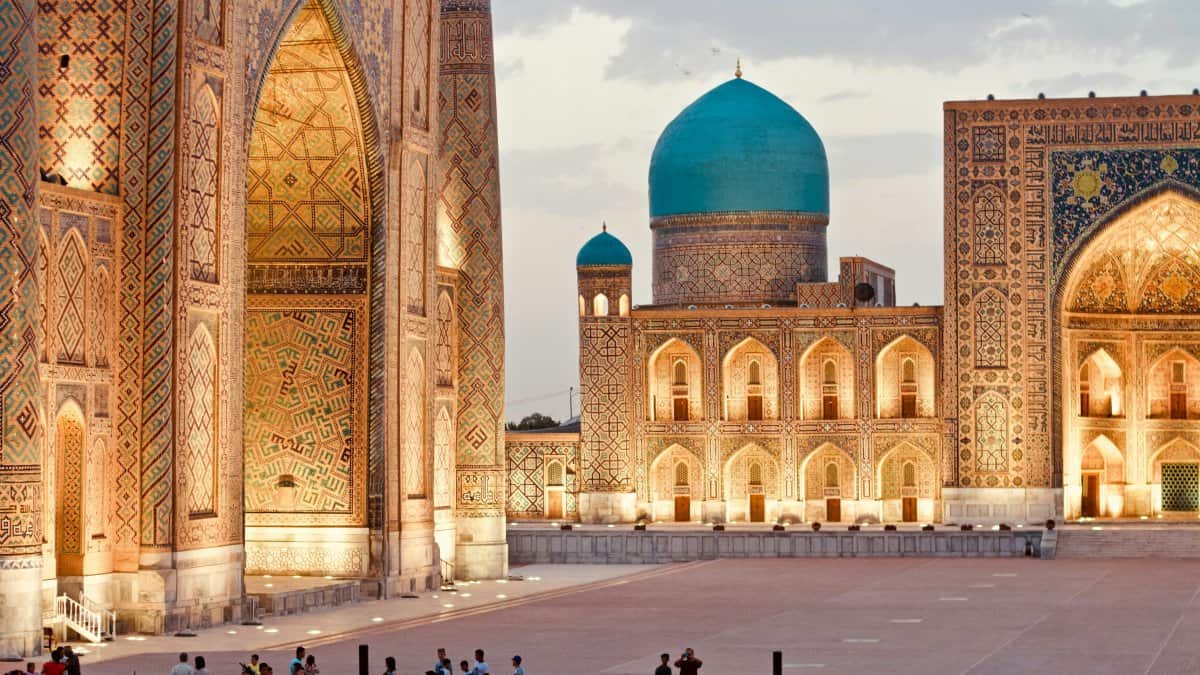
However, this happens for a good reason. Where to start? From the magnificent Registan Square or the impressive Shaj-i-Zinda necropolis? In Samarkand you’ll get the chance to learn about the history of the Timurid empire, while also being able to explore fantastic local markets, wooden (!) mosques and one of the most significant observatories in history!
I am sure that I’ve now captured your curiosity. If that’s the case, head to my Samarkand travel guide to find all the information you might need to know about it.
3. Bukhara

How often do you find yourselves lost in the beauty and awe of a single place? I am talking about the place that you visit without expectations, but end up feeling connected to it, maybe for no apparent reason. For me, that place was Bukhara, Uzbekistan’s third largest city.
It is a place full of history that doesn’t feel touristy. It is traditional, but also has a few modern touches. It is a place where you can get a glimpse of Uzbek life, while not feeling staged. It has historic buildings, museums, bustling markets and yet a calming aura that I have not experienced in many places in the world.
Spare no time and head to my Bukhara travel guide. You will not regret it, I promise.
4. Khiva

Khiva is a remarkable oasis city in western Uzbekistan, best known for its perfectly preserved inner town, Itchan Kala. Encircled by massive mud-brick walls, it is like an open-air museum, where turquoise minarets, madrasas, and ancient mosques rise above its narrow streets.
Key sites such as the Kalta Minor Minaret, the Kunya-Ark Fortress, and the Juma Mosque are all within easy walking distance. Unlike larger cities, Khiva allows you to explore at a relaxed pace, making it ideal for slow travel and photography, particularly at sunrise or sunset when the city’s walls glow in the soft light.
5. The republic of Karaklapakstan

This particular area is extremely interesting and you will immediately understand why. It is an autonomous state within Uzbekistan. But unlike other cases, the situation is very peaceful. It has all the rights that an independent state would have, except for the right to secede from Uzbekistan. Apparently, everyone is fine with that.
The main reasons you to visit this particular place are two. First, in the vast Uzbek desert lie a few ancient fortresses that are really impressive. Actually, I am not sure that there is anything like it anywhere else in the world.
The second, of course, is the Aral Sea. It was once the third largest inland body of water in the world, until the Soviets decided to divert the rivers that provided its water, in order to support cotton crops. This caused its gradual disappearance over the years, which is referred to by various sources as one of the greatest environmental disasters ever caused by mankind.
The former lake is available to visit, but now you can only find desert and abandoned ships. It is a punch in the stomach and definitely something worth doing if you have extra time.
My List of Suggested Uzbekistan Itineraries
5 days in Uzbekistan- Plan A
- Day 1: Arriving in Tashkent, exploring Tashkent – Overnight in Tashkent
- Day 2: Exploring Tashkent – Overnight in Tashkent
- Day 3: Morning train to Samarkand, Exploring Samarkand – Overnight in Samarkand
- Day 4: Exploring Samarkand – Overnight in Samarkand
- Day 5: Train back to Tashkent- Return flight
5 days in Uzbekistan- Plan B
- Day 1: Arriving to Tashkent, exploring Tashkent – Overnight in Tashkent
- Day 2: Morning train to Samarkand, Exploring Samarkand – Overnight in Samarkand
- Day 3: Exploring Samarkand – Overnight in Samarkand
- Day 4: Day trip to Sahrisabz – Overnight in Samarkand
- Day 5: Train back to Tashkent-Return flight
7 days in Uzbekistan- Plan A (Can be too tight)
- Day 1: Arriving directly in Samarkand, exploring Samarkand – Overnight in Samarkand
- Day 2: Exploring Samarkand – Night train to Bukhara
- Day 3: Exploring Bukhara – Overnight in Bukhara
- Day 4: Exploring Bukhara – Night train to Khiva
- Day 5: Exploring Khiva – Overnight in Khiva
- Day 6: Exploring Khiva – Night train to Tashkent
- Day 7: Arriving to Tashkent, exploring Tashkent – Return flight
7 days in Uzbekistan- Plan B (More relaxed version)
- Day 1: Arriving in Tashkent, exploring Tashkent – Overnight in Tashkent
- Day 2: Fast train to Samarkand, exploring Samarkand – Overnight in Samarkand
- Day 3: Exploring Samarkand – Overnight in Samarkand
- Day 4: Exploring Samarkand – Night train to Bukhara
- Day 5: Exploring Bukhara – Overnight in Bukhara
- Day 6: Exploring Bukhara, fast train to Tashkent – Overnight in Tashkent
- Day 7: Exploring Tashkent – Return flight
10 days in Uzbekistan- Plan A (My ideal version)
- Day 1: Arriving in Tashkent, exploring Tashkent – Overnight in Tashkent
- Day 2: Fast train to Samarkand, exploring Samarkand – Overnight in Samarkand
- Day 3: Day trip to Sahrisabz – Overnight in Samarkand
- Day 4: Exploring Samarkand – Night train to Bukhara
- Day 5: Exploring Bukhara – Overnight in Bukhara
- Day 6: Exploring Bukhara – Overnight in Bukhara
- Day 7: Bukhara to Khiva via the desert fortresses, exploring khiva- Overnight in Khiva
- Day 8: Exploring Khiva – Night train to Tashkent
- Day 9: Exploring Tashkent – Night train to Tashkent
- Day 10: Exploring Tashkent – Overnight in Tashkent
10 days in Uzbekistan- Plan B
- Day 1: Arriving in Tashkent, exploring Tashkent – Overnight in Tashkent
- Day 2: High-speed train to Samarkand, exploring Samarkand – Overnight in Samarkand
- Day 3: Exploring Samarkand – Night train to Bukhara
- Day 4: Exploring Bukhara – Overnight in Bukhara
- Day 5: Exploring Bukhara – Overnight in Bukhara
- Day 6: Flight from Bukhara to Urgench, transfer to Khiva by taxi (~40 min), Exploring Khiva – Overnight in Khiva
- Day 7: Exploring Khiva – Overnight in Khiva
- Day 8: train to Nukus, Exploring Nukus – Overnight in Nukus
- Day 9: Day trip to Moynaq (Aral Sea) from Nukus – Overnight in Nukus
- Day 10: Flight from Nukus to Tashkent, return flight
Final Thoughts
Uzbekistan has every reason has every reason to be on top of your bucket list. I hope that this guide has given you all the information you needed to take the next step and book your trip and explore this magnificent country.