
Getting Healthcare in Athens as a Tourist
Nobody plans a trip around getting sick, needing a pharmacy at midnight, or having to figure out how Greek hospitals work. But it can happen. Food poisoning, dehydration in summer, scooter accidents, twisted ankles on slippery marble and random fevers after island hopping are all part of daily life in a city that receives millions of visitors every year.
The good news is that Athens has plenty of pharmacies, public hospitals, private clinics and English-speaking doctors. The bad news is that the system can be confusing if you’re unfamiliar with it. Public hospitals can involve long waits, pharmacies run on rotating schedules, and where to go depends on whether the problem is urgent, minor, or somewhere in between.
So here’s how healthcare in Athens works for a tourist, where to go depending on the situation, and what I would avoid.
Just so you know: Some links on this page are affiliate links, which means I might earn a small commission if you book or buy through them, at no extra cost to you. Thank you for your support!
How Healthcare in Greece Works
The Greek healthcare system is split between public and private care. Public hospitals handle most emergencies and serious cases, while private clinics and doctors are used for faster access, convenience or specialist appointments.
Which of the two makes more sense often depends on cost and paperwork as much as on the medical problem itself, which is why I’d sort out insurance before anything else.
Travel Insurance

Even for a short visit to Athens, I would still recommend travel insurance. Accidents and health problems are impossible to predict in a city where days are spent walking outside in the heat, on slippery marble streets and around busy traffic. And while healthcare here is accessible, costs can add up quickly in private clinics, imaging centres or specialist appointments.
The travel insurance I use and recommend is SafetyWing’s Nomad Insurance. It works as a subscription in four-week blocks instead of a fixed-date policy, so it can start on any day, even after the trip has begun, and be cancelled whenever plans change. A long weekend in Athens that turns into three weeks on the islands doesn’t need a new policy.
What I look at first in any travel policy is the medical side, since that’s where costs can get serious. The main advantage of Nomad here is that the choice between a public hospital and a private clinic stays a medical one, because both are covered, along with scans, ambulance transport and hospital stays.
It also covers evacuation to a better-equipped hospital, which is easy to overlook until an accident happens on a small island with only a health centre. Emergency dental treatment is included, so a cracked tooth doesn’t have to wait until I’m home, and scooter accidents are covered as long as the rider has the right licence and wears a helmet, which counts for a lot on the islands.
The rest of the cover is for the smaller things that can still go wrong on a trip, like lost checked luggage, long flight delays, or having to fly home early because of an emergency there. Children under 10 can be added at no extra cost, up to two per family. Between the medical cover and these extras, it handles most of what can go wrong on a trip to Athens, which is why it’s the insurance I travel with.
Also, if you’ve never had a SafetyWing account, there’s a small Easter egg on their Nomad Insurance landing page right now: a pink Polaroid camera tucked somewhere on the page.
Click it and you’ll be asked for a code. Enter SAFEATHENS and you’ll get two months of free electronics theft coverage added to your plan. In a city where a pickpocketed phone is a much likelier problem than anything else on this list, that’s the add-on worth having.
The steps have to happen in this exact order, so don’t jump ahead:
- Open the Nomad Insurance page and look for the pink Polaroid camera.
- Click it and enter SAFEATHENS when asked.
- Wait until you see confirmation that the code is valid.
- Only after that, create your SafetyWing account and buy an Essential plan with the Electronics Theft add-on. The reward is applied automatically at this stage.
The offer is limited to first-time SafetyWing customers. One thing to know before you buy: the first two months are free, but the add-on switches to paid coverage automatically unless you cancel it from your dashboard before the first paid billing date.
Cancelling is free and only takes a couple of clicks, so the simplest approach is to set a reminder for around day 50 and decide then whether to keep it.
European Health Insurance Card
Visitors from an EU country should also bring their European Health Insurance Card. The EHIC gives access to medically necessary state healthcare in Greece under the same conditions as Greek residents, which is very useful for a public hospital visit during the trip.
The EHIC isn’t travel insurance, though. It doesn’t cover private healthcare, trip cancellation, lost luggage, medical repatriation, or emergencies outside the public system, and those are exactly the gaps travel insurance fills. So if you’re eligible, bring the card, but treat insurance as something separate.
With coverage sorted, the next question is where to go when something happens. For most minor problems, the answer is the nearest pharmacy.
Pharmacies
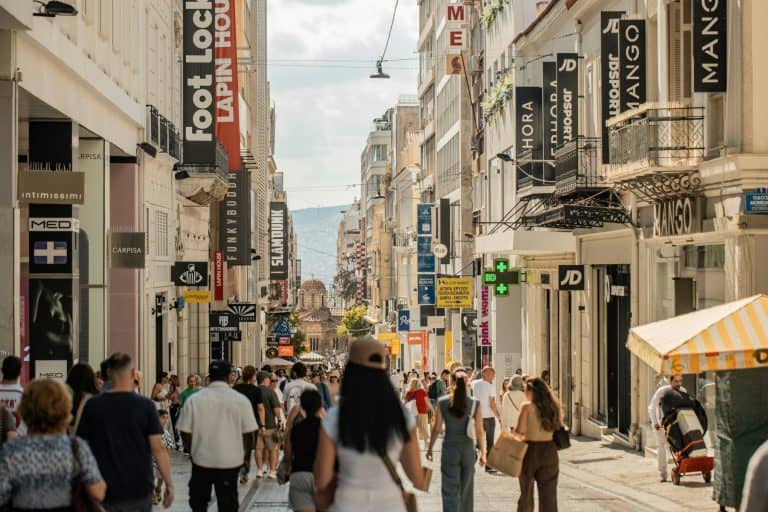
Pharmacies are everywhere in Athens, marked with a green cross, and Greek pharmacists play a much more active role in everyday healthcare than in many other countries. They can help with minor illnesses, recommend over-the-counter medication, and tell you what needs a doctor or a hospital, which often saves hours of sitting in an emergency department for no reason.
This is especially useful in summer, when the usual problems are dehydration, heat exhaustion, sunburn, stomach upsets, insect bites, mild allergic reactions and heat headaches.
Not every pharmacy stays open overnight or on Sundays. Instead, Greece runs a rota of duty pharmacies, called “εφημερεύον φαρμακείο”, so certain pharmacies stay open after hours depending on the area and day.
And despite Greece’s old reputation, antibiotics can no longer be bought without a prescription. They now require an electronic prescription, and pharmacies are much stricter about it than they used to be. When antibiotics are needed, the next step is a doctor, and seeing one in Greece works differently than in many other countries.
Greece Doesn’t Have a GP Gatekeeping System
Greece doesn’t really work around the idea of a family doctor as the first point of contact for everything. In many countries, especially in Northern Europe, the process starts with a call to the GP, a referral, or a structured appointment system before seeing a specialist or going to hospital.
Greece is much more direct. When something feels urgent, people go straight to the emergency department, and for less serious problems they visit a private doctor directly or ask a pharmacist first.
That doesn’t mean the system is well organised, because it isn’t. But for a visitor, it means faster and less bureaucratic access to care, and the main decision left is whether to go public or private.
Public vs Private Hospitals
This is probably the part that worries visitors the most, and I think Greece has an unfair reputation abroad when it comes to public healthcare.
Are public hospitals overcrowded sometimes? Absolutely. Can waiting times get frustrating during busy shifts? Of course. But many public hospitals in Athens are staffed by extremely capable doctors who handle a very high volume of serious cases every day. Like pharmacies, they work on a rotating on-call schedule, and for emergencies and serious problems I would feel very comfortable going to one. As a doctor myself, I would probably choose a large public hospital over many private clinics for something serious.
Private hospitals and clinics have their advantages too. They’re often faster, more comfortable, easier administratively, and less overwhelming for someone unfamiliar with the Greek system. In my experience, though, they can also be quicker to order extensive testing that isn’t always necessary. That doesn’t make private care bad. It just means that faster and more expensive doesn’t automatically mean better.
For smaller issues, the convenience can still make a private clinic worth it, and with travel insurance in place, the bill doesn’t have to be part of that decision. For serious emergencies, I wouldn’t hesitate to use the public system. English is rarely a problem in either, especially with younger doctors.
Emergency Numbers in Greece
Before closing, it’s a good idea to save the main emergency numbers on your phone. For any serious emergency, call 112, the European emergency number, which works in Greece for medical, police and fire emergencies. For medical emergencies specifically, 166 connects directly to EKAB, the Greek ambulance service.
Other useful numbers are:
- 100 for police
- 199 for fire
- 108 for the coast guard
- 1571 for tourist police
- 210 779 3777 for the Poisoning Centre
Final Thoughts
Hopefully this is one of those articles you never need during your trip. But if something does happen, pharmacies are everywhere, doctors speak English, and getting seen is usually much easier than in countries built around referrals and long waiting lists.
I hope this guide leaves you a bit more prepared, just in case something unexpected happens while you’re in Athens.