How to Avoid Being Overcharged in Athens
I hate scams. Watching someone hand over €5 for a bottle of water, ten times more than the regulated price for greek-branded water annoys me probably out of proportion to the amount involved.
Which is how I ended up at a kiosk near the Acropolis entrance a while back, watching a queue of tourists pay a fiver a bottle in 35 degree heat.
I asked the cashier for the price-control list (κατάλογος διατίμησης). Her expression changed instantly. She went to the back, opened a fridge that wasn’t visible from the counter, handed me a bottle at the regulated price, and said nothing at all.
The stock was there the whole time. It just wasn’t on display.
Greece has a set of consumer laws that cap prices, ban certain charges outright, and give customers the right to refuse payment in specific situations.
Almost none of it is explained to anyone arriving here, and a fair amount of it is quietly ignored by businesses banking on that. What follows is what applies and how to use it.
Just so you know: Some links on this page are affiliate links, which means I might earn a small commission if you book or buy through them, at no extra cost to you. Thank you for your support!
The Price-Control List
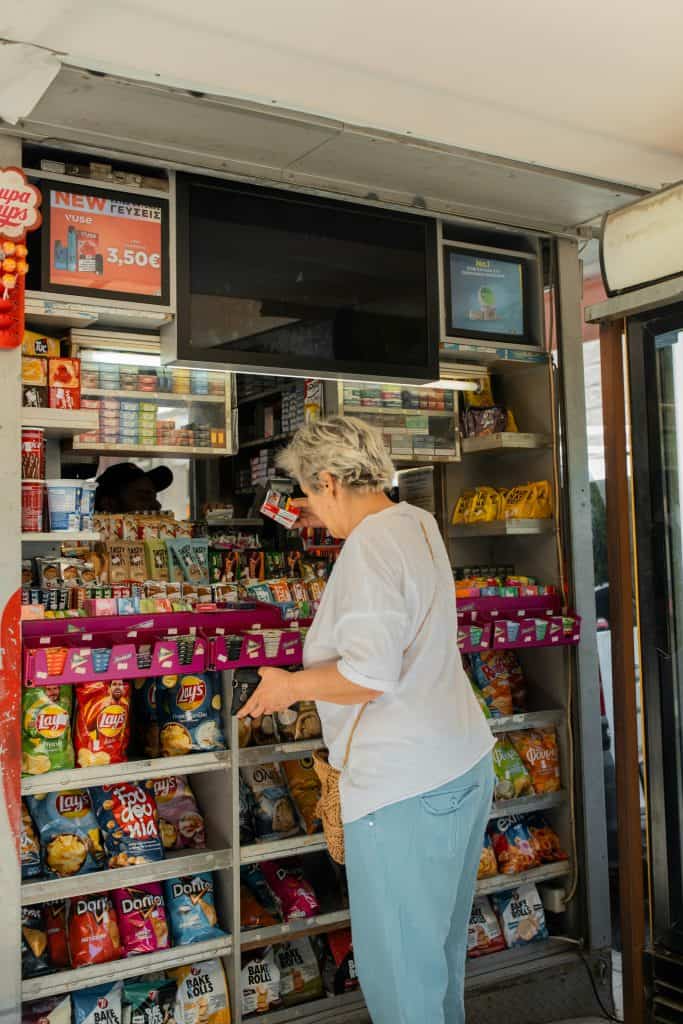
Greek law fixes maximum prices for a short list of basics sold to standing customers in what the legislation calls closed markets. The venue has to display the list somewhere visible and serve those items at those prices on request. Asking for it in English as “price control list” works.
The venues named in the law are the ones where a captive customer has nowhere else to go:
- Airports
- Ports and ships
- Trains and railway stations
- Archaeological sites and museums
- Stadiums and sports grounds
- Cinemas and theatres
- Hospitals
- Universities
- Courts
| Item | Maximum price |
|---|---|
| Bottled water, 500ml | €0.50, €0.60* |
| Bottled water, 750ml | €0.75, €0.90* |
| Greek coffee, single | €1.40, €1.50* |
| Filter coffee, single | €1.50, €1.60* |
| Espresso, single, hot or cold | €1.65, €1.80* |
| Cheese sandwich or toastie | €1.40, €1.60* |
| Ham and cheese sandwich or toastie | €1.60, €1.80* |
(*) These prices apply on ships and airports.
Two obligations sit on the business. It has to stock and sell the controlled items, and it has to display the price list somewhere customers can see it. Failing the second one is an offence on its own, separate from what gets charged at the till.
In March 2026 a canteen operating inside Asklepieio Voulas General Hospital (yes, inside a public institution) was fined €1,000 by the regional development authority for not having the list displayed.
The Video That Made Greeks Angry at Themselves
The reason this stopped being obscure was a short video.
In June 2026 someone filmed themselves asking for the price list at an airport café instead of paying the posted price for a coffee. It spread fast, first across TikTok and Instagram, then into Greek television coverage and a steady run of articles through the summer.
Plenty of Greeks were annoyed at the businesses. Plenty more were annoyed at themselves for having paid airport prices their whole lives without knowing there was an alternative behind the counter.
Greek outlets covered a piece of consumer legislation as a hack. A right that has existed for years, written into the market code, reported as though someone had found a loophole.
One line that gave me a lot of food for thought came from a piece on a Cretan site, was that social media had told younger generations something nobody else ever had.
Why This Keeps Happening
Underneath the rules there’s an attitude.
A certain part of the Greek population still works on the assumption that a tourist is wealthy, in a hurry, here once, and unlikely to argue.
I’ve watched the same kiosk charge me one price in Greek and quote a different one to the couple behind me in English. The reasoning, if anyone were pressed to say it out loud, would be that the season is short, the rent is high, and the people paying can afford it.
That thinking is fading, though. Card payments made a lot of the old flexibility harder. The receipt rules bite. Reviews travel, and a place that overcharges gets found out within a season.
What Restaurants Cannot Charge For
Apart from the price control list, there’s another set of rules about what businesses can and cannot charge for.
Cover charges are illegal. Restaurants, tavernas, cafés, fast food places, and entertainment venues cannot bill anyone for place settings, cutlery, or napkins. The fine is €500 per instance, and it applies even when the charge is printed on the menu. A taverna on Karpathos was fined for it, so this isn’t a dormant rule.
Bread and bottled water only on request. Nothing can arrive at a table and be charged for without the customer agreeing to it first. The basket of bread that lands unasked and appears on the bill is not legal, and neither is the bottle of water opened on arrival.
Menus must show final prices including VAT. Menus must be written in Greek, with other languages optional alongside.
Frozen and pre-cooked food has to be declared. Anything frozen carries the label “frozen” and pre-cooked or pre-fried items must say so. The type of oil used raw in dishes also has to be stated.
Card payment has to be available. A restaurant claiming the machine is broken is not offering a valid excuse.
The Receipt Rule
Greek menus carry a printed notice stating that the consumer is under no obligation to pay if they do not receive a legal receipt. No receipt, no obligation.
The rule exists to fight tax evasion rather than to protect, but it works either way. A bill that arrives handwritten on a scrap of paper, with no printed receipt behind it, is a bill nobody is required to settle.
Asking for the receipt is normal here and carries no social awkwardness. It also has a way of resolving disputed totals before the dispute starts.
Where Complaints Go
ECC Greece, for anyone from the EU, Norway or Iceland. The European Consumer Centre network is EU co-funded, operates in English, and the Greek branch runs under the Consumer Ombudsman. Its legal staff take complaints against Greek businesses for free and deal directly with the trader.
The Ombudsman’s own page on cross-border cases explains which centre to approach depending on country of residence, and complaints go through the ECC in the home country rather than the Greek one.
The Hellenic Consumer Ombudsman, an independent authority with an English site, handles disputes with suppliers directly. Mediation is free and there is a one-year window from the date of the incident.
The consumer line, 1520, run by the Ministry of Development, covers pricing disputes, illegal charges, and profiteering, and it’s the number behind the market inspections that produce the fines. The portal is Greek-only.
The tourist police, on 1571. English-speaking, and the quickest route for anything where a business has taken advantage of a foreign customer specifically. For taxi disputes, my Athens taxi guide covers the fare structure and the tariff number to check on the meter.
In practice, the threat of a receipt settles almost everything before it reaches that stage.
Final Thoughts
Athens is not a city built on ripping people off, and describing it that way would be both unfair and wrong. But the assumption is still there in enough places that knowing the rules changes what someone pays, which is the entire reason this article exists.
Ask for the price list where it applies. Ask for the receipt everywhere. Refuse bread nobody ordered.
For what a trip here costs once the overcharging is stripped out, my Athens cost guide has realistic daily figures, and what needs booking in advance covers where the real savings sit.