
Is Athens Expensive? 2026 Travel Cost Guide
Athens has a bit of a reputation problem when it comes to money.
Some still picture it as a cheap European capital. Others arrive expecting island-level prices and rooftop cocktails at €25. The truth really is somewhere in between.
Athens can be surprisingly affordable in some ways and unexpectedly expensive in others. Food, coffee, and everyday transport are easier on the budget than you might expect. Accommodation is where the surprise mostly happens.
So instead of vague answers, let’s break it down properly, with real numbers, realistic daily budgets, and the places where costs tend to creep up.
Just so you know: Some links on this page are affiliate links, which means I might earn a small commission if you book or buy through them, at no extra cost to you. Thank you for your support!
Is Athens Expensive to Visit in 2026?

Not necessarily, but it can be.
Athens is not cheap in the way Southeast Asia is cheap – or even parts of the Balkans. But compared with many capitals in central and northern Europe, it’s still more manageable.
Food can be very reasonable, public transport is inexpensive, and museum tickets are not wildly out of line with the likes of Rome or Paris.
Where things rise quickly is accommodation, mainly from May to September and holiday seasons. Add touristy restaurants, rooftop bars, and last-minute booking choices, and the budget changes fast.
Money is only part of planning a trip, of course. I explain a few everyday details about the city in my Athens travel tips guide.
Athens Compared to Other European Cities
Athens is cheaper than Paris, London, or Amsterdam when it comes to food and everyday spending.
A proper meal in a non-touristy restaurant in the city centre will mostly land somewhere around €15-25 per person. Coffee is not cheaper than most of Europe, but alcohol tends to be a bit easier on the budget.
The place where Athens has become less “budget-friendly” is summer accommodation. During high season, hotel prices in Plaka, Monastiraki, and Koukaki can compete with cities such as Barcelona.
Athens Compared to the United States
For American travellers, Athens is fairly affordable.
A proper dinner for $20-25 per person, even with wine, is very realistic. Public transport costs very little, and most museum tickets fall somewhere in the $10-20 range, depending on the site.
Compared with New York, San Francisco, or Miami, everyday spending in Athens is noticeably lower.
Hotels are where the gap narrows. In peak season, a well-rated boutique hotel can easily cost $200-350 per night. In winter, that same room might drop closer to $120-180.
So Athens is somewhere in the middle. It’s not ultra-cheap, but not painfully expensive either. With a bit of planning, it’s still easy to have a very good trip without overspending.
How Much do you Need per day in Athens?

I can imagine this is the main reason you clicked on this article.
My honest answer is that daily budget depends less on food and more on where you sleep. Accommodation is the biggest variable in Athens. Everything else, transport, museums, coffee, even proper dinners, is manageable.
Let’s now see what a realistic daily budget looks like in 2026, excluding flights.
Athens for Budget Travelers
Cost estimate: €70-€110 / $75-$120 per day.
This assumes:
- Hostel dorm or simple budget hotel (€30-€75 / $35-$80).
- Street food or local tavernas (€10-€25 total per meal / $12-$27).
- Public transport (€1.20 per ride / ~$1.30).
- One paid sight per day (€10-€20 / $11-$22).
You won’t be sleeping with an Acropolis view on this budget, but you can still eat well and see a lot.
Athens for Mid-Range Travelers
Cost estimate: €140-€230 | $150-$250 per day
This is probably the most realistic range.
It assumes:
- Well-rated boutique or 3-4 star hotel (€110-€200 / $120-$220 depending on season).
- Proper dinners (€15-€35 per meal / $17-$38).
- Museums and maybe one organized tour (€15-€40 / $16-$45).
- Occasional taxis (€10-15 / $11-$17).
At this level, you can comfortably visit Athens. You can stay in a good hotel in a nice neighbourhood, have a rooftop drink once or twice, and not think about every euro all day.
Athens for Luxury Travelers
Cost estimate: €280-€550+ | $300-$600+ per day
This includes:
- Luxury or high-end boutique hotel (€250-€650 / $270-$700 in peak season).
- Rooftop restaurants with Acropolis views (€30-€60 total per meal / $35-$65).
- Private tours or luxury experiences (€80-€200+ / $88-$200).
- Frequent taxis (€10-15 / $11-$17 per ride).
Even at this level, Athens is still less extreme than other major luxury city breaks.
A Quick Reality Check
For a lot of trips, the final number ends up somewhere in the middle.
In high season, a realistic total will land around €140-€230 ($150-$250) per day, all in. In winter, that can drop by 25-40%, mostly because hotel prices come down.
For a rough total trip cost, multiply your daily budget by:
- 3-4 days for a classic Athens visit.
- 5-6 days if you’re including museums, tours, and maybe 1-2 riviera nights.
If you’re doing your Athens planning, make sure to check out my 3-day itinerary suggestion.
Accommodation Costs in Athens

Accommodation is the biggest variable in an Athens budget.
This is where costs can shift quickly, sometimes more than anything else combined.
For a city of this size and popularity, Athens doesn’t actually have a huge hotel supply, which is why good central places fill faster than many people expect.
Budget Hotels in Athens
Price estimate: €60-€120 / $65-$130 per night (double room).
In winter, clean and well-rated budget hotels in central areas can still be found for under €80 / $88. In summer, that same room can easily rise above €120 / $132.
Staying in Syntagma, Monastiraki, or Koukaki on a budget is absolutely possible. Just don’t expect anything especially stylish or spacious at that level.
Boutique & Mid-Range Hotels in Athens
Price estimate: €130-€250 | $140-$270 per night
This is where Athens does quite well.
At this level, it’s possible to find boutique hotels with good design, strong locations, and proper air conditioning – which matters a lot more than people think in summer.
During the warmer months, well-rated central boutique hotels often land in the €180-€250 ($190-$270) range. In winter, those same rooms can drop to around €130-€160 ($140-$170).
If you’re unsure where to look, this is the category I break down in detail in my boutique hotels in Athens guide.
Luxury & Acropolis View Hotels
Price estimate: €280-€700+ / $300-$750+ per night
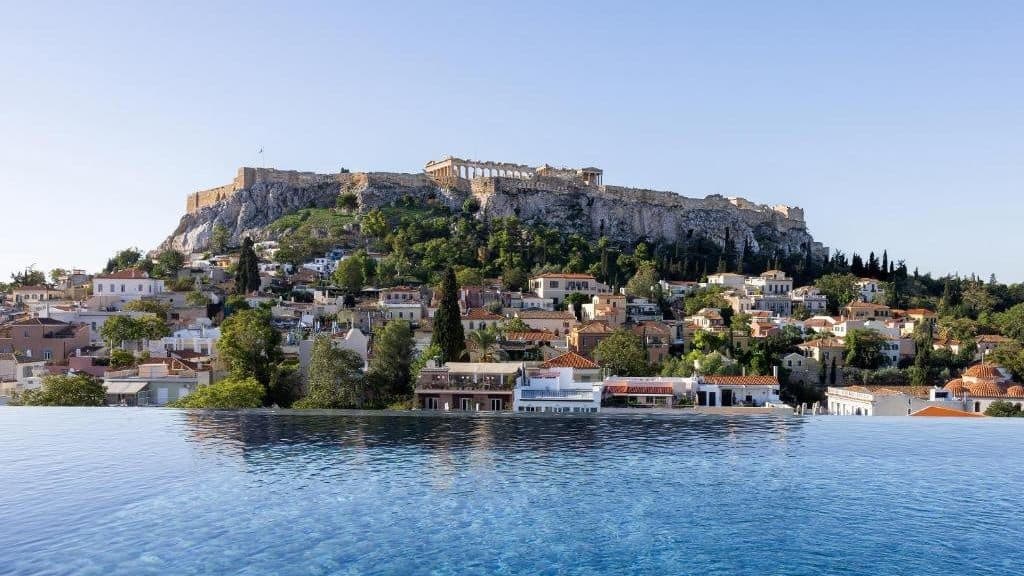
This is where prices climb quickly, especially when a direct Acropolis view is part of the room.
At that point, you’re paying for a mix of location, rooftop views, service level, and extras like spa facilities or concierge support. A standard luxury room may start around €280-€350 in shoulder season.
In peak summer, premium suites with direct Acropolis views can move well beyond €600-€800 per night.
Sometimes that premium is worth it. Sometimes you’re paying more for the angle of the balcony than for the room itself. I’ve broken that down properly in my guide to hotels with Acropolis views, including which ones are actually worth the extra cost.
Food & Drink Prices in Athens

Food is where Athens can be fairly inexpensive, but only when you don’t exclusively eat under the Acropolis with a laminated photo menu.
It’s very easy to eat well here without spending much. Prices rise quickly, though, depending on location, view, and how heavily a place leans on tourists.
Coffee Prices
Coffee is not optional in Greece. It’s part of the daily rhythm.
- Espresso / Freddo espresso: €2.00-€3.50 / $2.20-$3.80
- Cappuccino / Freddo cappuccino: €2.50-€4.00 / $2.70-$4.40
- Specialty coffee place (Kolonaki, Pangrati, Koukaki): €3.50-€4.50 / $3.80-$5.00
Sit down in a busy central square with table service and the price goes up. Grab takeaway from a neighbourhood café and it drops a bit, partly because of the lower VAT.
Compared with most US cities, coffee in Athens is affordable. Compared with Italy or Spain, it can be slightly higher in cost.
Street Food & Quick Meals
Athens does quick food very well.
- Souvlaki wrap (gyro in pita): €3.00-€4.50 / $3.30-$5.00
- Portion of souvlaki (plate): €8-€12 / $9-$13
- Spanakopita or tiropita (traditional greek pies at a bakery): €2.00-€3.50 / $2.20-$3.80
- Bakery sandwich: €3-€5 / $3.30-$5.50
Keeping things to bakeries, souvlaki spots, and quick local places makes it very easy to eat for under €10 / $11 per person.
Even on touristier streets, street food remains one of the better-value categories in the city.
Greek Tavernas
Street food is great, but at some point a proper meal is the whole point.
Typical prices:
- Greek salad: €6-€10 / $6.50-$11
- Meze plates: €5-€12 / $5.50-$13
- Main dish (grilled meat, seafood, pasta): €12-€20 / $13-$22
- House wine (½ liter): €6-€10 / $6.50-$11
- Beer: €4-€6 / $4.50-$6.50
A realistic dinner for two with shared plates and wine is often €35-€60 / $38-$65 total.
In the most central streets, prices creep up and quality is less reliable. Walk one or two streets away and things often improve immediately.
And for plant-based food, Athens has plenty of options. I’ve listed proper recommendations in my guide to vegan spots in Athens.
Rooftop Bars & Tourist Areas
This is where budgets can quietly disappear.
- Cocktail in a rooftop bar with Acropolis view: €12-€18 / $13-$20
- Glass of wine: €8-€14 / $9-$15
- Beer: €6-€9 / $6.50-$10
At that point, you’re paying for the view, not the drink.
One rooftop evening won’t ruin your budget. Turning it into a nightly habit is a different story.
My Take
Athens can be cheap when you eat locally, moderate when you mix cafés and tavernas, and expensive very quickly when every meal comes with a view.
The good news is that this part of the budget is still fairly easy to control.
Eat where locals eat, don’t panic-order on the first street below the Acropolis, and food costs stay very reasonable even in high season.
Sightseeing & Attraction Costs

Athens is surprisingly manageable when it comes to sightseeing – at least until the Acropolis ticket enters the picture.
The real difference in cost depends on how many ticketed sites you decide to enter, and whether you start adding guided tours, skip-the-line options, or extra experiences on top.
And honestly, not every ancient site in Athens needs to be entered to be appreciated. Plenty are perfectly enjoyable from the outside, and I’ve explained that in my guide to the best things to do in Athens.
Acropolis & Archaeological Sites
The Acropolis is the ticket almost everyone ends up buying – and yes, it’s worth it.
A standard entry ticket costs €30 / about $33.
There used to be a combined archaeological pass covering several major sites around the city, but that option no longer exists.
Museum Entry Prices
Museum prices in Athens are not that high for European standards.
- Acropolis Museum: €20 / $22.
- National Archaeological Museum: €20 / $22.
- Benaki Museum: €12 / $13
- Most other museums: €5-€10 / $5-$11
So even a full museum day doesn’t have to become expensive. Two or three museum visits can still land under €30 / $33 total, depending on what you choose.
Another useful detail: most museums, though not the Acropolis Museum, offer free entry on the first and third Sunday of each month from November through March. With flexible dates, that can reduce costs quite a bit.
And if museums are a priority, I’ve put together a guide to museums in Athens beyond the Acropolis Museum.
Transport Costs in Athens

Transport is not the part of an Athens trip that will ruin your budget.
In fact, getting around is fairly affordable once you understand when to walk, when to use the metro, and when a taxi is worth the annoyance.
The city centre is compact enough that a lot of movement happens on foot.
The bigger transport costs tend to come from airport transfers and, occasionally, taxis when the heat becomes unbearable or timing is tight.
Airport to City Centre
Athens International Airport sits about 35-45 minutes from central Athens.
The metro (Line 3) costs €9 / about $10 one way and connects directly with Syntagma and Monastiraki. It runs roughly every 30 minutes and is the most predictable option.
The X95 airport bus to Syntagma costs €5.50 / about $6 and runs 24/7. It’s slower, but useful for very late arrivals or departures when the metro is no longer running.
That’s why the metro is my first choice during the day, while the bus in the middle of the night.
Taxis are a different story. Sometimes they are worth it after a long flight, with heavy luggage, or in extreme summer heat, but Athens taxis come with enough small frustrations that I would never treat them as the default option.
Public Transport in the City
Once you’re in the city centre, transport costs drop.
Stay somewhere like Koukaki, Plaka, Monastiraki, or Syntagma and most of the city becomes walkable. In that case, the metro is more of a backup than something you’ll rely on constantly.
A single public transport ticket costs €1.20 / about $1.30, lasts 90 minutes, and covers multiple rides within that period.
There’s also a 24-hour ticket for €4.10 / about $4.50.
I wouldn’t overcomplicate this by buying passes “just in case”. Central Athens is fairly walkable.
Do You Need a Taxi?
Not very often.
A taxi becomes useful late at night after the metro has closed, on the way back from the Riviera, for very early airport or ferry departures, or on those days when it’s 38°C (100.4°F) and walking stops being a noble idea.
Short rides in the city cost somewhere around €5-€20 ($5.5-$21), depending on distance and traffic.
The important part is how you book it, and I’d strongly recommend using an app. Uber works in Athens, but it connects you with a licensed taxi rather than a private driver. That will remove most of the nonsense.
Traffic is also worth taking seriously. A ride that looks like ten minutes on the map can easily become twenty-five during rush hour. When a flight or ferry is involved, it can easily make you anxious.
The Bottom Line on Transport Costs
Stay central and transport inside the city will cost very little.
Across many days, metro rides add up to no more than €10-€20 total. The airport transfer is the main fixed expense.
Athens is not an expensive city to move around, as long as your hotel is in the right area.
When Is Athens Cheapest?
Athens is not expensive all year round. But prices change a lot depending on the season.
By now the pattern is probably obvious. Accommodation will be your biggest expense. Flights depend on where you’re coming from, and summer demand pushes everything up – hotels first, but also things like rooftop bars and organized tours.
Cheapest Months for Hotels
The cheapest months for hotels in Athens are January and February.
Once the holidays are over, tourism drops, island traffic disappears, and hotel availability opens up. In practical terms, that can make a big difference.
A boutique hotel charging €220-€300 ($240-$325) in June might drop to €120-€160 ($130-$175) in January.
A mid-range hotel sitting around €180 ($195) in summer can fall closer to €100-€130 ($110-$140) in winter.
Even some Acropolis-view hotels become far more accessible.
March is still fairly affordable. November can also offer good value, though the weather is a bit less reliable.
So if budget matters more than anything else, winter wins. If you want lower prices without giving up milder weather, late March or early November make a good compromise.
Cheapest Months for Flights
Flights depend on origin, but the broader pattern stays the same.
The cheapest months to fly into Athens are usually January, February, and sometimes early March. Demand is at its lowest then, especially from North America and Australia.
April, May, and October sit somewhere in the middle – cheaper than peak summer, but rarely as cheap as winter.
From the US, the biggest savings often appear in winter. Late September and early October can also work well, especially when the goal is balancing decent weather with less painful airfare.
And when Athens is part of a wider Greece trip, it’s worth remembering that once mid-June arrives, both flights and ferries start climbing.
Where People Overspend in Athens (And How to Avoid It)

It’s very easy to spend more than planned in Athens without noticing.
The budget usually doesn’t collapse because of one big expense. It happens through small choices that repeat themselves – rooftop drinks, touristy meals, unnecessary taxis.
Rooftop Drinks
Let’s start with the obvious one.
Acropolis-view rooftops are beautiful. That part is true. They’re also expensive.
A cocktail around Monastiraki or Syntagma can easily cost €14-€20 ($15-$22), and sometimes more if the place leans into “signature” drinks. Two people, two rounds, and suddenly €60-€80 ($65-$85) are gone.
My advice is to do one proper rooftop evening. Go around sunset, enjoy it, and leave it there.
For the rest of the trip, drink Koukaki, Psirri, Pangrati, or Petralona, where cocktails are closer to €8-€12 ($9-$13).
Tourist Menus
This is another easy way to overpay.
When someone is standing outside trying to pull you in, the menu has photos of every dish, and “Authentic Greek Menu €25” is written in four languages, the odds are not in your favor.
In those places, basic dishes can climb to €18-€22 ($20-$24), bottled water somehow costs €4-€6 ($4-$7), and alcohol is marked up far beyond what makes sense.
By Athens standards, that’s expensive.
And the food is often mediocre.
Walk one street away and the same meal can cost €12-€18 ($13-$20) with far better quality. A good rule here is very simple: short menu, busy tables, plenty of locals.
Unnecessary Transport
Taxis are another quiet budget leak.
A single ride inside the centre might cost €8-€15 ($9-$16). Do that several times a day and the total adds up quickly.
This is why location in Athens is so important. Stay somewhere walkable, use the metro for longer jumps, and save taxis for late nights, exhaustion, or airport and ferry runs.
The mistake I see all the time is booking a cheaper hotel outside the centre, then spending the difference on daily transport back into it.
In Athens, a better location saves money in the end.
Sample 3-Day Athens Budget (Realistic Example)

Let’s make this practical.
Here’s what a realistic 3-day trip to Athens can look like in 2026, based on current average prices. This assumes a central stay, plenty of walking, an Acropolis ticket, proper meals, and at least one rooftop drink.
These are per-person estimates and do not include international flights.
Budget Version
Estimated Total (3 Days Budget): €210-€290 / $230-$315.
This covers a simple hotel or budget stay, street food and casual tavernas, public transport, and very limited splurges.
- Accommodation (3 nights): €90-€120 / $100-$130 total (€30-€40 per night in a budget hotel or shared accommodation).
- Food & Drinks (3 days): €75-€105 / $80-$115 total (€25-€35 per day for coffee, street food, simple dinners, and 1 drink).
- Attractions: €30-€40 / $32-$45 for an Acropolis ticket and maybe one additional museum.
- Transport: €20-€30 / $22-$33 for an Airport metro round trip and a few city rides.
Mid-Range Version
Estimated Total (3 Days Mid-Range): €500-€760 / $550-$825.
This is the range I’d call the most realistic for a comfortable trip. It includes a good central hotel, proper dinners, the main sights, and a couple of drinks without checking the price every time.
- Accommodation (3 nights): €300-€480 / $330-$520 total (€100-€160 per night in a central boutique or mid-range hotel).
- Food & Drinks (3 days): €135-€180 / $150-$195 total (€45-€60 per day for dinners, coffee stops, 1-2 drinks).
- Attractions: €40-€60 / $45-$65 total (Acropolis and 1-2 museums).
- Transport: €25-€40 / $27-$45 total (Airport transfer, metro, and maybe one taxi ride).
Luxury Version
Estimated Total (3 Days Comfortable): €1,100-€2,000+ / $1,200-$2,200+/
This is the version with Acropolis-view hotels, rooftop restaurants, frequent taxis, and very little compromise.
- Accommodation (3 nights): €750-€1,500+ / $820-$1,650+ (~€250-€500 per night depending on view and season)
- Food & Drinks (3 days): €210-€300 / $230-$330 (€70-€100 per day including rooftop dinners or wine)
- Attractions & Tours: €80-€150 / $90-$165 (Skip-the-line tickets, guided tour, maybe a half-day trip)
- Transport: €40-€70 / $45-$75 ( Airport and city taxis)
Is Athens Worth the Price?

Yes.
Athens is no longer the bargain it may have been ten years ago, but it still offers very good value compared with a lot of European capitals.
A central hotel, proper food, good coffee, and a few paid sights can still cost less than the same kind of trip in much of Western Europe with careful planning.
Is Athens Cheaper Than the Greek Islands?
Yes, and the difference is noticeable.
Athens is a capital city with prices shaped by people who live there. The islands on the other hand run on a much more seasonal model. Short season, heavy demand, higher prices.
A mid-range hotel in Athens might cost around €120-€180 ($130-$195) per night in summer. On Santorini, Mykonos, or Paros in July or August, that same budget can get you something much more basic – or something far from the beach and the centre.
The same applies to food. In Athens, a very good dinner at a proper taverna can still land around €15-€20 ($16-$22). On some islands, the same kind of meal can climb to €25-€35 ($27-$38), especially near the waterfront.
That said, not every island is expensive. Less touristy islands can be comparable to Athens. But in general, Athens is easier on the budget than Greece’s best-known island destinations.
Can You Visit Athens on $100 a Day?

Yes, but it depends on what that $100 covers.
If we’re talking $100 (€90-€95) per day excluding accommodation, it’s very doable. You can visit one major archaeological site, eat two proper meals, have coffee and maybe a drink, use public transport, and avoid obvious tourist traps.
If we’re talking $100 including accommodation, it becomes tighter. You would need a hostel dorm or very basic budget hotel, street food or casual meals, limited paid attractions, and minimal taxis or paid experiences
In winter season, it’s much more realistic. In July and August, it’s possible but requires planning and flexibility.
Athens rewards simplicity. Walk a lot. Choose one main paid site per day. Eat where locals eat. Skip the €18 rooftop cocktail every night. That’s how you stay under budget without feeling deprived.
FAQ: Athens on a Budget
1. Is Athens expensive?
Not by Western European capital standards.
Athens is somewhere in the middle. It’s cheaper than Paris, Amsterdam, or London, but not as cheap as the eastern Balkans or south-eastern Asia.
2. Is Athens cheaper than Mykonos or Santorini?
Almost always.
Those islands run on short high seasons and heavy demand, which pushes prices up fast. Athens has more competition, more year-round life, and far more options at different price levels.
3. Are rooftop bars worth it?
Sometimes.
You’re paying for the view more than the drink. That can be worth it once. Repeating it every night is where the budget starts leaking for no good reason.
4. Is public transport expensive?
No. It’s actually one of the cheaper parts of the trip.
The airport metro costs more than a normal ticket, but transport inside the city is inexpensive enough that it rarely becomes a budget problem.
5. Are museums and archaeological sites expensive?
Moderately.
The Acropolis is the main expensive ticket. Many museums are more reasonable, and several offer free or discounted entry on certain dates.
6. When is Athens at its cheapest?
January and February are the lowest point for hotel prices.
Flights can also be cheaper then, outside holiday periods. April and October are the better compromise when lower prices matter but winter doesn’t appeal.
7. What’s the biggest budget mistake?
Saving money on the hotel and losing it again on the location.
A cheaper room outside the centre often means more transport, more time wasted, and less flexibility. In Athens, staying central often saves money in the end.ually saves money overall.
Final Thoughts
Athens is no longer the bargain it once was, but it’s still far from the most expensive city in Europe.
A lot comes down to timing, hotel choice, and the small decisions that repeat themselves throughout a trip. Stay central, avoid the obvious tourist traps, and keep a bit of balance between splurges and everyday places, and the city stays very manageable.
Athens can work on a tighter budget. It can also become expensive very quickly.
That gap is what matters most, and it’s largely in your hands.