Athens Safety Guide for First-Time Visitors
Athens is safe to visit. Violent crime against visitors is rare, and in a recent global safety index measuring pickpocketing and scams, the city ranked 15th worldwide and 19th overall.
That’s well below cities like Paris, Rome, or Bangkok in reported tourist thefts.
The real risks are petty, for example pickpocketing in crowded spots and the occasional taxi overcharge. It’s rarely anything more serious than that.
That said, I’ve heard just about everything when it comes to safety here.
Scroll long enough online and you’ll find warnings about protests, pickpocketing, “sketchy areas,” and advice to avoid half the city.
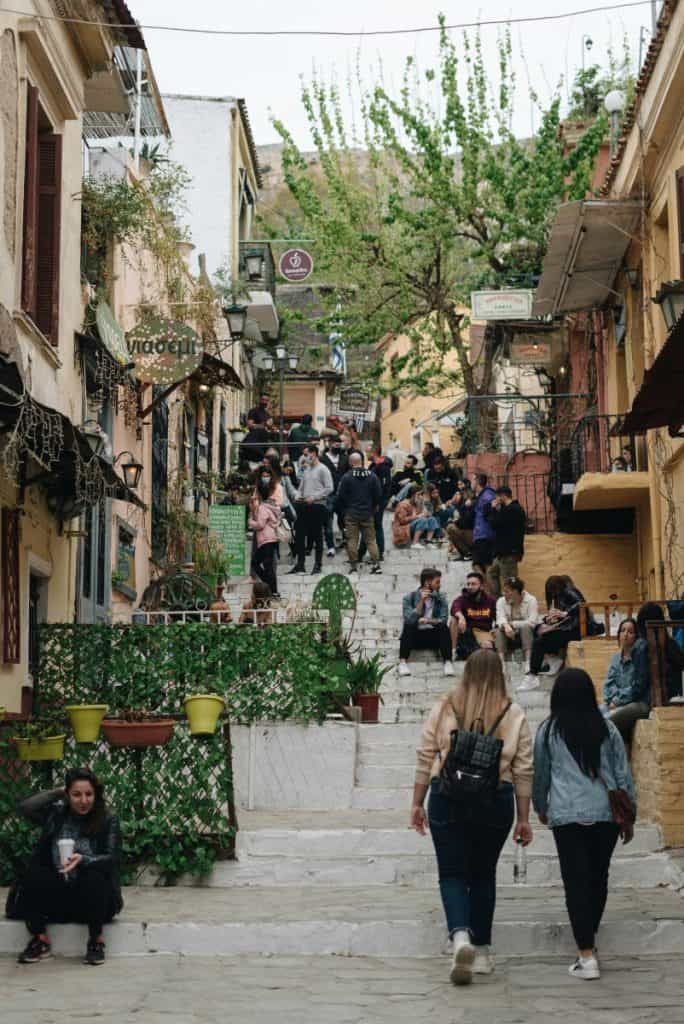
But then you actually arrive, and you see families in Plaka, couples taking sunset photos on Filopappou Hill, students drinking coffee in Exarcheia, and people wandering around Monastiraki with shopping bags and ice cream.
Athens isn’t a perfect city. It’s messy, loud, and chaotic in places. But messy doesn’t mean dangerous. That said, it isn’t a city where you can leave your belongings unattended without a second thought either.
Below is a breakdown of what’s actually worth paying attention to, neighborhood by neighborhood and situation by situation.
Oh, and as a gift, I’ll also tell you how you can get free electronics theft coverage for your trip.
Just so you know: Some links on this page are affiliate links, which means I might earn a small commission if you book or buy through them, at no extra cost to you. Thank you for your support!
Quick Safety Tips
If you don’t have time to read the whole thing, here’s the short version:
- If you’re lost or uncomfortable, step into a café, kiosk (periptero), or shop. People will help, and English is widely spoken in central areas. It also helps to just have data on you in the first place, so you can pull up a map or a taxi app before you’re actually lost – I put together a guide to SIM cards and eSIMs in Athens, if you haven’t sorted that yet.
- Keep your phone in a front pocket in crowded areas, especially on the metro between the airport and Syntagma/Monastiraki. Don’t hold it loosely near the doors when trains are stopping. (Full details on the ride in from the airport are in my Athens airport guide.)
- Use taxi apps instead of flagging cars on the street at night. They give you route tracking, price transparency, and driver details, which removes most of the usual taxi headaches. (See my full Athens taxi guide for fares and how to avoid getting overcharged.)
- Avoid empty side streets around Omonia late at night. Not because something will definitely happen, but because there’s no reason to test it when a livelier street is one block over.
- Don’t flash valuables in busy squares. Monastiraki, Syntagma, and Ermou Street get crowded. Keep bags zipped and worn in front.
- If you run into a protest, just walk away. Change direction if you see police gathering or roads closing. Protests in Athens are contained and predictable.
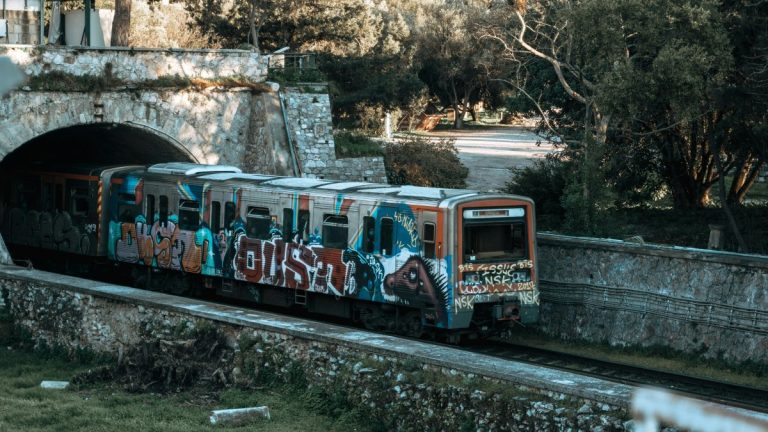
- Calibrate your instincts. Athens looks gritty in parts (graffiti, older buildings, loud streets). Learn to tell the difference between “not pretty” and “not safe.”
Pickpocketing
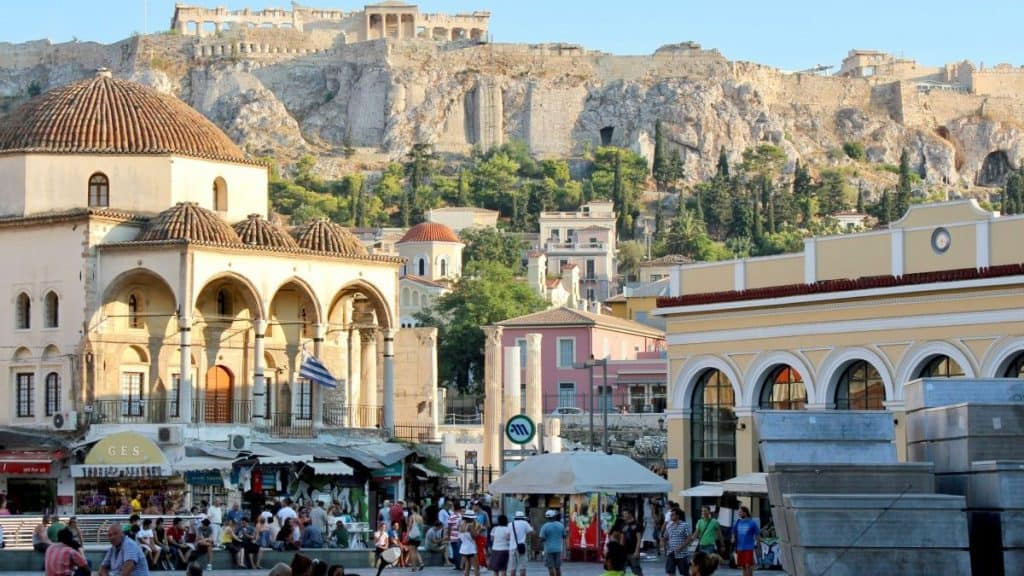
If there’s one issue that is really worth paying attention to, it’s pickpocketing.
Not because it is a very big issue, but because crowded places create the right conditions for that kind of theft – and Athens has plenty of crowded places.
It tends to happen in the same spots over and over, those being Monastiraki and Syntagma squares, busy metro stations, and packed trains.
Typical setups include someone “accidentally” bumping into you, a group blocking the metro doors while you’re trying to exit, a stranger asking for directions while standing too close, or a sudden commotion that pulls your attention away for ten seconds.
Typical scenarios include someone “accidentally” bumping into you, a group blocking the metro door while you’re trying to exit, someone asking for directions while standing too close or a sudden commotion draws your attention for 10 seconds.
Or just combinations of the above.
Here’s what I do to avoid being an easy target:
- Backpack: zippers closed, bag worn facing forward in crowds.
- Phone: never loose in a back pocket.
- Wallet: never in an open tote bag.
- Metro: a bit of extra awareness right as the doors open at crowded stops.
Even with all that, no amount of zipped pockets makes you pickpocket-proof – it just lowers the odds. So the backup plan is equally important.
I travel with SafetyWing’s Nomad Insurance, and the reason I bring it up here specifically is a small, easy-to-miss perk: if you’re a first-time SafetyWing member, there’s a hidden reward tucked into their Nomad Insurance landing page right now. A little pink Polaroid camera.
Click it, and you’ll be prompted to enter a code. Use SAFEATHENS, and you unlock two months of free electronics theft coverage on top of your plan, which is exactly the kind of thing worth having in a city where a stolen phone is a far more realistic risk than anything else on this page.
The redemption has to happen in this order, so don’t skip ahead:
- Go to the Nomad Insurance page and find the pink Polaroid camera hidden on it.
- Click it, and enter the code SAFEATHENS when prompted.
- Wait for the confirmation that the code’s been validated.
- Only then create your SafetyWing account and buy an Essential plan with the Electronics Theft add-on – the reward attaches automatically at that point.

It’s only for people who’ve never had a SafetyWing account before, and one worth reading before you buy: the two months are free, but the add-on then rolls into paid coverage automatically unless you cancel it from your dashboard before the first paid billing date.
Cancelling costs nothing and takes a couple of clicks, so it’s easy to just set a reminder for day 50-something and decide then.
Protests
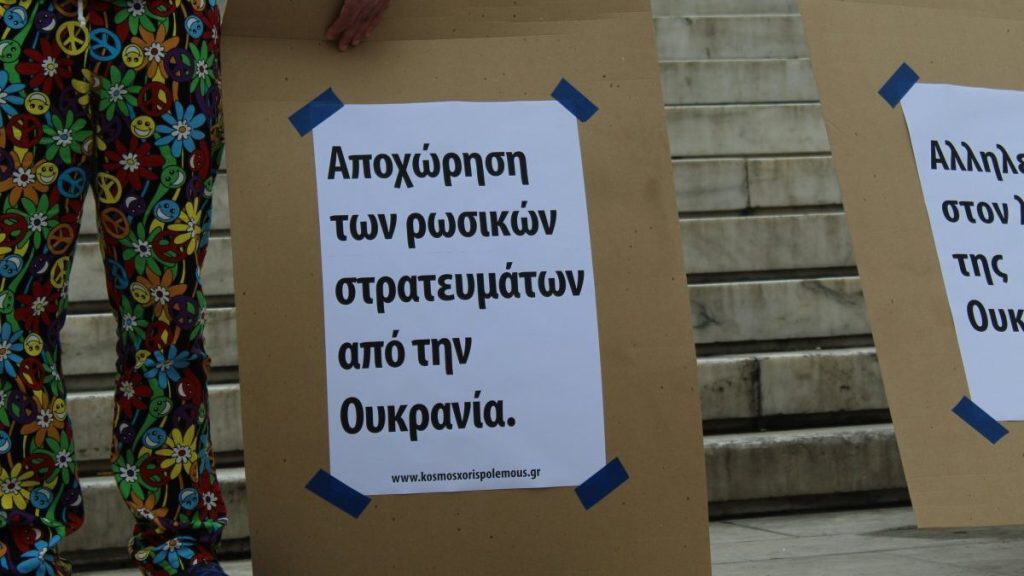
Athens does have protests, however most of them are planned, easy to spot, and even easier to avoid.
By law, protests have to be scheduled and announced in advance. They usually follow the same routes, and concentrate around Syntagma Square and the main avenues.
They are mostly marches, banners, chants, and street closures. The “dramatic” moments are the ones that make headlines, not the ones that really define daily life in the city.
There are, however, a few dates that bring larger crowds, more police presence, and a louder atmosphere in the centre.
- 6 December (the anniversary of a policeman murdering a student in 2008).
- 17 November (Athens technical University uprising anniversary).
- 28 February (the anniversary of the Tempi train crash).
The actual effect on a trip is limited.
At most, it might mean a few streets around Syntagma closing for a couple hours, a metro station shutting briefly near the protest route, or more traffic in the centre.
When something larger is planned, just avoid the immediate area around Syntagma for 1-2 hours and continue elsewhere.
Athens is not really a city where one protest shuts everything down. Well, with the above few exceptions.
“Dangerous” Areas in Athens
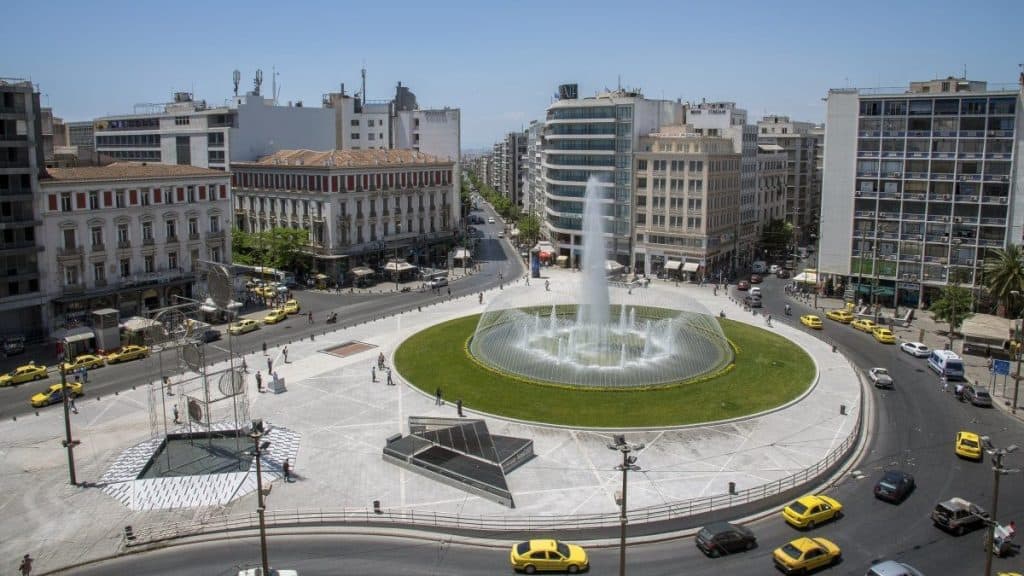
I’m not a fan of the phrase “dangerous areas,” because I don’t think any neighborhood in Athens is inherently dangerous. That said, some places can feel uneasy, especially on a first visit, when the visual contrast catches you off guard.
The neighborhoods that come up most often are Omonia, parts of Metaxourgio, and some streets around Larissis Station. These areas have gone through long cycles of decline, partial redevelopment, and uneven change. Some streets are improving fast, others still look neglected.
What people usually mean by “dangerous” here is really visible poverty, some drug use on certain corners, poor lighting on side streets, and blocks that empty out after dark.
Take Omonia for example. Walking through it during the day is absolutely not a problem. At night, some nearby streets can make you feel uncomfortable due to the reasons i mentioned above.
Metaxourgio is a little bit more complicated because it changes from block to block. One street can have boutique hotels, luxurious apartments and wine bars, and the next can look completely different.
On the other hand, Larissis Station is mostly functional, more train-station-adjacent than anything else..
The important thing is that these are not the parts of Athens where you’ll probably end up to. Stick to well-lit areas with people around and you’ll be completely fine.
Safety at Night
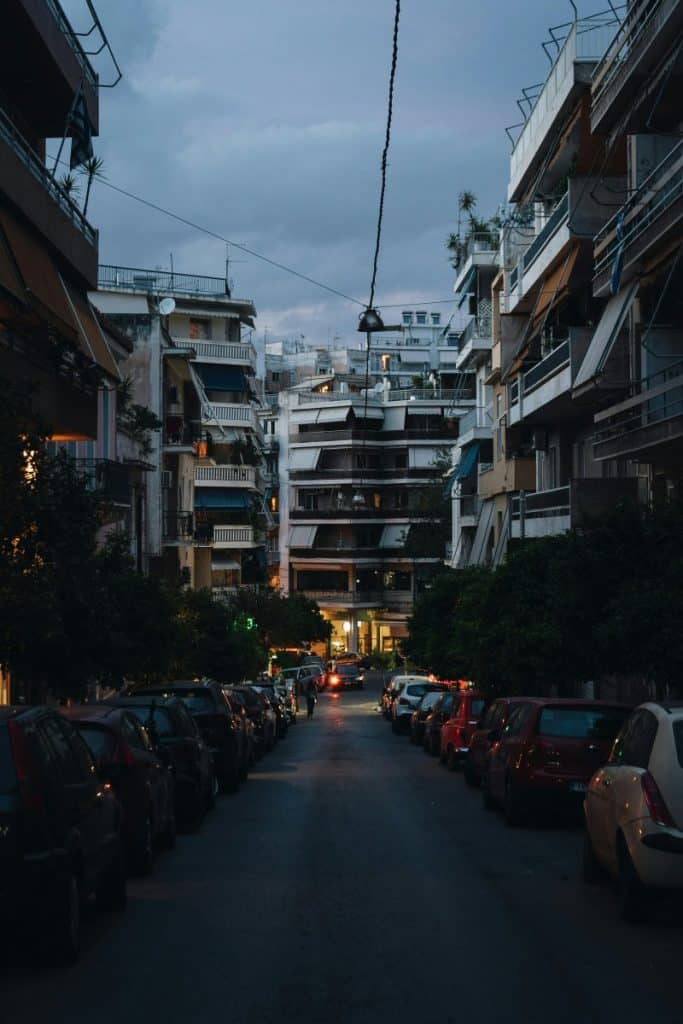
This is another topic where I think Athens gets misread.
The Athenian nightlife is in my opinion one of the best in Europe. The central areas stay active well into the evening. Restaurants and bars are full, people are outside, while in summer the city barely starts dinner before 9pm.
The exceptions are the areas mentioned above, mostly because of poor lighting and streets that look emptier than they actually are. When that happens, the easiest fix is just to take the next parallel street instead.
Some blocks get quieter after dark and others stay loud, and that contrast is normal, not a warning sign on its own.
Solo Female Travel in Athens
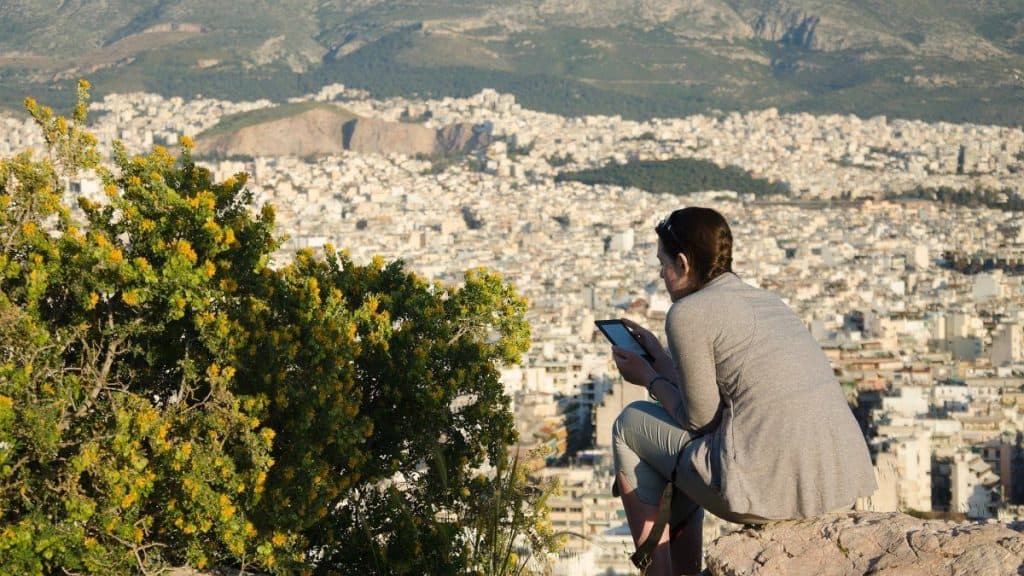
Athens isn’t a city where constant harassment is part of the experience, but it’s also not one where I’d suggest switching off entirely. It sits somewhere in the middle, similar to most Southern European capitals.
In central neighborhoods like Koukaki, Plaka, Kolonaki, Syntagma, and most of Monastiraki, walking alone (day or night) isn’t something that draws attention.
Coffee or dinner solo, walking back to your hotel late, none of it stands out. (If you’re still deciding where to stay, here’s my full breakdown of where to stay in Athens, area by area).
That said, you might get some staring, the occasional comment, or men trying to strike up conversation in nightlife areas. It’s more annoying than threatening most of the time. For getting around after dark, an app-booked taxi is the safest and easiest option.
Common Scams to Watch For
Scams are not that common in Athens, but there are a few small, predictable things worth knowing.
1. The “helpful stranger” at the metro: This tends to happen around ticket machines in busy stations like Syntagma or Monastiraki. Someone offers to help with the machine, gets a little too involved, and it’s either just awkward (or a distraction while someone else eyes your wallet or card). Decline politely, use the machine yourself, or head to the ticket desk instead.
2. Taxi overcharging: Probably the most common annoyance, especially near the airport and major tourist spots. Taxis in Athens are regulated, but issues can crop up when you hail one straight off the street. I am talking about a “broken” meter, a needlessly long route, or someone claiming the airport doesn’t have a fixed fare. I stick to FREE NOW or Uber, which connect you with licensed taxis and remove most of the guesswork. My Athens taxi guide covers fares and every common trick in detail.
3. The bracelet / “gift” trick Less common here than in some other cities, but it still shows up occasionally. Someone approaches with a bracelet, flower, or small object, places it in your hand, then asks for money. The easiest fix is to not engage in the first place. Don’t take anything, don’t stop walking.
Emergency Numbers to Save Before You Go
Odds are you won’t need any of these, but it’s worth having them saved rather than trying to find them mid-panic:
- 112 – general emergency number, works EU-wide, connects you to police, ambulance, or fire depending on what you say. English-speaking operators.
- 100 – Police
- 166 – Ambulance (EKAB)
- 199 – Fire Department
- 171 – Tourist Police, specifically for tourist issues like theft, scams, or overcharging, and they’ll deal with you in English
For anything that isn’t urgent (reporting a theft after the fact, for instance) it’s actually better to go to the nearest police station in person rather than call, since that’s where you’ll need to file the report anyway if you need it for an insurance claim.
Final thoughts
Athens is not a dangerous city.
If you stay aware in crowded places, choose your accommodation carefully, and use basic city common sense, you’re extremely unlikely to have a problem.
Don’t let overdramatic headlines shape your expectations. Come informed, aware, and you’ll most likely leave wondering why you were worried in the first place.
And once safety is no longer the question, planning the trip becomes much easier – here’s how I’d plan 3 days in the city.