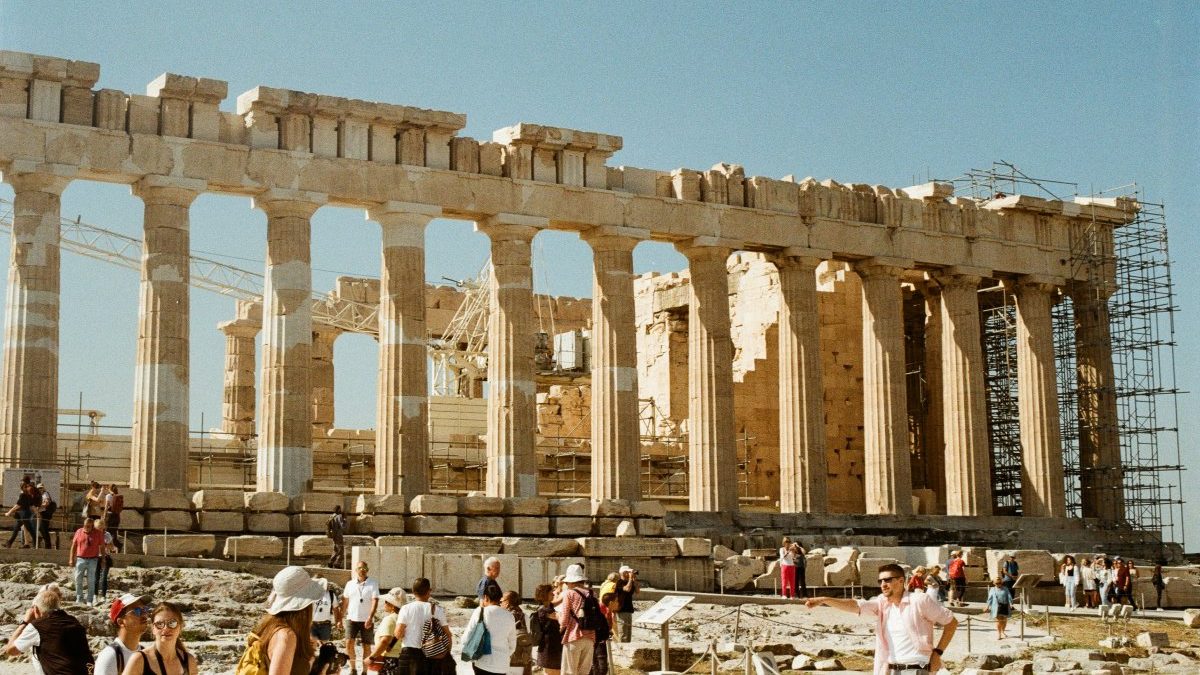
Visiting the Acropolis: Tickets, History, and Local Tips
The Acropolis is the reason many people come to Athens in the first place, and honestly, I think that is completely justified.
After all, it is one of the most important ancient sites in the world, it is visible from most of the city, and yes, it is absolutely worth visiting.
However, it is also very easy to become overwhelming, even frustrating.
The hill is exposed, the marble can be slippery, tickets now work with timed entry, and the crowds can make the visit much harder than it needs to be.
So before going, it helps to understand what the Acropolis actually is, how the site is laid out, when to visit, which entrance works best, and what to pay attention to once you are up there.
Just so you know: Some links on this page are affiliate links, which means I might earn a small commission if you book or buy through them, at no extra cost to you. Thank you for your support!
What is the Acropolis?
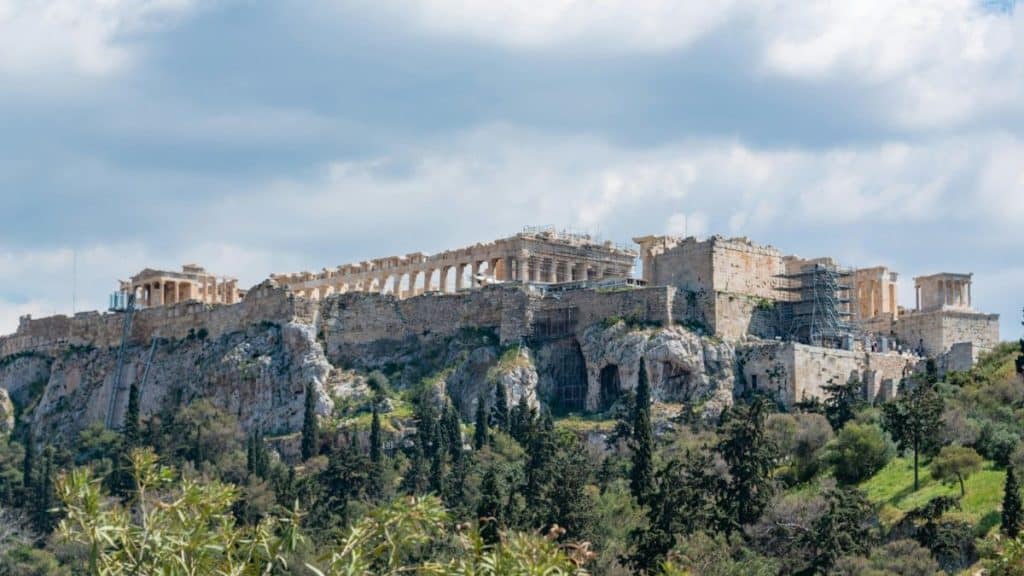
the Acropolis is the hill, NOT A BUILDING.
You’d be surprised to learn how many people arrive in Athens thinking the Acropolis is the same as the Parthenon.
The Parthenon is the biggest structure and most famous part of it, but the Acropolis is the entire sacred rock, including all the monuments built on top of it and the ruins on its slopes below.
The word acropolis is directly translated from greek to “high city”.
The term itself was not unique at the time, and it was used in most ancient Greek cities, meaning the fortified upper part built on higher ground for defensive protection.
A Short History of the Acropolis
People were using the hill as far back as the Bronze Age, but at the time it was just a fortified high point.
Later, it evolved to the religious centre of Athens, dedicated above all to Athena, the city’s patron goddess.
What you see today mostly comes from the 5th century BC, after an earlier version was destroyed by the Persians in 480 BC.
Athens, at that time wealthy and powerful, rebuilt the Acropolis on a far bigger scale under Pericles.
Over the centuries, the buildings were reused, altered, damaged, and adapted to very different eras.
The single most destructive moment came in 1687, when a Venetian bombardment hit the Parthenon while gunpowder was being stored inside it (talk to me about smart decisions).
That explosion is a big reason why the building survives in the broken form you see today.
Then came the long modern story of excavation, restoration, and argument over what should be repaired, what should be left alone, and what was taken away by the British, issues that continue existing to this day.
Why the Acropolis is Important
Well, that’s partly due to its age, but not only because of that.
In fact, there are plenty of bigger and older sites in Greece.
But this was not an isolated temple on a hill.
It was the high point of the city, built to be seen, to impress, and to say something very clear about Athens at the height of its power as a city-state.
And that can still be understood right now.
Furthermore, much of what people think of as classical Greece is tied up with this hill.
The Parthenon in particular has become far bigger than the building itself. It has turned into a symbol of democracy, beauty, western civilisation, even national identity.
Whether that is fair or not, it carries all of it.
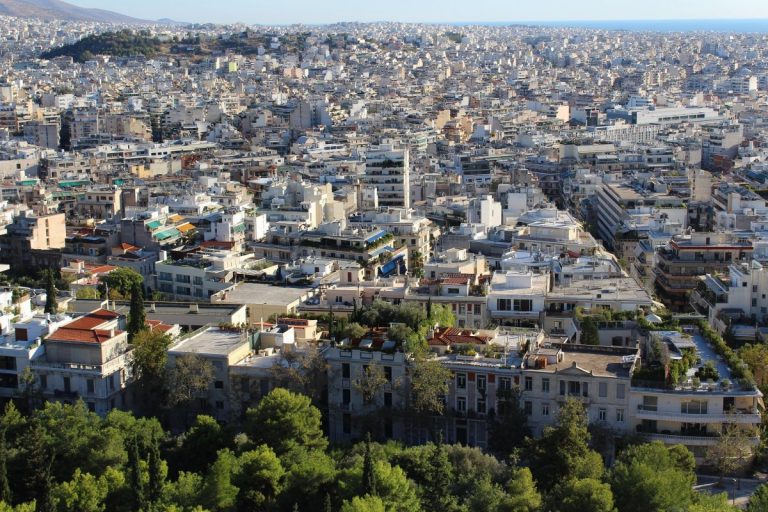
Then there is the simpler reason. It still dominates the city skyline.
You will keep seeing it from different parts of Athens all day.
From rooftops, hills, side streets, museum windows, evening walks. It is always in the frame.
That gives it an aura that other ancient sites in the city simply do not have.
Acropolis Tickets (2026)
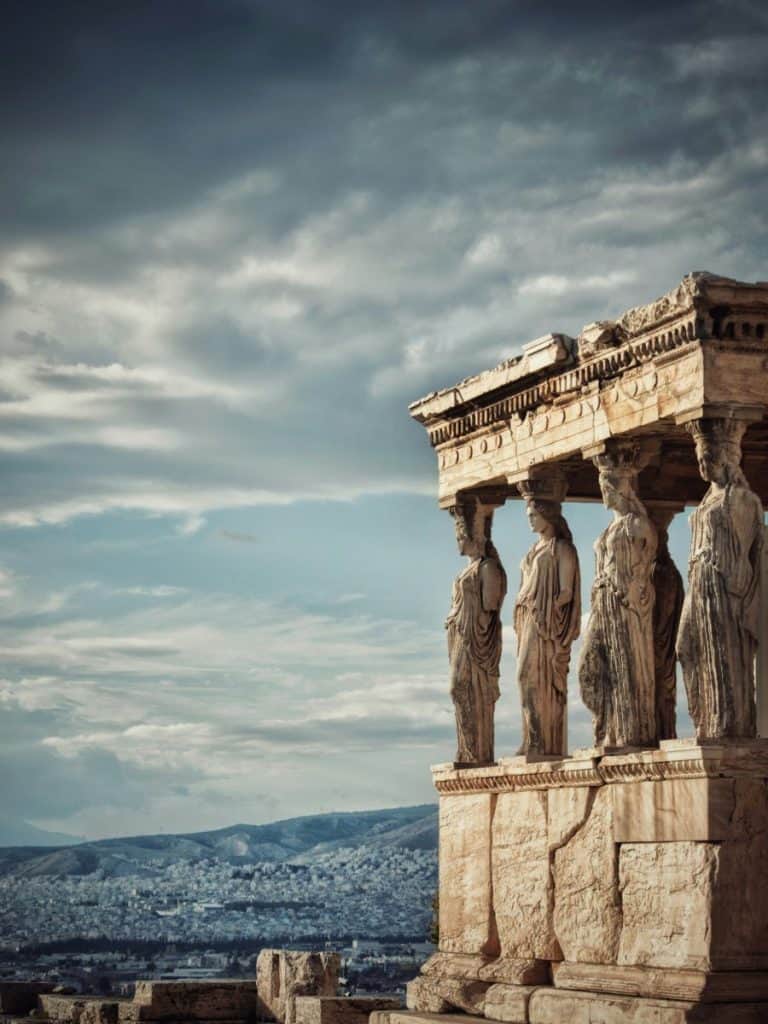
That significance comes at a cost.
The ticket for the Acropolis and its slopes recently increased to €30 full / €15 reduced ($33 / $16.5).
Entry to the site has been limited to 20.000 visitors per day, and it works with a timed-entry slot.
So when you book online, that Acropolis slot is strict.
The ticket is valid to enter the site from 15 minutes before to 15 minutes after the selected time for the main hill.
The Acropolis Museum ticket is separate. It is currently €20 full / €10 reduced ($22 / $11), and there is no combined Acropolis and Museum ticket.
In both sites, entry is free for EU citizens under 25 years of age.
Lastly, there are also official free-admission days for state archaeological sites and museums in Greece, including 6 March, 18 April, 18 May, the last weekend of September, 28 October, and the first and third Sunday from 1 November to 31 March.
Opening Hours and Best Time to Visit
The Acropolis opens early year-round, but the closing time changes through the year.
- 1 November to 31 March: 08:00 – 17:00 (last entry 16:30)
- 1 April to 15 April: 08:00 – 18:00 (last entry 17:30)
- 16 April to 15 May: 08:00 – 19:00 (last entry 18:30)
- 16 May to 31 August: 08:00 – 20:00 (last entry 19:30)
- 1 September to 15 September: 08:00 – 19:30 (last entry 19:00)
- 16 September to 30 September: 08:00 – 19:00 (last entry 18:30)
- 1 October to 15 October: 08:00 – 18:30 (last entry 18:00)
- 16 October to 31 October: 08:00 – 18:00 (last entry 17:30)
As for the best time to visit, I only have one piece of advice: go as early as you can.
The rock is exposed, the marble reflects the heat back at you, and the crowds build up exactly as you would expect at the most famous site in Greece.
That’s why the smartest move is to book the first slot of the day.
A later visit can also work if you’re mainly trying to avoid the midday heat, but I still prefer the morning.
The crowds are usually smaller, and once you’re done, you have the rest of the day free to plan around it.
How to Get to the Acropolis
The Akropoli station on Metro Line 2 has exits at Makrygianni / Dionysiou Areopagitou and Makrygianni / Athanasiou Diakou.
From there, you are already on the southern side of the hill, close to the museum.
But if you are already in the historic centre, I’d encourage you to walk to the site instead.
The Acropolis area is largely pedestrianised and connected to Dionysiou Areopagitou, Makrygianni, Thissio, and the wider archaeological zone in the centre.
Which Entrance to Use
The Acropolis has two entrances.
The main entrance is on the west slope, near Theorias Street.
The south entrance, which, if I’m being honest, I didn’t even know existed until a year ago, is on the South Slope, at the junction of Thrasyllou Street and Dionysiou Areopagitou.
Still, even though the south entrance is almost always less busy, I prefer entering through the main entrance.
It is closer to the Monastiraki side of the centre, and it takes you directly toward the Propylaea, which are one of the highlights for me.
There is just something about them that resonates with me every single time.
I also think the route works better this way.
You start from the upper side of the site and gradually head down, instead of doing the same walk in reverse.
It feels more natural, saves some unnecessary uphill walking, and leaves you in a better position to continue toward the South Slope, Dionysiou Areopagitou, or the Acropolis Museum.
The Monuments
Once you are up on the hill, there are four “main” structures.
The one that “greets” you in the archaeological site is the Propylaea, the great entrance on the western side of the hill.
Just beside it, on the bastion, is the Temple of Athena Nike, smaller in scale but impossible to separate from the entrance sequence.
And then comes the Parthenon, which is still the centre of gravity up there no matter how many photos of it you have already seen.
But it is not the only one worth your attention.
Lastly, the Erechtheion is just as good but in a different way, due to its position, its shape, and, of course, the Caryatids.
1. The Propylaea
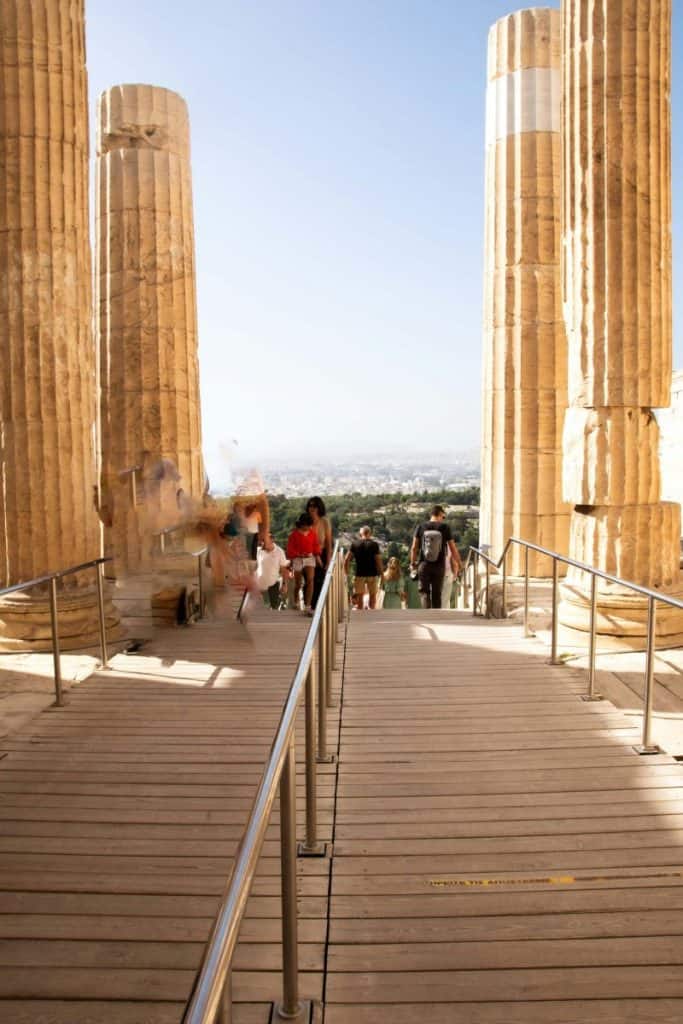
Built on the western side of the hill, the Propylaea were designed by Mnesikles and erected between 437 and 431 BC on the site of an earlier gate.
They served as the formal entrance to the sanctuary, built to make it clear that you were entering the most important sacred space in the city.
Work stopped with the outbreak of the Peloponnesian War, which is why the building was never completed as originally planned.
I always feel a real sense of awe when passing through the Propylaea, and I usually take a short break there to admire the fantastic views over Athens.
It is, hands down, my favourite moment on the site every single time.
2. Temple of Athena Nike
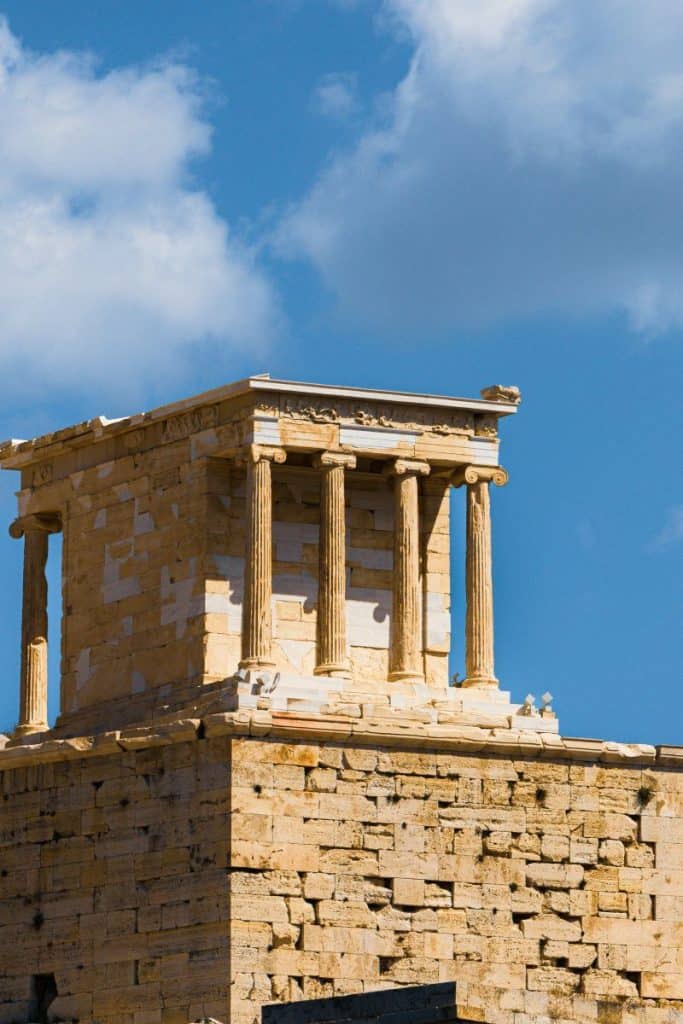
The Temple of Athena Nike is easy to miss because of its size.
It stands on the bastion at the southwestern edge of the Acropolis, right beside the entrance, so many people pass it while focusing on the Propylaea.
But it is worth noticing.
The temple was designed by Kallikrates and built between 426 and 421 BC, replacing earlier temples whose remains still survive inside the bastion.
Nike was the goddess of victory (the name literally means “victory” in Greek) and here Athena was worshipped in her victorious form, obviously meaning success in war.
That theme appeared clearly in the temple’s decoration.
Its sculpted frieze showed gods and battle scenes, including a depiction of the Greek victory over the Persians at Marathon on the south side.
Around 410 BC, a marble parapet was added around the edge of the bastion, both to protect visitors and to decorate the space with reliefs of Athena.
It may not have the scale of the Parthenon or the details of the Erechtheion, but it carries a lot of history in a very small space.
3. The Parthenon
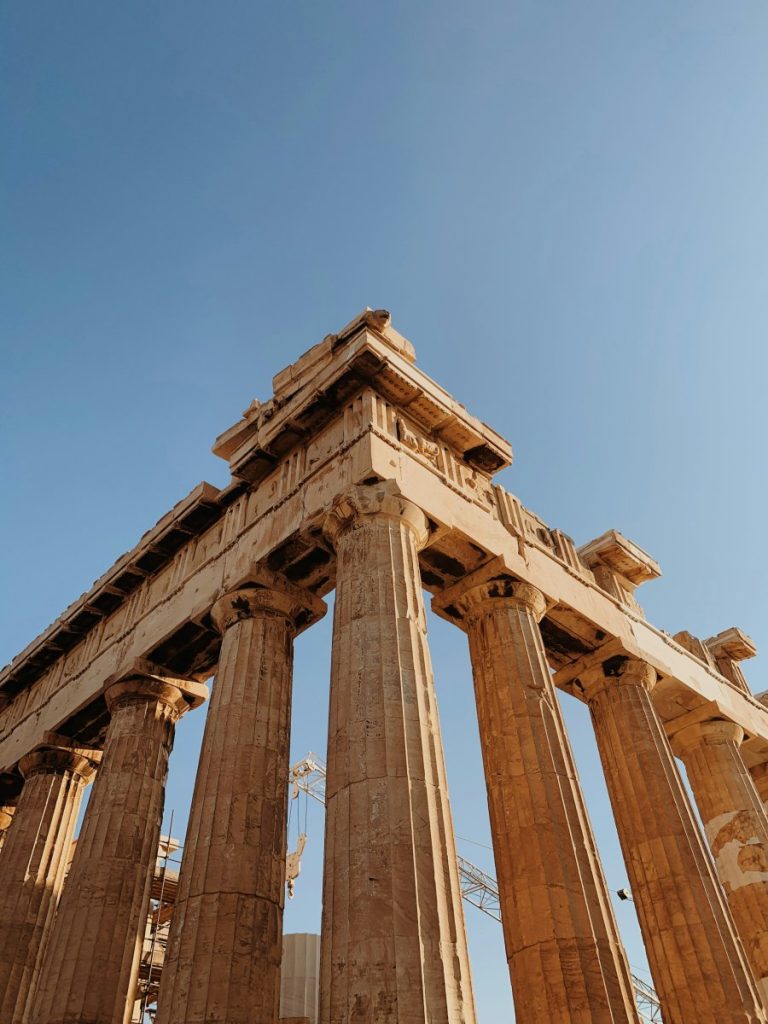
The Parthenon is probably the most recognisable building in all of Greece.
It was dedicated to Athena Parthenos, the patron goddess of the city, and was built between 447 and 438 BC.
Everything about it was meant to project the wealth, confidence, and ambition of Athens at its peak.
Inside once stood a massive statue of Athena, created by Pheidias.
It was made of gold and ivory, stood around 12 metres tall, and showed the godess fully armed, holding Nike, the goddess of victory, in one hand.
That statue was lost in time.
It is also worth mentioning that the Parthenon is not in some romantically ruined state by accident.
Over the centuries, it became a church, later a mosque, and in 1687 it was badly damaged when a Venetian bombardment hit the building while gunpowder was being stored inside.
On site, take your time to appreciate the scale, the columns, and the fact that even now, damaged and under restoration, the Parthenon still holds the whole Acropolis together.
The other thing worth keeping in mind is that a lot of what gave the Parthenon its visual richness is no longer up there.
The metopes, pediments, and frieze are now split, with some parts in the Acropolis Museum and others abroad.
But even with so much missing, the Parthenon still feels like the centre of gravity of the Acropolis, and that alone says a lot.
4. The Erechtheion
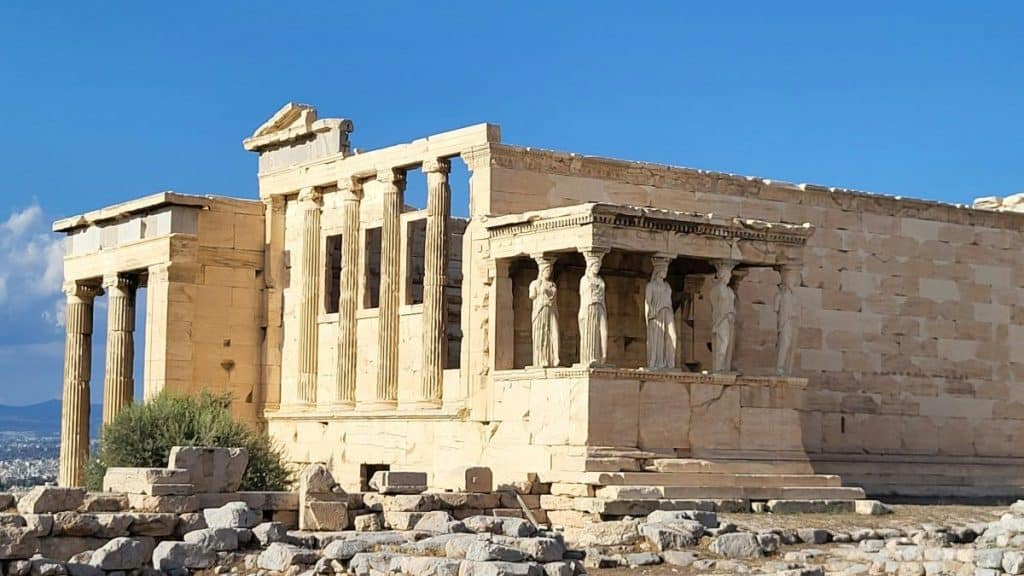
Unlike the Parthenon, the Erechtheion was not built as one simple rectangular monument.
It had to accommodate several cults in the same place and adapt to uneven ground, which is why its layout is so irregular.
And that is part of what makes it so interesting.
The eastern part was dedicated to Athena, while the western side housed shrines connected to Poseidon and other figures.
The temple is also tied to the mythological contest between Athena and Poseidon.
According to the myth, both gods wanted to become the patron deity of the city. To decide, each offered a gift to the people.
Poseidon struck the ground of the Acropolis with his trident. In some versions, this created a saltwater spring. In others, he produced the first horse.
Athena offered the olive tree, a gift that promised wood, oil, food, and long-term prosperity.
The king, or in some versions the people themselves, judged Athena’s gift to be better. So Athena won, and the city was named Athens after her.
The Erechtheion was believed to be the place where the Athenians located Athena’s olive tree, as well as Poseidon’s mark in the rock and his saltwater spring.
I love how mythology, religion, and the identity of the city all meet in the same small space.
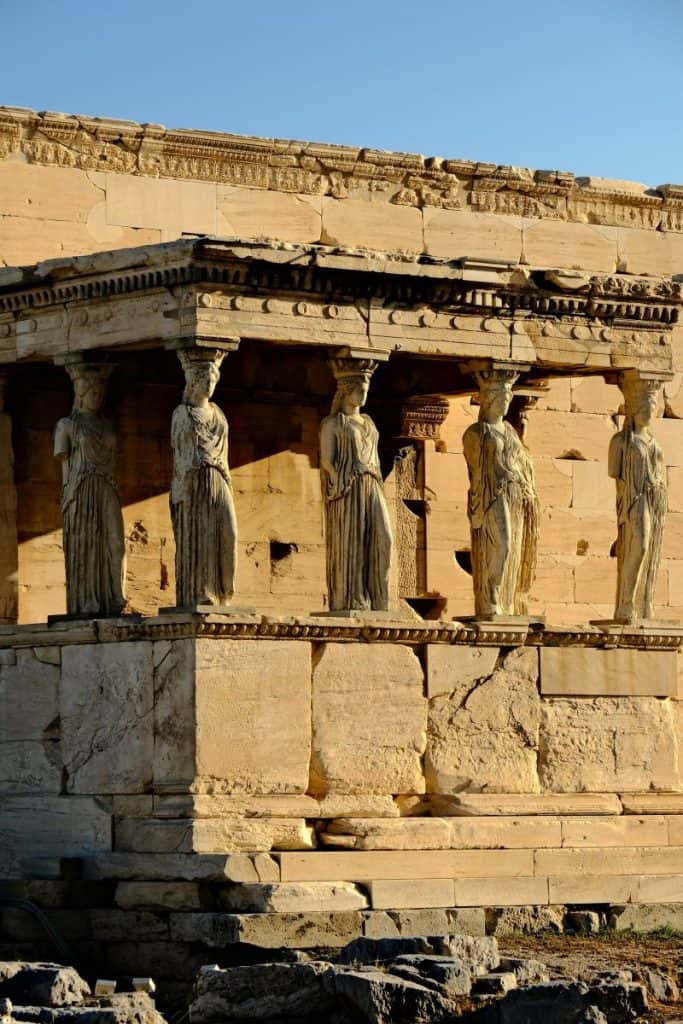
And then, of course, there are the Caryatids.
The south porch is carried by six sculpted female figures instead of ordinary columns.
Five of the originals are now in the Acropolis Museum, while the sixth is in the British Museum.
That missing Caryatid, together with the wider question of the Parthenon sculptures, has been a topic of heated discussion in Greek politics for decades.
5. The Theatre of Dionysus
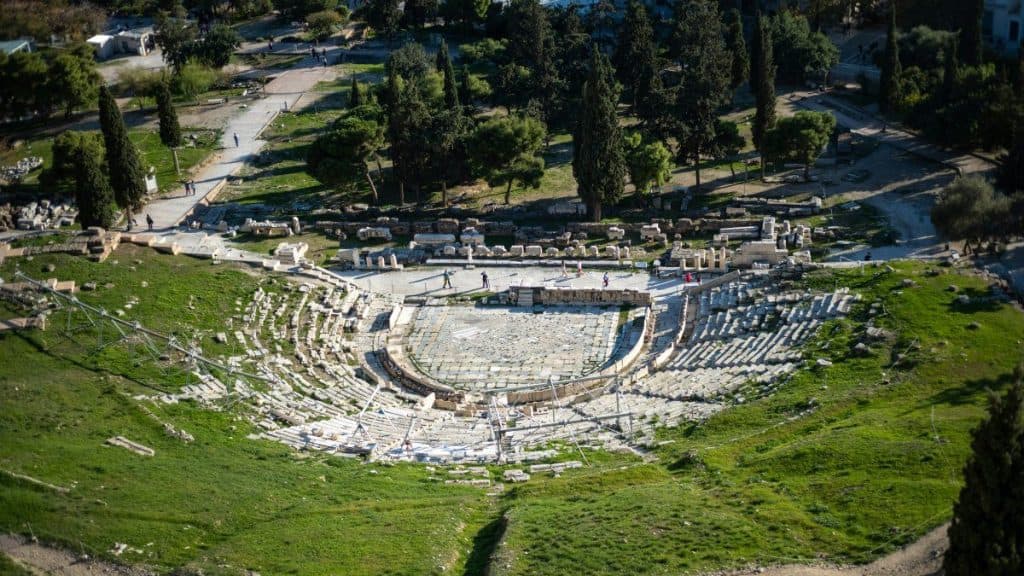
As you make your way down toward the South Slope, you’ll eventually reach the Theatre of Dionysus, built into the hillside below the Acropolis.
This is where tragedies and comedies by writers like Aeschylus, Sophocles, Euripides, and Aristophanes were performed as part of the cult of Dionysus.
You do need a bit of imagination here, because visually it is not the most impressive part of the site today.
Still, I think it is worth stopping for in its own right.
6. The Odeon of Herodes Atticus
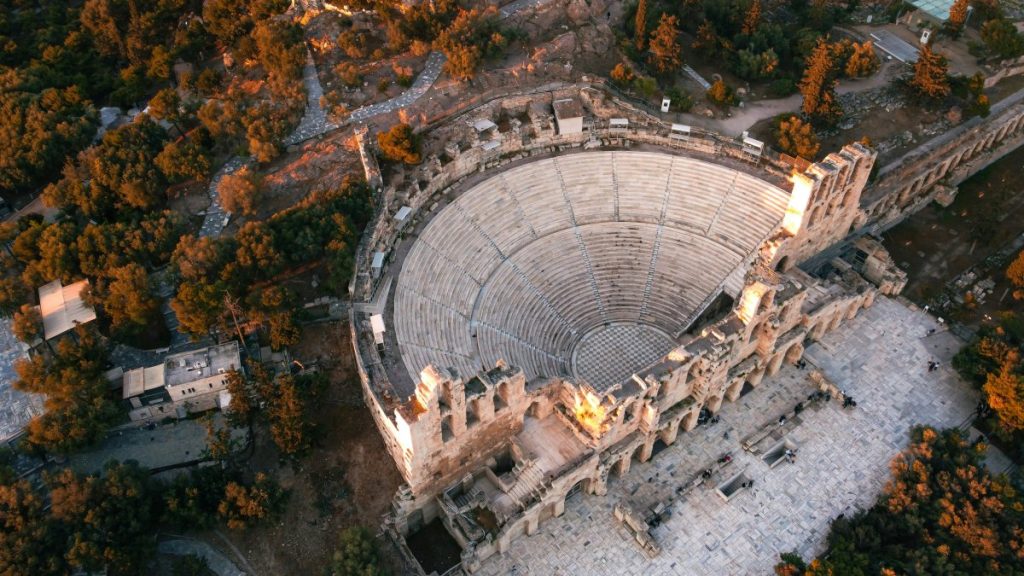
This is the Roman theatre you see on the southwestern side of the hill, built in the 2nd century AD by Herodes Atticus in memory of his wife.
I also think it is one of the most beautiful parts of the Acropolis area to see from below, under the evening light.
And if you ever get the chance to attend a performance there, take it.
It is one of the best ways to experience ancient Athens.
Tips for Visiting the Acropolis
- Book the Acropolis ahead. Entry works on timed slots, and the official ticket is valid from 15 minutes before to 15 minutes after your selected Acropolis slot.
- Go early if you can. The hill is far better before the heat builds and before the site gets more crowded. The midday version is the one I would avoid.
- Leave the museum for later in the day. If you are doing both on the same day, the Acropolis first and the museum after works much better. The museum also stays open late on Fridays until 10 pm, which gives you more room to play with.
- Wear shoes with grip. This is not a hard hike, but the marble can be slippery and parts of the ground are uneven.
- Bring water and do not underestimate the sun. There is very little shade on the hill, and you’ll feel it once you get up there.
- Do not overpack the day. The Acropolis is better when you give it some room instead of squeezing it between too many other stops.
Accessibility at the Acropolis
The Acropolis has an elevator for visitors with mobility impairments.
It is located on the north side of the hill, about 300 metres from the main entrance, and it is available for wheelchair users, people with reduced mobility, and a parent accompanying two or more infants alone.
That said, the Acropolis is still a difficult site in physical terms.
Even with the elevator, it’s still a hilltop monument with uneven surfaces, exposed paths, and limited shade.
Final Thoughts
What makes the Acropolis special is not only the Parthenon itself, but how much of Athens still revolves around this hill.
The mythology, the museums, the neighbourhoods below it, the long arguments over the sculptures, even the way the city is laid out all somehow lead back here.
And once you come down from the hill, continue toward the Acropolis Museum, walk through Plaka and Dionysiou Areopagitou, build the day around a one-day Athens itinerary, or use it as the starting point for a slower look at the city’s best things to do.