An Athenian’s Guide to Where to Stay in the Greek Capital
I’ve lived in three different parts of Athens over the years, and I’ve concluded that there’s no single best neighbourhood in the city. That’s mainly because of the fact that the centre itself is made up of a number of distinct areas that, believe it or not, are very different from one another.
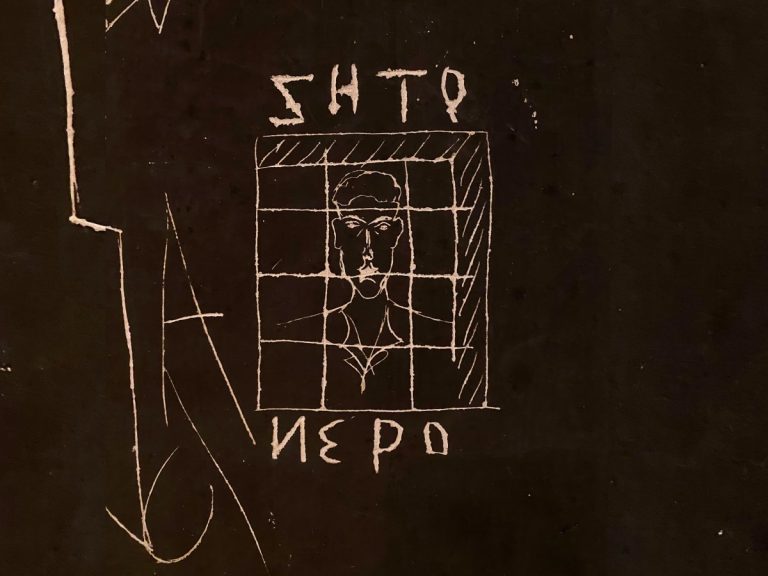
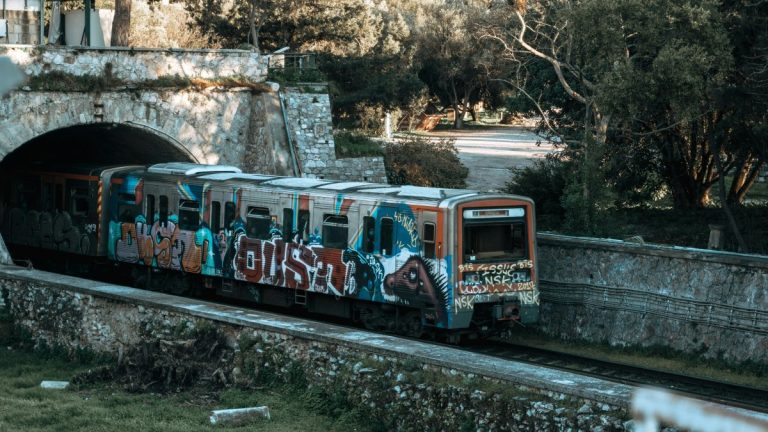
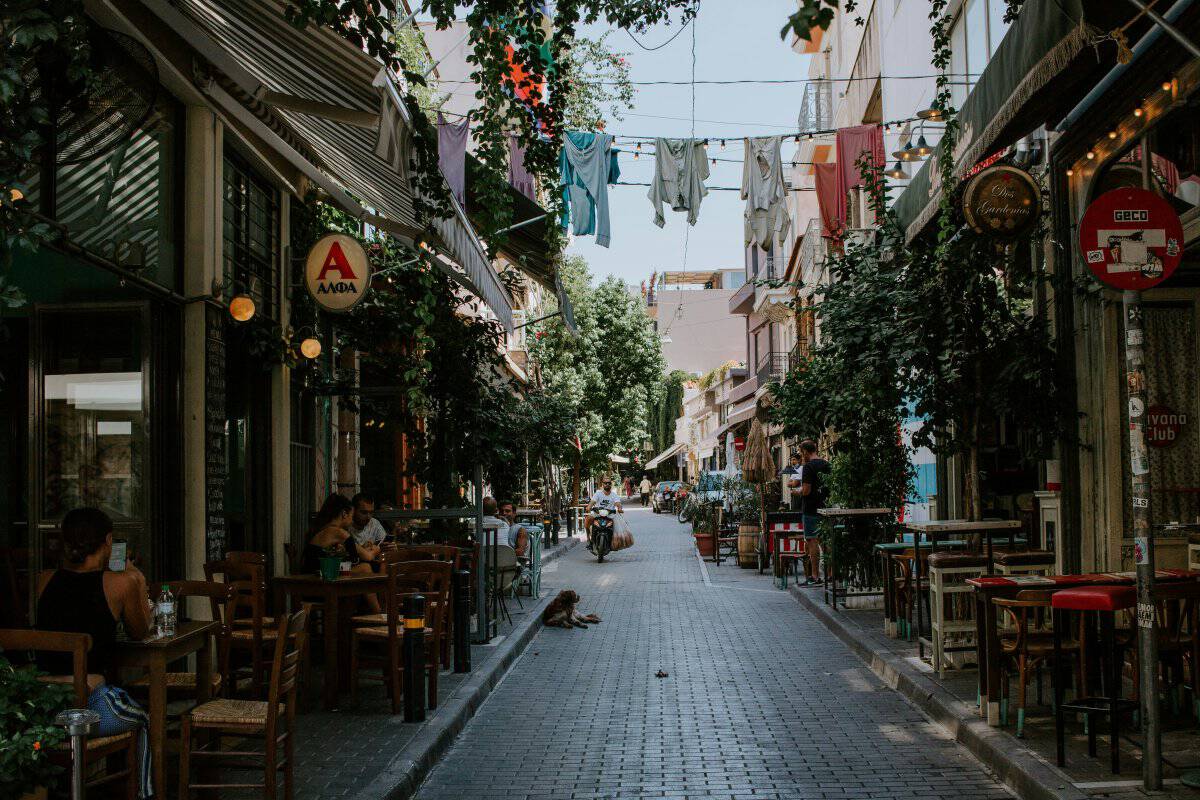
Koukaki is calm and residential, while Monastiraki and Psirri are loud and busy. Kolonaki is expensive and well-kept, but a few streets away, Exarcheia is cheaper and covered in graffitti. Plaka still earns its reputation, but it’s more expensive, crowded, and a bit “staged” for tourists.
Out of all of them, Koukaki is my favourite. The Acropolis and most of what is worth seeing are within walking distance, but the area itself is more isolated. It’s also where Acropolis Magenta is located, which along with COCO-MAT Athens Jumelle in Kolonaki and Ergon House Athens near Syntagma are my favourite hotels in Athens.
So here’s the breakdown. Nine areas, what each one gets you, why you should pick it, and what its main disadvantages are.
Just so you know: Some links on this page are affiliate links, which means I might earn a small commission if you book or buy through them, at no extra cost to you. Thank you for your support!
Start here
- Best all-round starting point: Koukaki, Syntagma or Kolonaki. Easy to reach, walkable, and close to most sites. My pick: Acropolis Magenta in Koukaki.
- Best neighbourhoods for nightlife: Psirri, Exarcheia or Monastiraki. Rooftops, bars, late dinners (but can be quite loud). My pick: The Zillers Boutique Hotel in Monastiraki.
- Best quiet areas near the Acropolis: Koukaki or Thisseio. Both close to the centre but calmer at night. My pick: Hotel Thissio.
- Best upscale pick: Kolonaki. Museums, restaurants, a tidier atmosphere. My pick: The Modernist Athens.
- Best alternative neighbourhood: Exarcheia. Bohemian, creative, more local. My pick: Radisson Blu Park Hotel Athens.
- Best area for ferries: Piraeus. The port city of Athens, with a few cosy neighbourhoods that make ferries easy. My pick: Mitsis N’U Piraeus Port.
- Best splurge, if budget isn’t the concern: Hotel Grande Bretagne in Syntagma. Old-school grandeur, right on the square, the kind of hotel that’s a landmark in its own right.
- Best on a hostel budget: Worth reading separately. I’ve written a whole guide to the best hostels in Athens if that’s your situation, since this guide leans mid-range and up.
1. Koukaki
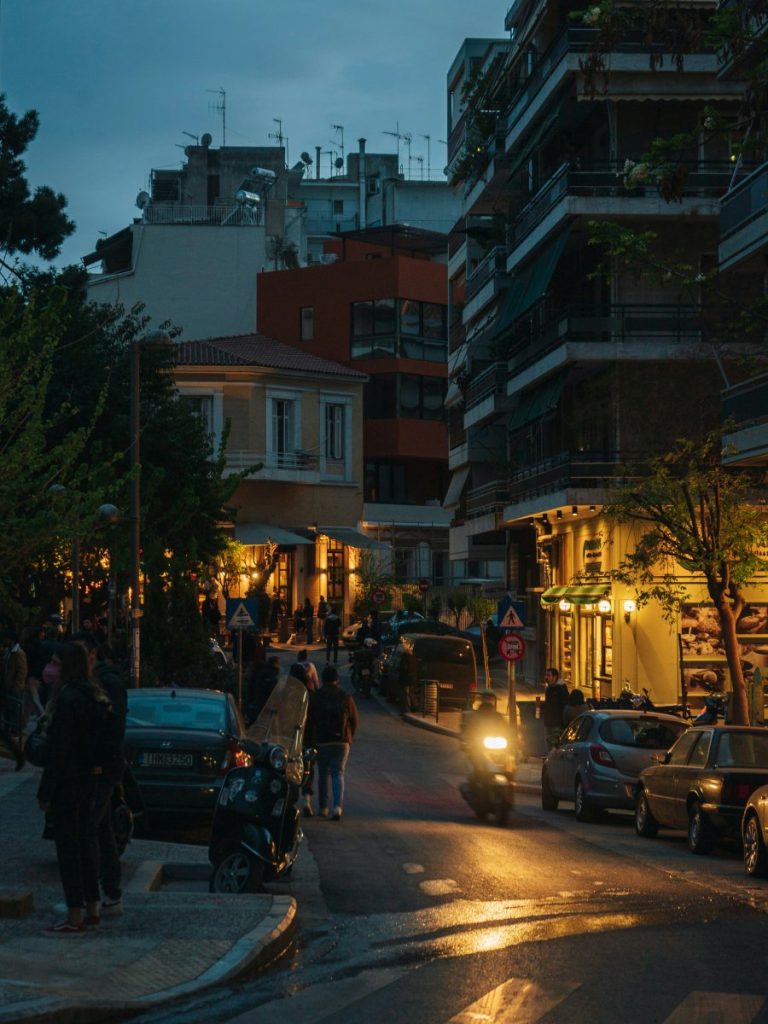
If I had to choose just one area to stay in Athens, it would be Koukaki. Its name comes from a manufacturer of iron beds who lived in the area in the early 20th century.
It originally consisted of smaller districts and was relatively undeveloped, but as Athens expanded, it gradually became a residential neighborhood. Many older houses were later replaced by apartment buildings, particularly during the building boom of the 1960s and 1970s.
What I like most about Koukaki is that it is always lively without becoming loud or overwhelming. There are plenty of cafés, bakeries, bars, and restaurants, but the atmosphere is calmer than Monastiraki or Plaka. A lot of my go-to food spots are here too, including “Pizza dough!”, which serves some of the best pizza-and-wine in the city.
It’s also home to EMST, the National Museum of Contemporary Art, which, in my opinion, doesn’t get nearly as much attention as it should.
Interestingly, one of the advantages of Koukaki is also its main disadvantage. Since it was built as a residential area, hotel choices are much more limited than elsewhere in the centre. There are plenty of Airbnbs here, but I’d not recommend staying in them.
Too much of Koukaki has already been absorbed by short-term rentals, and a lot of its character has started to slowly fade.
My favourite hotels in Koukaki
- Budget: Marble House
- Budget: NOHO Boutique Koukaki
- Mid-range: Acropolis Magenta Luxury Suites
- Mid range: Acropolis Select
- Luxury: Neoma
- Luxury: Anthology of Athens
Koukaki Overview
- Location: 5/5. A short walk from the Acropolis and the old town.
- Transport: 5/5. Served by Syngrou-Fix metro station (Line 2).
- Restaurants & bars: 5/5. Excellent local and international options, usually better prices than the most touristy areas.
2. Plaka
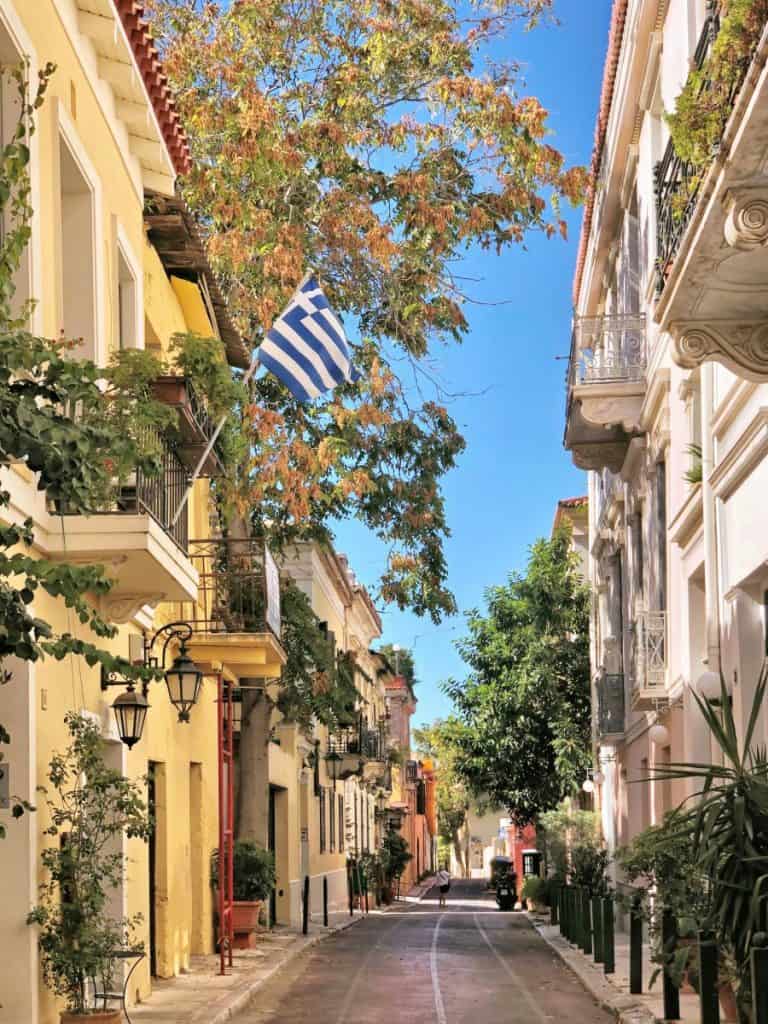
Plaka is a well-kept and lively neighbourhood right under the Acropolis, and that might still be an understatement. The streets around the Roman Agora, specifically, lined with neoclassical houses, small squares, and countless restaurants, are my favourites for an afternoon walk with a cold freddo espresso on hand.
The Benizelos Mansion on Adrianou Street is among the best surviving examples of an Ottoman-era residence in Athens, and not far from it stands the Monument of Lysicrates, built in 335-334 BCE and considered the oldest surviving sponsored monuments in the world.
That said, staying in Plaka comes with real issues, both practical and ethical. First, it’s one of the most expensive neighbourhoods to stay in and one of the most crowded, even well into the night.
It is equally important to mention that it has also been the biggest victim of overtourism in Athens. Whole buildings here were converted into short-term rentals over the past decade, and residents have been leaving faster than almost anywhere else in the city.
The problem has got so bad that the city council has started restricting new short-term rental permits specifically to try to slow it down (I’ve written more about why I steer people away from Airbnb in Athens elsewhere, if you want the full picture).
None of that has erased what makes Plaka Plaka, though. The right alley on the right evening still turns up a taverna with someone playing bouzouki live, tables pushed together, half the room singing along to songs they all (but me) somehow know by heart.
That part hasn’t been priced out yet, and it’s still something you’ll enjoy walking around or just relaxing on your hotel room’s balcony while drinking a cold beer or a glass of wine.
Best hotels in Plaka
- Budget: Phaedra Hotel
- Mid-range: Sweet home Hotel
- Mid-range: Central Hotel
- Luxury: Electra Palace Athens
Plaka Overview
- Location: 5/5 – one of the best positions in the city for sightseeing.
- Transport: 4/5 – easy to explore on foot, though there isn’t a metro station directly inside the neighborhood.
- Restaurants & bars: 3/5 – many options, but prices tend to be higher and many places cater mainly to tourists.
3. Monastiraki
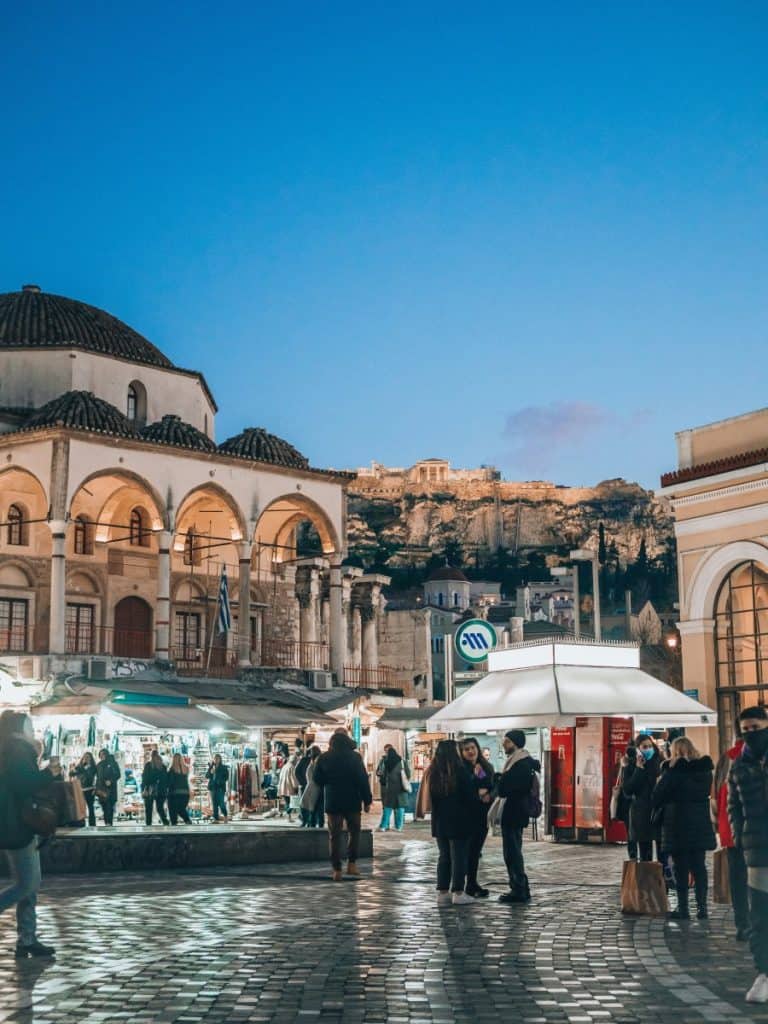
Cross one metro stop from Plaka and it’s a whole different place. Monastiraki is loud, chaotic, and unmistakably Athenian.
The name comes from a small monastery that once stood nearby, and the neighbourhood has a long history of trade, markets, and small businesses. That character is still there, even if parts of it are now more built for visitors.
At the centre of everything is Monastiraki Square, which stays busy throughout the day. Right next to it stands the old Tzistarakis Mosque, which today houses a small museum as part of the Ancient Agora site.
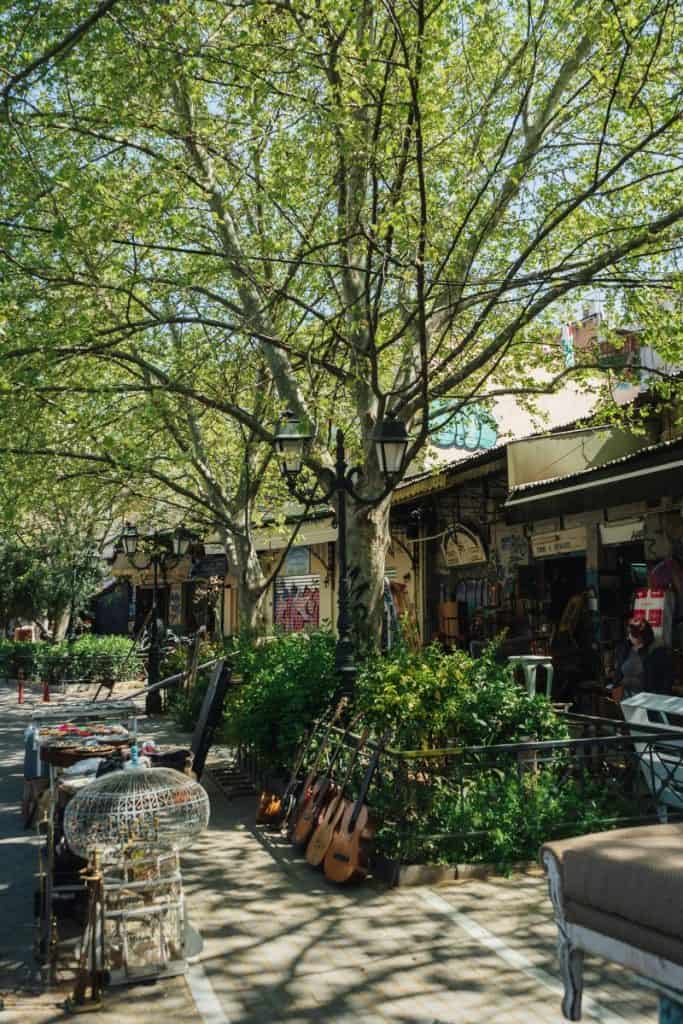
From the square, the Monastiraki flea market spreads through the surrounding streets. It’s not really a place I’d go for shopping with a purpose, but it’s an interesting walk and a good way to feel the energy of the area.
A few minutes further on you’ll reach the Roman Agora and the Ancient Agora, two open-air archaeological sites surrounded by cafés and small streets. Both are historically important, but just as enjoyable to admire from the outside while walking around.
The main reason to stay in Monastiraki is convenience. Almost everything is reachable on foot, and the metro makes the rest easy. Now that I think about it, I should have probably started with the views. For some reason, the area happens to have the biggest concentration of hotels with rooftop bars in the centre, most of which have fantastic Acropolis Views.
The restaurants are open to non-residents as well, but many are built more around the location than the food.
The reason not to stay here is just as obvious, and it’s noise. The area stays active late into the night, especially on weekends. That’s why the specific hotel and street can make a big difference.
Best hotels in Monastiraki
- Hostel: Bedbox
- Budget: Kimon Hotel Athens
- Budget: Regal Hotel Mitropoleos
- Mid-range: Plaka Hotel
- Mid-range: Muse Urban Suites
- Luxury: The Zillers Boutique Hotel
- Luxury: 360 Degrees
Monastiraki Overview
- Location: 5/5 – central and walkable to everything.
- Transport: 5/5 – one of the best-connected areas, with two metro lines.
- Restaurants & bars: 3/5 – endless options, but many flirt with being tourist traps.
4. Psirri
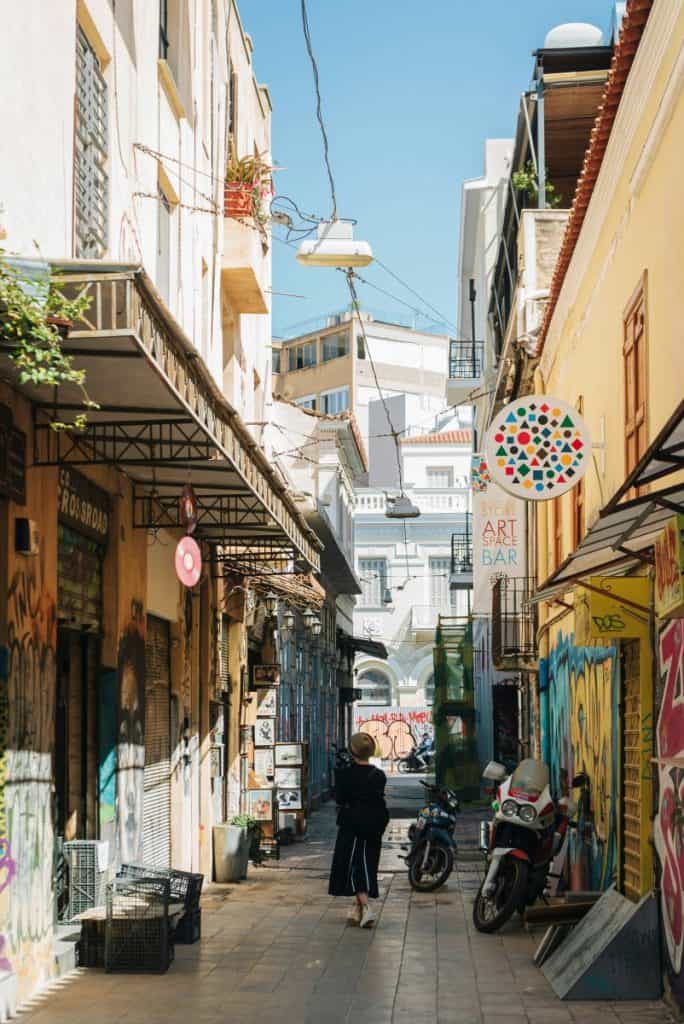
I’d place Psirri in roughly the same category as Monastiraki, since the two are separated by little more than a street. In fact, during the Ottoman period Monastiraki was even considered part of the wider Psirri area.
Speaking of history, one of the weirdest parts of Psirri’s past comes from the late 19th century, when the area was associated with the koutsavakides, a gang of weird-looking people. They had long greased hair, curled moustaches, a jacket worn so the right arm stayed free for a knife, and a red sash used to hide weapons.
Even their walk was staged, an exaggerated limp meant to suggest street fights and toughness. For a long time they operated through political connections, until Dimitrios Bairaktaris became police chief of Athens in the late 19th century and was tasked with cleaning up the area.
His method was humiliation. He had their hair cut short, their moustaches shaved, their sleeves trimmed, and even the pointed tips of their shoes cut off, before parading them through the cafés of Psirri.
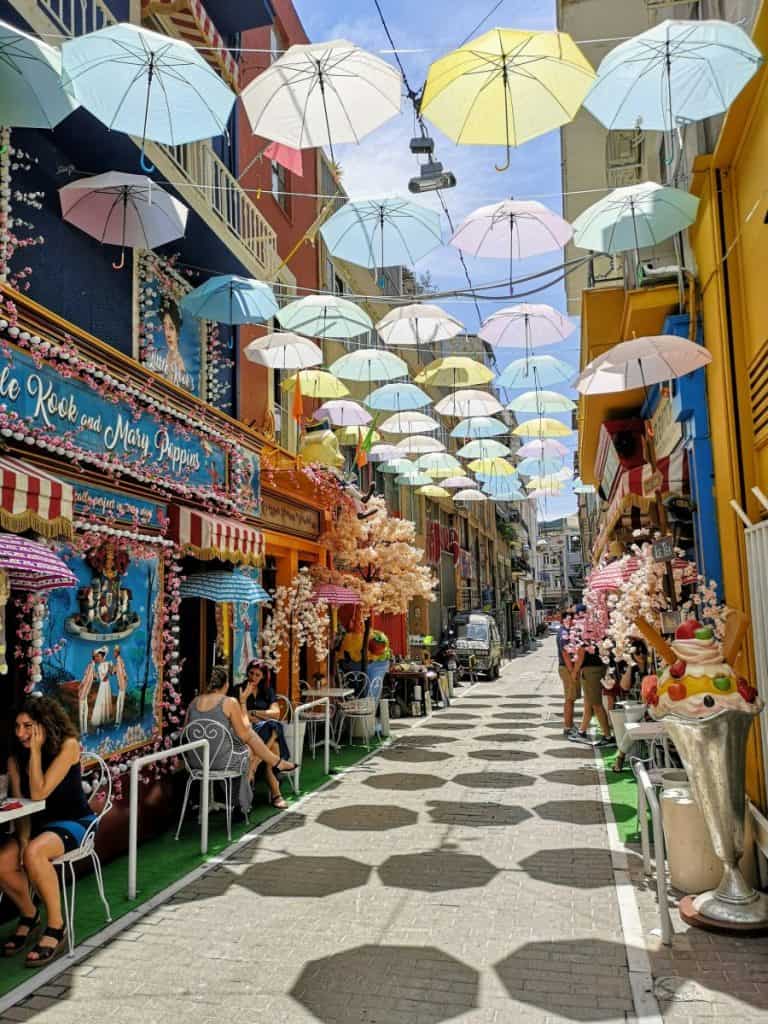
Psirri today is a completely different neighbourhood. There aren’t any big ancient or historical sights, but that was never the draw. During the day it’s full of street art, small shops, cafés, and bars. At night it turns into one of the busiest nightlife pockets in the city centre, which can be fun, but again it means noise.
Somewhere, the ghost of Bairaktaris is almost certainly unimpressed that moustaches have made such a strong comeback.
Hotels in Psirri
- Budget: Athens Psiri hotel
- Budget: Attalos Hotel
- Mid-range: Athens21
- Mid-range: Philia Boutique Hotel
- Luxury: Monument Hotel
- Luxury: Ivis 4 Boutique hotel
Psirri Overview
- Location: 5/5. Right in the middle of things and easy to explore on foot.
- Transport: 5/5. Very close to Monastiraki metro station.
- Restaurants & bars: 5/5. One of the best areas in Athens for nightlife.
5. Syntagma
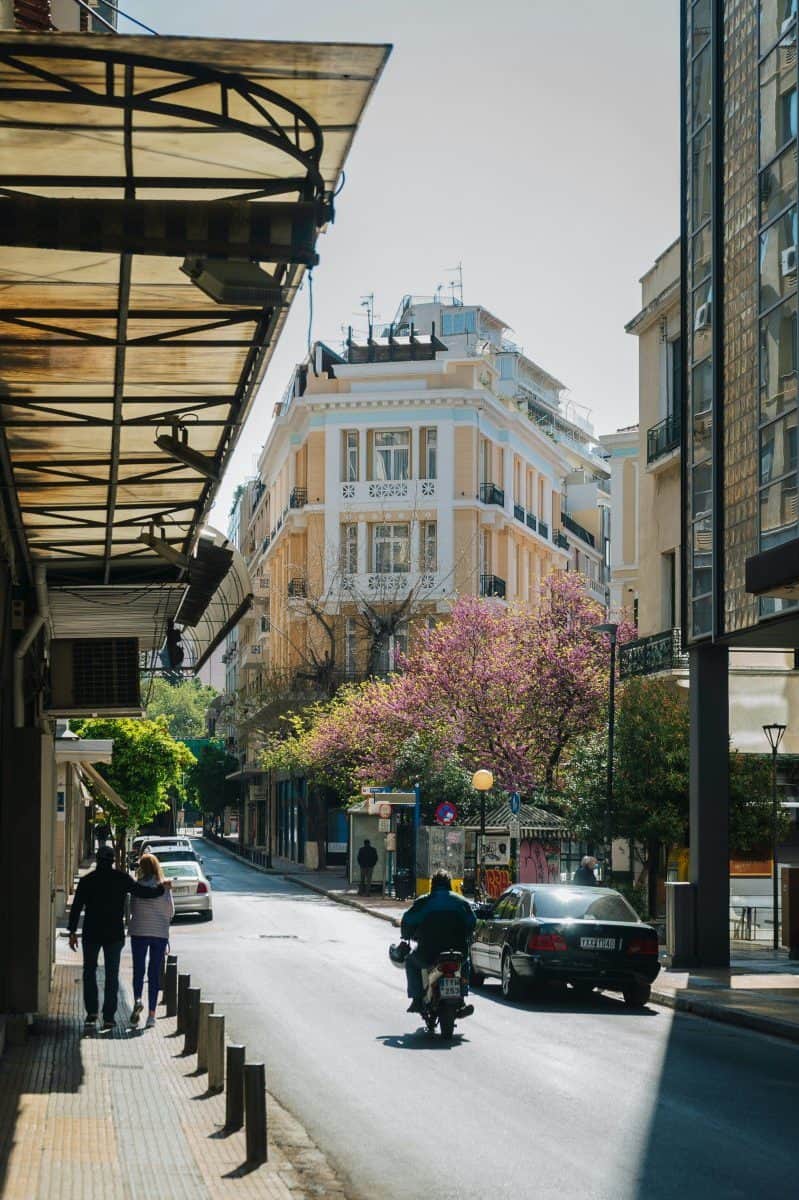
The other direction from Monastiraki, past the shopping streets, leads to Syntagma, which isn’t really a neighbourhood in the usual sense.
For this guide, I mean the area that stretches from the Hellenic Parliament down Ermou Street toward Monastiraki, which is worth clarifying because when someone says they’re staying “in Syntagma,” they usually mean this wider zone around the square.
Syntagma Square is directly in front of Parliament, where the Evzones guard the Tomb of the Unknown Soldier around the clock. The changing of the guard happens every hour, but the full ceremony, with the whole unit and the band, only happens on Sunday at 11am.
The main advantage of staying in Syntagma is the location. From there, Ermou runs west toward Monastiraki and works as one of the main shopping streets in Athens. It’s also within easy walking distance of the Acropolis, Plaka, Monastiraki, and pretty much everything else.
Transport is another big advantage. Metro lines 2 and 3 meet here, the airport metro stops here, and so does the 24-hour X95 airport bus. That combination is quite hard to beat.
The main reason not to stay in Syntagma is that it can be busy, touristy, and less atmospheric. Some streets around the square are noisy and commercial, and you won’t get the same neighborhood feel as in Plaka for example.
Last but not least, because this is the political centre of the country, demonstrations happen here from time to time. That’s nothing to worry about since they are mostly peaceful, but I understand that it can cause unnecessary stress.
Hotels in Syntagma
- Budget: Ermoo Athens Modern Living
- Budget: Astikon House
- Mid-range: The Athenians Art Apartments
- Mid-range: Ergon House Athens
- Luxury: Hotel Grande Bretagne
- Luxury: King George, a Luxury Collection Hotel
Syntagma Overview
- Location: 5/5. About as central as it gets.
- Transport: 5/5. Airport metro, airport bus, and two metro lines.
- Restaurants & bars: 4/5. Many options, quality varies.
- Vibe: 3.5/5. Practical rather than charming.
6. Kolonaki
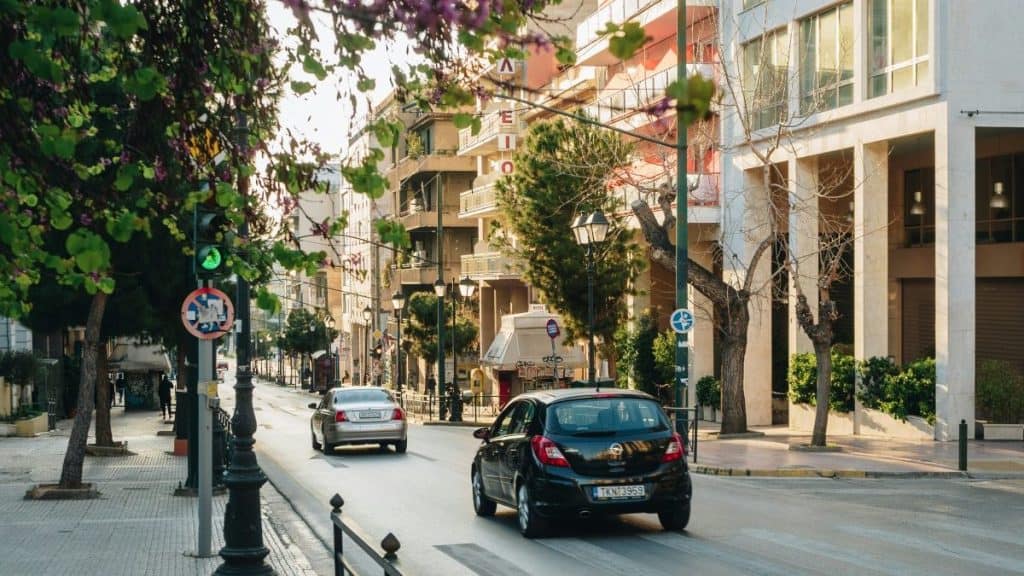
Kolonaki is the more upscale side of the city centre. It’s better preserved than most of the neighbourhoods around it, and while other parts of the centre can be noisy, Kolonaki stays quiet throughout the day.
Its name means “little column,” after the small column still standing in Filikis Etaireias Square.
A lot of Kolonaki’s character comes from pre-war buildings, like the Mavromatis building (1933) on Ploutarchou & Ypsilantou, or the pre-war block at Alopekis 25A, once owned by Maria Callas’s family.
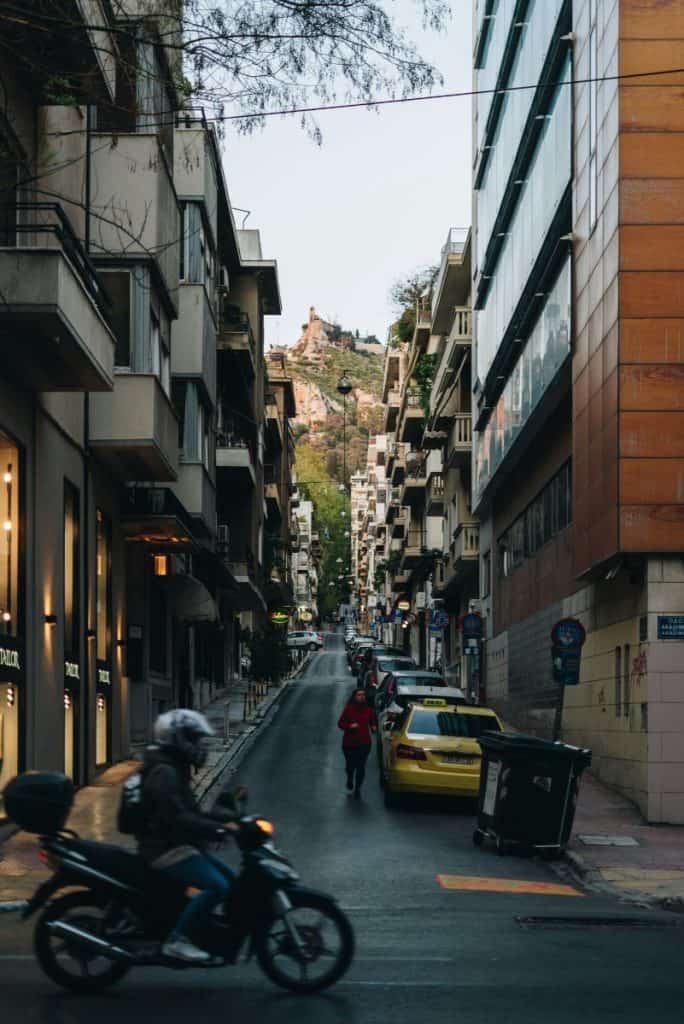
This is also the part of the city where a series of fantastic museums are concentrated. The Benaki Museum, the Museum of Cycladic Art, the Byzantine and Christian Museum, and the Gennadius Library are all close enough to visit together in one afternoon, and I’ve mapped out how to prioritise them in my guide to Athens’s best museums.
Then there are the smaller details, like the bitter orange trees on Kanari Street that survived an attempt to replace them, and the fact that you’re living right on the edge of Mount Lycabettus.
The restaurant and café scene here is excellent too, even if prices run higher than elsewhere. Wild Souls is fantastic for vegan food on the go, one of many stops in my vegan spots in Athens guide, while Oikeio is among my favourite spots in the city for traditional Greek food.
Kolonaki is a great place to stay because it’s calmer than most neighbourhoods this close to the middle of things. The downside is price, and paying Kolonaki rates for a coffee is a bit of a rite of passage.
It’s also hilly in places, which is worth keeping in mind if you’re not a fan of uphill walks in the heat or when accessibility is important.
Hotels in Kolonaki
- Budget: CITYLUXE Suites & rooms
- Budget: Oniro city
- Mid-range: St George Lycabettus Lifestyle Hotel
- Mid-range: COCO-MAT Athens Jumelle
- Luxury: The Modernist Athens
- Luxury: Academias Hotel
Kolonaki Overview
- Location: 5/5. Close to the centre, walkable to major areas.
- Transport: 4.5/5. Excellent access via nearby metro, but you’ll still walk uphill a lot.
- Restaurants & bars: 4/5. Quality is high, and prices often are too.
- Sleep: 4/5. Calmer than other neighbourhoods this close in.
- Value: 3/5. You’re paying for the postcode.
7. Exarchia
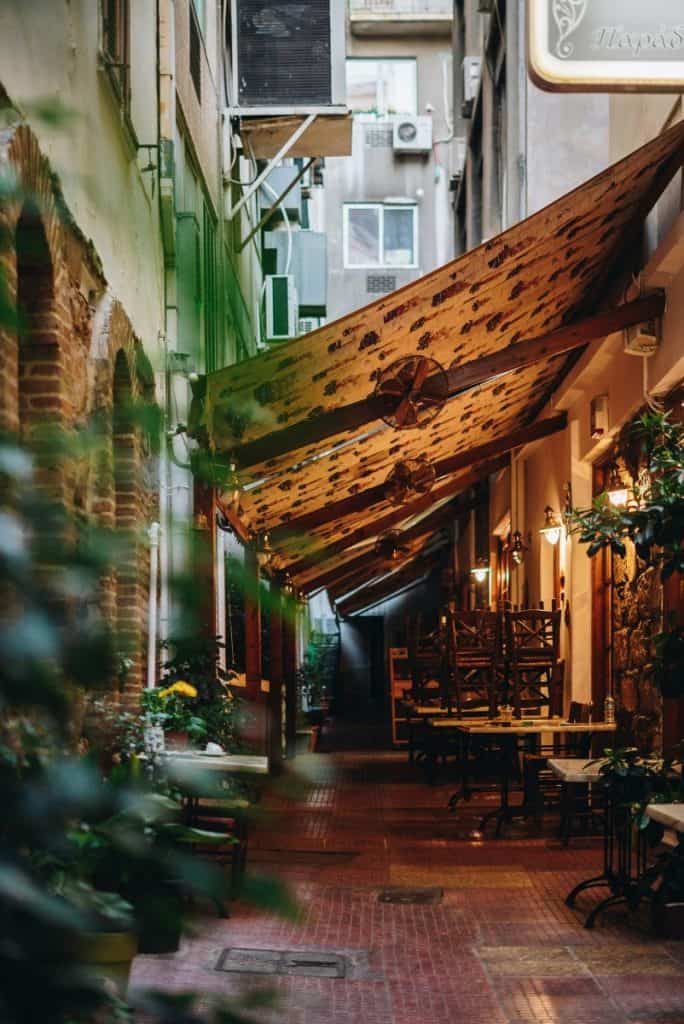
Exarcheia is located right on the other side of Kolonaki, close enough to walk, worlds apart in atmosphere, and it’s, in my opinion, one of the most misunderstood neighbourhoods in Athens.
A lot of guides still tell people to avoid it completely, and I think that’s too simplistic. Exarcheia’s reputation has been shaped by its long connection to political activism. Demonstrations and occasional clashes with police have happened here for decades.
December 6, the anniversary of the 2008 police shooting of a 15-year-old student, brings demonstrations that can escalate later in the evening, and November 17, commemorating the Athens Polytechnic uprising, can lead to protests too. Outside those specific occasions, daily life in the neighbourhood is calm.
The other piece of this is the fight over Exarcheia Square itself. Since 2022, the square has been fenced off for construction of a new metro station, and that fence has become the focal point of years of protest.
Locals are split on the metro line itself, most of the actual pushback is about what a station tends to bring with it, more foot traffic, more investment interest, more of the pressure already reshaping Plaka. It amounts to a fenced-off square, maybe some visible police presence, and the odd banner. None of this really affects a normal stay.
There’s a lot more to Exarcheia than protests. The area is bohemian, full of students, and unapologetically alternative, with independent bookshops, publishing houses, post-war apartment blocks, cafés, bars, murals, and street art everywhere.
The National Archaeological Museum is here too, which alone makes the area worth paying attention to, and it’s covered in more depth in my guide to Athens’s best museums. Then there are the smaller details that explain the place better than any label does.
Every Saturday, Kallidromiou Street hosts a farmers market where you can buy fresh fruit, vegetables, nuts, and household goods at very low prices. Parko Navarinou was created when residents turned an abandoned parking lot into a self-managed park, and just above the area sits Strefi Hill, a good spot for a quieter walk and a different view over the city.
What Exarcheia offers is something Athens doesn’t really have elsewhere. Hotels are cheaper than in neighbouring Kolonaki, the café and food scene is excellent, and nights are active without being loud in the same way as Psirri or Monastiraki.
Hotels in Exarcheia
- Budget: PAME Wild
- Budget: Graffiti House
- Budget: Dryades & Orion Hotel
- Budget: The Square Hotel by X&N
- Mid-range: Neapolis 1897 Boutique Luxury Rooms
- Luxury: Radisson Blu Park Hotel Athens
Exarcheia Overview
- Location: 4.5/5. Close to the centre but slightly outside the main tourist core.
- Transport: 4/5. Metro access is nearby but not always right next door.
- Restaurants & bars: 4/5. Plenty of options, generally cheaper and more alternative.
8. Thisseio
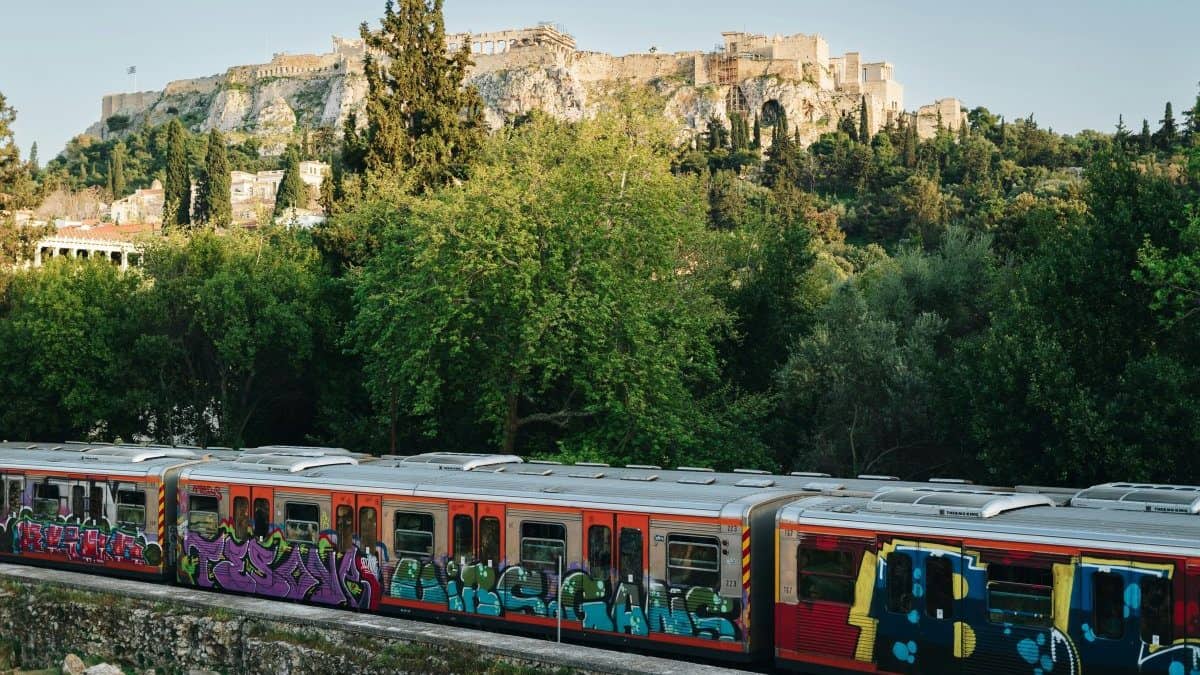
On the opposite side of the Acropolis from Koukaki sits Thisseio. Despite the name, it has nothing to do with Theseus. It was misnamed in the 19th century when the Temple of Hephaestus in the Ancient Agora was mistakenly identified as the Temple of Theseus, and the name stuck.
Thisseio is in a comfortable middle ground, calmer than Monastiraki and more tourist-friendly than Exarcheia, but without Kolonaki’s prices. It is close to everything without the chaos, except on weekend evenings.
The pedestrian Dionysiou Areopagitou-Apostolou Pavlou promenade, which connects the area to the Acropolis, the Ancient Agora, and Filopappou Hill, is one of the most beautiful walks in the city.
The biggest advantage of staying here is that everything sits close by. Compared to Plaka, Psirri, or pretty much anywhere else in the city, the streets also feel a little more open and relaxed.
There are a couple of small downsides though. Many restaurants here rely heavily on their Acropolis views, which sometimes shows up in both the menu and the prices, so if a place advertises “ACROPOLIS VIEW” in five languages, it’s worth checking reviews before sitting down.
The other limitation is accommodation. Thisseio is largely residential, so there are fewer hotels here.
Hotels in Thisseio
- Budget: AIONION RESIDENCES by K&K
- Mid-range: Greece U Around Athens Thissio Suites
- Mid-range: Be My Guest Athens
- Mid-range: Acropolis Vision
- High-end: Hotel Thissio
Thisseio Overview
- Location: 5/5. Walking distance to most major archaeological sites.
- Transport: 4.5/5. Thisseio metro station plus an easy walk into the old town.
- Restaurants & bars: 3/5. Many options, though some are view-driven and pricey.
9. Piraeus
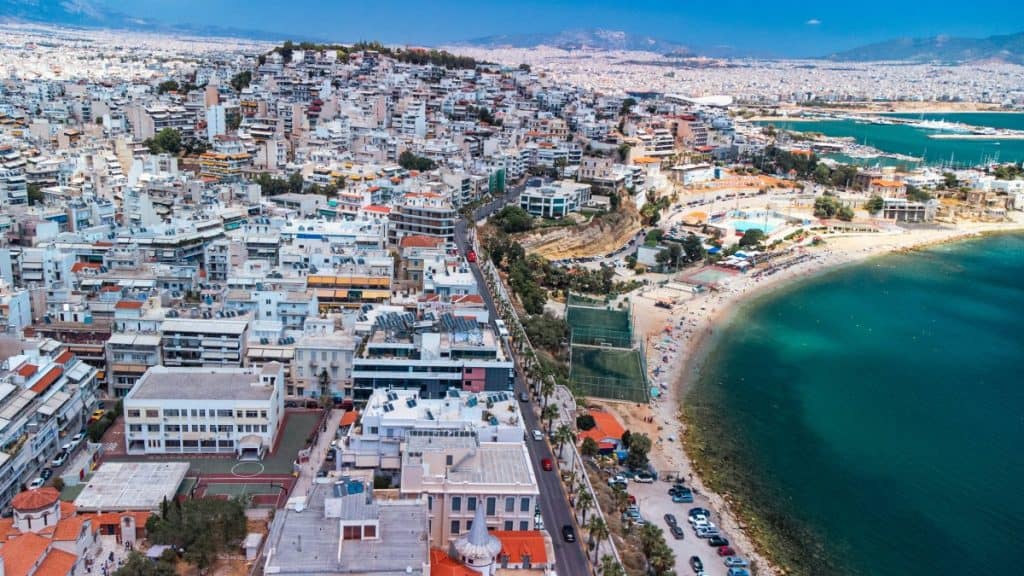
Everything so far has stayed inside the city itself. Piraeus is Athens’s port city, and even though it’s connected to the centre by metro, it is its own place.
This is where the ferries leave for the Greek islands, so when your trip includes island travel, staying here can make a lot of sense. When it doesn’t, Piraeus is not the best base for Athens itself.
Historically, this has always been the city’s link to the sea. In ancient times, Piraeus was fortified and connected to Athens through the Long Walls, and in modern times it grew into one of the busiest passenger ports in Europe.
The area right around the ferry gates is busy, noisy, and fairly chaotic, and it is great for transport but not much else. Walk five minutes toward Pasalimani or Mikrolimano, though, and it’s a different story entirely. They sit right on the water, with cafés, restaurants, and walking paths along the sea, and that part of Piraeus is easy to enjoy.
Food-wise, there are some very good spots. Varoulko in Mikrolimano is one of the most famous seafood restaurants in the area, and Psarokastella is another reliable choice for traditional seafood. Around Pasalimani you’ll find local favourites like Mpar-Mpee-Kiou for huge burgers, Steve’s for Chicago-style pizza, Jackaroo for fried chicken, and Mpyrama, a popular low-key bar.
Piraeus has a few attractions of its own too. The Archaeological Museum of Piraeus offers a smaller but interesting look at the port’s ancient past, the Nautical Museum of Greece focuses on the country’s long maritime history, and the Municipal Theatre of Piraeus, an impressive neoclassical building, hosts performances and cultural events.
In practice, Piraeus works best as an overnight stop. An early morning ferry becomes far less stressful without a pre-dawn journey across town, and the same applies arriving late from the islands with a night’s rest needed before the city.
Hotels in Piraeus
- Budget: Limehome Piraeus Olive
- Budget: Glaros Hotel
- Mid-range: Piraeus City Hotel
- Mid-range: Phidias Boutique Hotel
- Luxury: Gallery Central Piraeus Port
- Luxury: Mitsis N’U Piraeus Port
Piraeus Overview
- Location: 3/5. Excellent for ferries, less ideal for sightseeing.
- Transport: 4/5. Metro connection and immediate access to the port.
- Restaurants & bars: 3.5/5. Good local food options.
Final Thoughts
Choosing where to stay in Athens shapes the whole trip more than it might seem at first, and on a short stay, location counts for even more. In that case, my guide to where to stay in Athens for one night is probably more useful than this full neighbourhood breakdown.
For the route itself, my one day in Athens itinerary and 3 days in Athens itinerary help settle how close to the action a base needs to be, and my guide to the best things to do in Athens is worth a look too, since the shape of the days changes which neighbourhood makes sense.
In the end, the best area to stay in Athens is the one that matches the trip, historic sights, quieter evenings, nightlife, museums, or easy transport. Pick the right neighbourhood and the rest gets a lot easier, and the opinion that comes out of it will probably be just as strong as everyone else’s here. That’s fine. Welcome to the club.