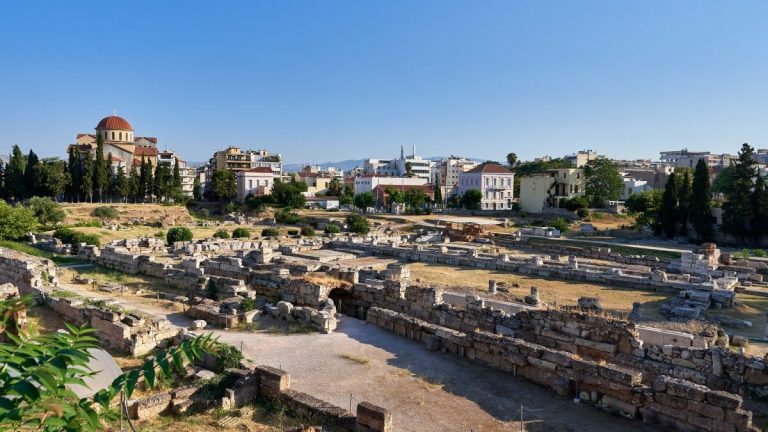

A Metro in Athens. Public transport is one of the things to take into account when planning a trip to Athens
|

How to Get Around Athens: Metro, Bus, Taxi & Walking Guide

Athens is a big city, but getting around is easier than it first looks.

Once you reach the historic centre, a lot of the city starts working on foot. You can walk between neighbourhoods for hours without thinking much about transport at all.

For longer distances, Athens has a modern metro system, buses, trams, taxis, and a few other options. Some are genuinely useful, while others not so much for a short trip.

This guide breaks down how transport in Athens works and which options are actually worth using.

Just so you know: Some links on this page are affiliate links, which means I might earn a small commission if you book or buy through them, at no extra cost to you. Thank you for your support!

Walking in Athens

City street scene with modern buildings and evening lighting, lively atmosphere.

Walking is the easiest way to explore central Athens.

A lot of the main sights are located surprisingly close to each other, so once you’re in the centre, transport stops mattering for a while. The area around the Acropolis is also much better for walking than the rest of the city, thanks to the pedestrian streets around it.

A good example is Dionysiou Areopagitou, the promenade that runs along the southern side of the Acropolis and connects the museum with Thisseio. It’s still one of the best walks in the city.

That said, Athens is not always especially kind to pedestrians. Sidewalks can be narrow, uneven, or half-blocked by scooters, poles, or café tables. In summer, the heat also turns short walks into harder work, so that’s also something to take into account.

The Athens Metro

Metro in Athens

The Athens Metro is the most reliable way to move around the city.

It’s modern, easy to understand, and connects most of the places people actually need – the airport, the city centre, and Piraeus.

There are three main lines, each marked by colour, and stations use both Greek and English, so the system is straightforward even on a first trip.

Trains run frequently through most of the day (3-15 minutes), though the airport line is less frequent than the rest (30 minutes). For short stays, the metro does most of the heavy lifting.

Navigation apps help a lot here, which is why having mobile data makes things easier. I’ve explained that in my guide to SIM cards in Athens and mobile data options.

Athens Metro Lines Explained

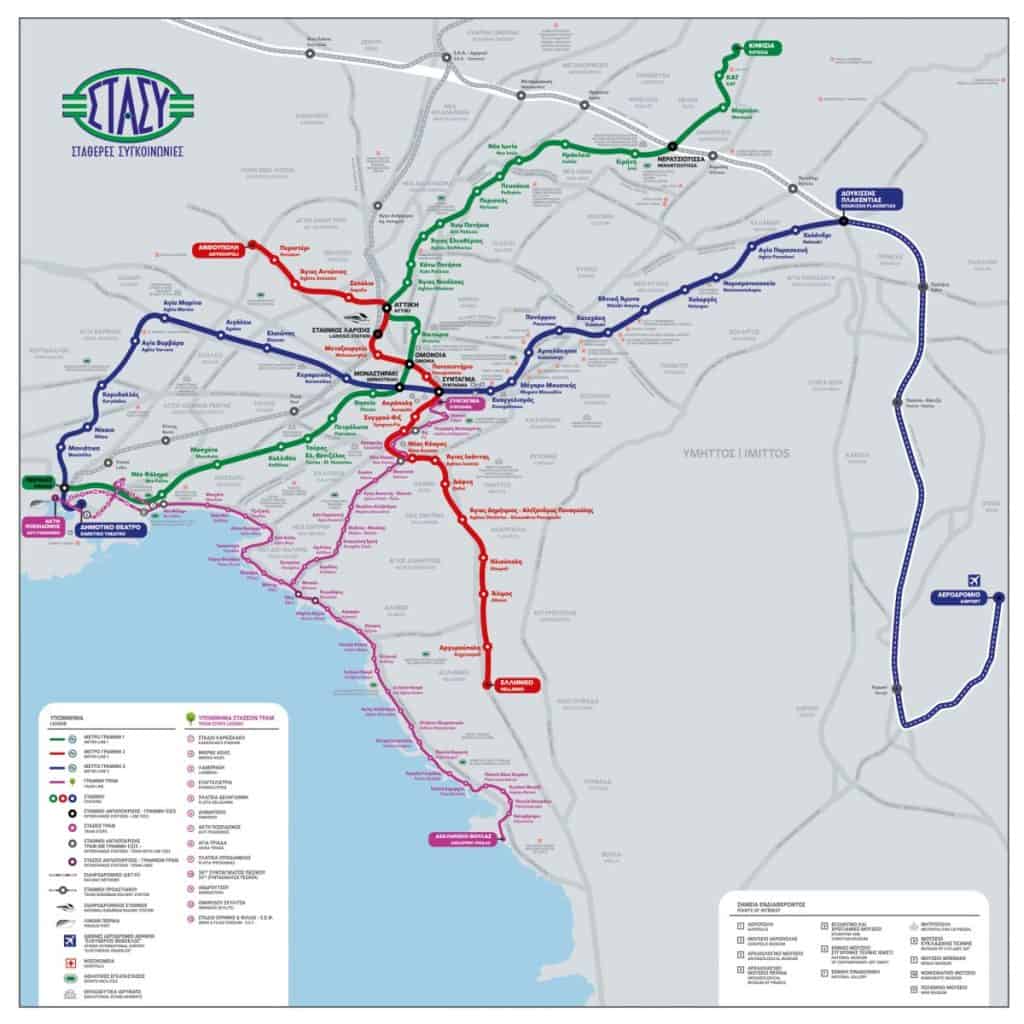
Here is a map of the Athens metro system.

Athens metro map
© ΣΤΑΣΥ

Line 1 (Green Line)

Line 1 is technically the oldest metro line in Athens and much of it runs above ground. It connects the port of Piraeus with the northern suburb of Kifissia.

Piraeus → Kifissia

  1. Piraeus
  2. Faliro
  3. Moschato
  4. Kallithea
  5. Tavros
  6. Petralona
  7. Thissio
  8. Monastiraki
  9. Omonia
  10. Viktoria
  11. Attiki
  12. Aghios Nikolaos
  13. Kato Patisia
  14. Aghios Eleftherios
  15. Ano Patisia
  16. Perissos
  17. Pefkakia
  18. Nea Ionia
  19. Iraklio
  20. Irini
  21. Neratziotissa
  22. Marousi
  23. KAT
  24. Kifissia

While this line is older than the others, it’s still very useful if you’re traveling between the port and the city centre.

Line 2 (Red Line)

This line connects the northern and southern parts of the city, passing through the city centre.

Anthoupoli → Elliniko

  1. Anthoupoli
  2. Peristeri
  3. Aghios Antonios
  4. Sepolia
  5. Attiki
  6. Larissa Station
  7. Metaxourgio
  8. Omonia
  9. Panepistimio
  10. Syntagma
  11. Akropoli
  12. Syngrou-Fix
  13. Neos Kosmos
  14. Aghios Ioannis
  15. Dafni
  16. Aghios Dimitrios – Alexandros Panagoulis
  17. Ilioupoli
  18. Alimos
  19. Argyroupoli
  20. Elliniko

Line 3 (Blue Line)

Line 3 will probably be the most important metro line for your trip because it connects Athens International Airport with the city centre and Piraeus.

Airport → Piraeus

  1. Athens International Airport
  2. Koropi
  3. Paiania-Kantza
  4. Pallini
  5. Doukissis Plakentias
  6. Halandri
  7. Nomismatokopio
  8. Aghia Paraskevi
  9. Holargos
  10. Ethniki Amyna
  11. Katehaki
  12. Panormou
  13. Ambelokipi
  14. Megaro Moussikis
  15. Evangelismos
  16. Syntagma
  17. Monastiraki
  18. Kerameikos
  19. Eleonas
  20. Egaleo
  21. Agia Marina
  22. Korydallos
  23. Nikaia
  24. Maniatika
  25. Piraeus

The airport trains run about every 30 minutes, and the journey to Syntagma takes roughly 40 minutes.  

Athens Metro Opening Hours

Metro services run daily from early morning until late at night.

Operating hours are:

  • From Monday to Thursday 05:30-00:30.
  • On Fridays & Saturdays → Line 1 operates until 01:00, while lineσ 2 and 3 (except for the airport) now run 24 hours on Saturdays.
  • On Sundays 06:00-00:30

Athens Metro Ticket Prices (2026)

Athens uses a unified public transport ticket system, which means the same ticket works across the metro, buses, trams, and trolleybuses. This makes moving around the city easy, since you don’t need separate tickets for each type of transport.

The most common option is the 90-minute ticket, which costs €1.20 (about $1.30). It allows unlimited transfers between metro, buses, and trams during those 90 minutes. In practice, this is enough for most short trips across the city.

If you plan to move around more during the day, there are also longer validity tickets available:

  • 24-hour ticket: €4.10 (about $4.40)
  • 5-day ticket: €8.20 (about $8.80)

Both allow unlimited travel within their validity period across all forms of public transport in the city. However, it’s important to know that these tickets do not include the airport metro route, which requires a separate ticket.

There are also multi-ride tickets, which can be convenient if you expect to use the metro several times but not enough to justify a daily pass. These include:

  • 2 rides (90 minutes each): €2.30 (around $2.50)
  • 5 rides: €5.70 (around $6)
  • 10 + 1 rides: €12 (around $13.50)

If you’ll be staying in Athens for a few days (and plan on using public transport), the 3-day tourist ticket is another option. It costs €20 (about $22) and includes unlimited public transport for 72 hours, along with one return trip between the airport and the city using either the metro or the express airport bus.

Travel to and from Athens International Airport requires a special ticket. The standard prices are:

  • One-way airport metro ticket: €9 (about $10)
  • Return airport ticket: €16 (about $17)

These airport tickets are valid for the airport route and also allow transfers within the public transport network for 90 minutes after validation.

Tickets can be purchased at metro stations, ticket machines, and kiosks, and they can also be loaded onto the rechargeable ATH.ENA card (you can buy one in Syntagma station), which is used across the entire transport system.

You can also use your debit or credit card as a ticket, by just tapping it to the validation machine.

How the Athens Metro System Works

The metro in Athens is easy to use.

Most stations have ticket machines and gates. You buy a ticket or load one onto an ATH.ENA card, then scan it at the gate before entering.

The same ticket works across metro, bus, and tram within its time limit, and ticket inspectors do appear from time to time on trains and platforms.

Stations are clearly marked, announcements are made in Greek and English, and the central stations have enough signs that getting lost is not really likely.

A nice detail is that a few metro stations display archaeological finds discovered during construction, which means parts of the system also work as small underground museums.

Buses in Athens

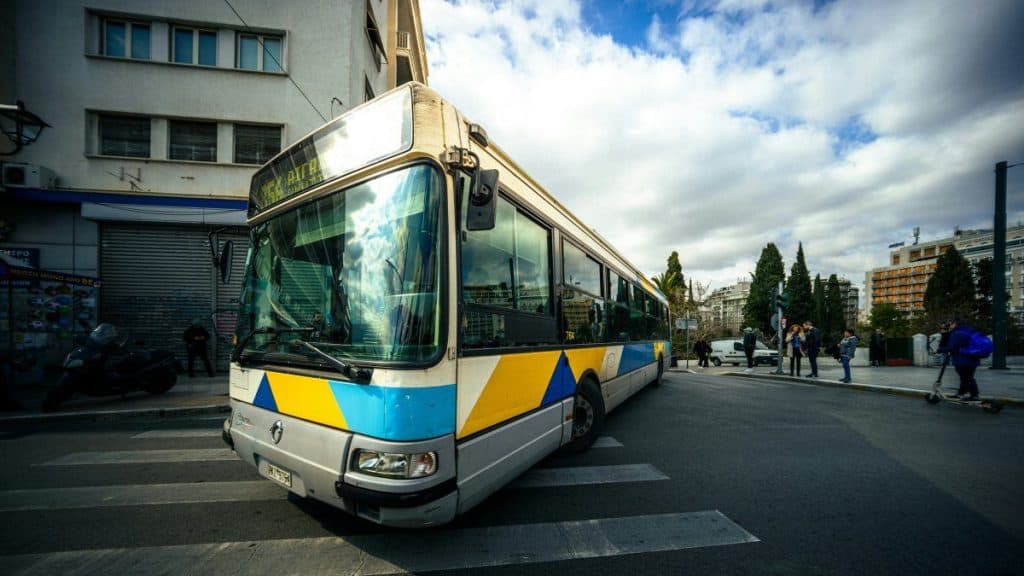
A bus in Athens

Unlike the metro, which only runs on three lines, buses in Athens reach almost every part of the city. They connect central neighborhoods, outer districts, and areas that are far from metro stations, which makes them useful in theory for getting almost anywhere.

In practice, however, buses are not always the most reliable option.

Buses share the same roads as cars, so once traffic builds up, delays become part of the experience. That’s why buses are useful, but not always the best choice when timing matters.

Another thing worth knowing is that not every stop has live arrival information. Some have electronic boards, many don’t.

The OASA Transport app helps a lot here. It’s the easiest way to check routes, schedules, and estimated arrivals, even if those estimates are not always perfect during busy hours.

Because of that, buses are useful when you’re not in a hurry or when you’re heading somewhere the metro doesn’t reach. But if you need to be somewhere at a very specific time, it’s usually safer to rely on the metro or a taxi instead.

Taxis in Athens

Taxi in Athens

Taxis are everywhere in Athens and, compared with many other European capitals, they’re not expensive. In the centre, finding one is rarely difficult.

That said, taxis here have a mixed reputation.

Most drivers are fine, but the usual tourist problems do exist: longer routes, vague pricing, or claims that the meter is somehow not working. That’s why I’d book through an app instead of hailing one from the street.

The two apps people use most are FREE NOW and Uber. In Athens, Uber still connects you with regular licensed taxis, not private drivers, but the app makes the whole thing easier. The route is recorded, the pricing is clearer, and there’s less room for nonsense.

Airport transfers are a separate case, because they run on fixed prices. As of 2026, the official fares between Athens Airport and the central Athens zone are €45 ($49) during the day and €55 ($60) at night. That covers places like Syntagma, Monastiraki, and most of the historic centre.

Inside the city, short rides often start around €4-€5 ($5-6), and many central trips land somewhere between €7 and €15 ($8-16), depending on distance and traffic.

So taxis do have their place – late at night, after a long day, when the heat is too much, or when public transport stops being worth the effort. I just wouldn’t take them from the street unless I had to.

I’ve broken the whole thing down properly in my Athens taxi guide, including fares, common scams, and when a taxi actually makes sense.

Biking in Athens

Cycling isn’t really a part of daily transport in Athens.

The city was not designed with bicycles in mind, and dedicated bike lanes are limited. Traffic can also be quite intense, which makes riding in many central streets uncomfortable unless you’re already familiar with the local driving style.

That said, there is one cycling route that works well. A long bike and pedestrian path runs from the historic centre toward the coast, ending near the Stavros Niarchos Foundation Cultural Center.

This route follows parts of the old tram corridor and passes through quieter areas, which makes it much more suitable for cycling than most city streets.

Because of these limitations, biking in Athens is usually more of an activity than a practical way to move around the city.

Athens Tram

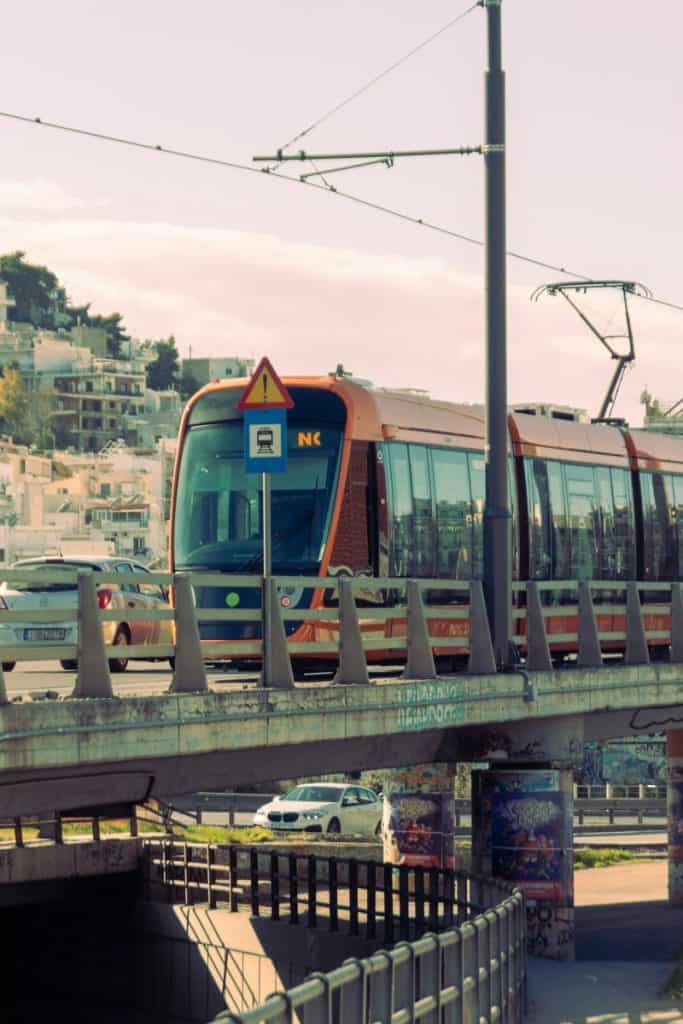
Tram in Athens

The tram in Athens is mainly for the southern coastal part of the city.

It links the centre with the Athens Riviera, passing through places like Palaio Faliro, Glyfada, and Voula. So it is mostly useful when the plan involves the sea or a stay in the southern suburbs.

There are two main tram routes. They begin near the centre and then split once they reach the coast – one heading toward Glyfada, the other continuing further down to Voula.

It’s not a fast way to move around. The tram runs at street level, stops often, and takes much longer than the metro.

Still, it can be a pleasant ride, especially once it reaches the coast and the sea starts opening up beside you.

Trolleybuses in Athens

Trolley Athens

Athens also still has trolleybuses, the electric buses connected to overhead wires.

They mainly run through central districts and older parts of the city, following routes that have existed for decades. In practice, though, they work much like regular buses. They use the same ticket system and the same basic logic once you’re on board.

For most short trips, you probably won’t think much about whether a vehicle is a bus or a trolleybus. The bigger issue is the same as with buses in general: traffic.

However, the system is gradually being phased out. As of 2026, Greek authorities have announced plans to replace trolleybuses with modern electric buses over the coming years.

Transport from Athens Airport

Athens International Airport sits about 35 to 45 minutes from the city centre, depending on traffic and how you get in.

The easiest option is the metro (Line 3). It connects the airport directly with Syntagma, Monastiraki, and Piraeus, so it works well both for the historic centre and for ferry connections. Trains run roughly every 30 minutes, and the ride to Syntagma takes around 40 minutes.

The other useful option is the express airport bus. The main route is the X95, which runs between the airport and Syntagma Square. It’s slower than the metro, but it runs 24 hours a day, which makes it very useful late at night.

Taxis are also easy to find outside the terminal. They can make sense with luggage or after a long flight, especially when the metro is no longer running. The airport has fixed taxi fares, though not every driver is in a hurry to mention that.

Because the best option depends on where you’re staying and what time you land, I’ve explained all of this properly in my Athens Airport to City Centre guide, including prices, timing, and which option makes the most sense in each case.

Is Public Transport Safe in Athens?

Yes, public transport in Athens is safe.

The metro in particular is modern, well lit, and easy to use, with signs in both Greek and English. It’s the easiest part of the system.

The only thing really worth watching for is pickpocketing in crowded places. That tends to happen around stations like Syntagma, Monastiraki, and Omonia, or on packed trains during rush hour.

keep your bag closed, don’t leave valuables in easy pockets, and pay a little more attention when the train is crowded.

Other than that, the system is straightforward and easy to use at most hours of the day.

Do You Need a Car in Athens?

Not unless the plan includes leaving the city.

Inside Athens, a car is more trouble than help. The centre is walkable, the metro covers the main useful routes, and taxis are easy enough when you really need one.

Driving here is also not especially pleasant. Traffic gets heavy, parking is difficult, and the local driving style can be a bit much on a first trip.

A car is useful once Athens becomes the base for trips outside the city. For day trips, it gives you much more freedom than buses or organised tours.

But for Athens itself, walking, the metro, and the occasional taxi are more than enough.

What’s the Best Way to Get Around Athens?

In most cases, Athens doesn’t need much transport planning.

A lot of the main sights sit close to each other, so once you’re in the centre, walking does most of the work. Transport becomes more relevant for the airport, Piraeus, or parts of the city that sit outside the main sightseeing area.

For longer distances, public transport works well. Taxis help late at night or when walking stops being worth it. And in the middle of the city, your own feet will usually do the job best.

FAQ: Getting Around Athens

1. Is Athens easy to get around without a car?

Yes.

You probably won’t need a car in Athens itself. A lot of the main sights sit close enough that walking works well, and public transport covers the longer distances.

2. Is the Athens metro easy to use?

Yes.

The metro is modern, clearly marked in Greek and English, and easy to understand even on a first trip. Stations like Syntagma, Monastiraki, and Acropoli connect most of the places people actually need.

3. Does Athens have Uber?

Yes, but it works differently from some other countries.

In Athens, Uber connects you with licensed taxis, not private drivers. So it’s still a normal taxi ride, just booked through the app.

4. Can you use public transport from Athens Airport?

Yes.

The airport connects to the city by metro, express bus, and taxi. The metro is the easiest daytime option, while the airport bus helps more late at night.

I’ve broken all of that down in my Athens Airport to City Centre guide.

5. Is public transport expensive in Athens?

No.

Compared with many European capitals, it’s quite affordable. Standard tickets are cheap and work across metro, buses, and trams within their time limit.

6. Do Athens taxis accept credit cards?

They should.

In practice, some drivers still prefer cash, which is another reason apps like FREE NOW and Uber make things easier. Card payment is usually smoother that way.

7. Is the Athens metro safe at night?

Yes.

The main thing worth watching for is pickpocketing in crowded places, especially around busy stations and packed trains.

8. What is the biggest transport mistake people make in Athens?

Relying too much on buses when timing matters.

Buses go almost everywhere, but traffic can make them unpredictable. When the schedule matters, the metro is the safer option.

9. How much is the metro from Athens Airport to the city center?

The metro from Athens Airport to central Athens costs €9 (about $10) one way. The journey to stations like Syntagma or Monastiraki takes about 40 minutes.

There is also a return ticket for €16 (about $17) and a 3-day tourist ticket (€20 / about $22) that includes a round airport trip and unlimited public transport.

10. Is Athens a walkable city?

Yes, at least in the centre.

Once you’re around the Acropolis, Plaka, Monastiraki, and the surrounding streets, a lot of the city works very well on foot. Outside that part of Athens, transport becomes more useful.

11. What is the cheapest way to get around Athens?

Public transport.

A standard 90-minute ticket is the cheapest option, and it covers transfers across metro, bus, and tram within that time window.

Final Thoughts

Athens isn’t the neatest city to move around, and that becomes obvious quite quickly.

Some parts work very well, others depend a bit too much on traffic, timing, or luck. Still, once you understand when to walk, when to use the metro, and when a taxi is worth it, getting around stops being a problem.

After that, transport becomes just part of the day rather than something you have to think about too much.

Similar Posts